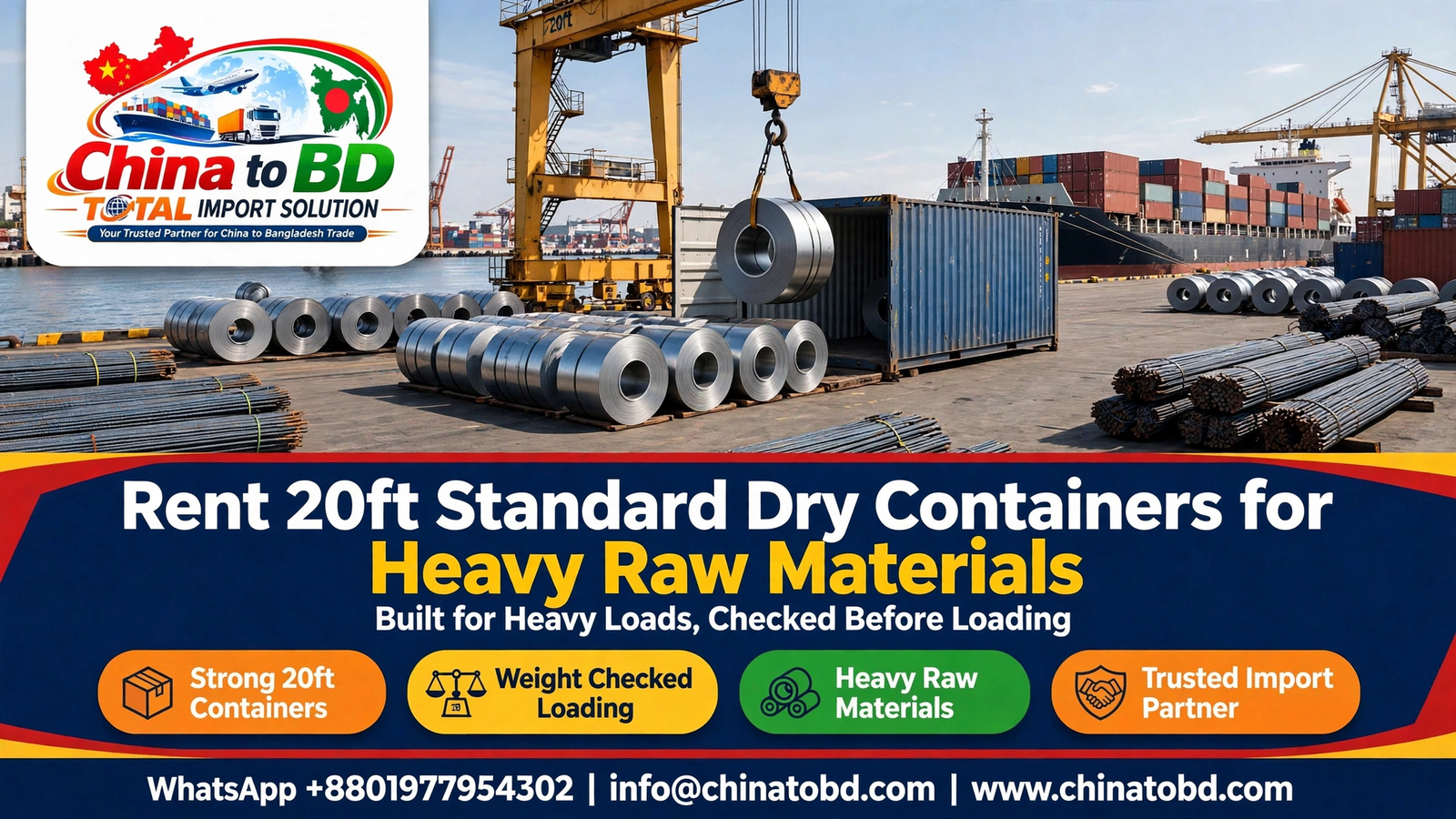
Rent 20ft Standard Dry Containers for Heavy Raw Materials
Rent 20ft Standard Dry Containers for Heavy Raw Materials
Heavy raw materials are unforgiving cargo. A load of steel coils, metal sheets, stone slabs, timber bundles, or dense machine parts carries its weight in every carton, bundle, and pallet, and a container that is wrong for the load will show the problem quickly: a floor that bends, a stack that leans, a door that will not close, or a load that shifts when the container is lifted. Renting a 20ft standard dry container for such a load is therefore a decision about strength and fit, not only about size.
A 20ft standard dry container is the smaller of the two common dry container sizes, and its size is its advantage for heavy material. The load is compact, the weight sits over a shorter floor, and the container can enter yards, gates, and warehouses that a longer container cannot reach. For a factory or importer bringing a single heavy material from China to Bangladesh, a 20ft container often fits the order, the loading point, and the delivery point better than a larger box that would travel half empty or that could not enter the site.
This article explains, in practical steps, how to rent a 20ft standard dry container for heavy raw materials: what the container is, why it suits heavy loads, which materials suit it, how to check the container before loading, how to load heavy material safely, which documents to prepare, which cost factors to confirm, how to plan delivery and unloading in Bangladesh, which mistakes to avoid, and which checks to complete before the shipment leaves China.
China to BD | Total Import Solution has supported importers from China to Bangladesh since 2016, with sourcing, shipping, customs handling, warehousing, and delivery. The steps here follow the order used in a real shipment: confirm the material, the container, the papers, and the delivery plan, and only then confirm the booking. For help, call +8801977954302, email info@chinatobd.com, or visit www.chinatobd.com. The warehouse and office are at House 38A, Mendi Dental College Road, Road 11, Dhanmondi Riverview Model Town, Dhaka 1209.
What a 20ft Standard Dry Container Is
A 20ft standard dry container is a steel box built for general cargo, with doors at one end, a solid floor, and a roof that keeps the cargo dry. It suits loads packed in cartons, bags, bundles, pallets, or crates, and it is closed and sealed at loading so the cargo travels in a locked space from China to Bangladesh. The container is loaded at the supplier’s point, sealed with a recorded seal number, carried by vessel, and opened in Bangladesh only after the seal number is checked.
Renting a 20ft container means the importer uses a container under written terms for one shipment, or for an agreed period, rather than owning the box. The rental terms should name the container, the loading point, the delivery point, the return point, the period allowed, the condition required on return, and the contact person for changes. These terms should be in writing before the material is packed, because a term agreed after loading is hard to change and easy to dispute.
Why a 20ft Container Suits Heavy Raw Materials
Heavy raw material has three traits that shape the container plan: weight, density, and handling. Weight means the floor, the doors, and the lifting points all carry a real load, and a container with a weak floor or a bent door frame is a risk. Density means the material takes up less space than its weight suggests, so the container can look half empty while carrying a full load. Handling means the material needs equipment to load and unload: a forklift for pallets, a crane for coils, or a team for bundles.
A 20ft container suits these traits because the load is compact and the weight can be spread across a short, strong floor. The loading team can place the heaviest items low and in the centre of the floor, with lighter items around them, and can brace the load so it cannot shift. A longer container with the same heavy load would leave a large empty space, and the load would need more bracing to stop it from moving during the voyage.
The article Breakbulk Shipping from China to Bangladesh explains how cargo that cannot fit in a standard container is planned, and its guidance on checking the route, the equipment, and the handling in advance applies here as well, even when the cargo does fit in a 20ft box.
Which Heavy Raw Materials Suit a 20ft Container
Not every heavy material suits a 20ft container, and the decision should be made from the material list, not from habit. Steel coils, steel sheets, metal bars, and bundles of metal parts suit a 20ft container when the load is planned with the weight spread across the floor and the coils or bundles braced so they cannot roll or slide. Stone slabs and tiles suit a 20ft container when they are packed in crates or bundles, stood upright or laid flat to the supplier’s instructions, and braced against movement.
Timber bundles, dense machine parts, and heavy bags of granules or powder also suit a 20ft container, provided the loading plan spreads the weight and the packages are marked by type and batch. Materials that are very long, such as long steel bars or long timber, may not fit through the doors or along the floor of a 20ft container, and the importer should measure the longest piece against the container’s door and interior before booking. Where a piece is too long, a different container or a different transport plan is needed, and that decision should be made before the material is packed.
| Heavy raw material | Packing | What to confirm |
|---|---|---|
| Steel coils | Coils on pallets or cradles | Coils braced against rolling; weight spread across the floor |
| Steel sheets and bars | Bundles, strapped | Bundles secured; longest piece fits through the doors |
| Stone slabs and tiles | Crates and bundles | Crates braced; packing protects edges and corners |
| Timber bundles | Bundles, strapped | Bundles secured against shifting; dry interior |
| Machine parts | Crates and pallets | Crates marked by part; heavy crates low and centred |
| Dense bags and granules | Bags and bulk bags | Bags stacked so they cannot split or slide |
| Metal parts and fittings | Cartons and crates | Cartons marked by type and batch; heavy cartons low |
Checking a 20ft Container Before Loading
A heavy load will expose any weakness in a container, so the check before loading matters more for heavy material than for light cargo. The container should be inspected in daylight, inside and out, before the material arrives at the loading point. The floor should be checked by walking on it and by eye: it should be level, sound, and free of soft spots, holes, cracks, or damp patches. A floor that bends underfoot will not carry a heavy load safely, and a damp floor will mark timber, paper, and packed material.
The doors should close fully, the seals should sit flat, and the locking rods should move freely. A door that does not close will not seal, and a container that cannot be sealed cannot be protected. The roof should be checked for dents or damage that could let in water, and the walls should be checked for holes, rust, or previous repairs that have not held. The container should be clean and dry, with no odour or residue from a previous cargo, because residue can contaminate the new load.
| Check | How to check | Refuse if |
|---|---|---|
| Floor | Walk on it; look for soft spots, holes, cracks, damp | Floor bends, is soft, holed, or damp |
| Doors | Close fully; check seals and locking rods | Door will not close, seal is damaged, rod is bent |
| Roof | Look for dents, damage, and signs of leaks | Roof is dented or shows signs of leaking |
| Walls | Look for holes, rust, and failed repairs | Wall is holed or badly rusted |
| Cleanliness | Look and smell for residue or odour | Container is dirty or carries a strong odour |
| Seal set | Check that a seal is available and fits | No seal, or the seal does not fit the hasp |
Steps to Rent and Load a 20ft Container
Follow these steps in order, completing each one before the next is confirmed. A step that is skipped usually appears later as a delay, a damaged load, or a document problem at the port.
- List the material in full. Write the material names, the grades, the quantities, the packing type, the number of packages, and any handling note, such as keep dry, fragile, or store upright.
- Confirm the longest piece and the heaviest package. Measure the longest piece against the container’s door and interior, and confirm how the heaviest package will be lifted.
- Ask for the container in writing. State the size, the loading point in China, the loading date, and the condition required, and ask for the container number in advance.
- Inspect the container before loading. Check the floor, the doors, the seals, the roof, and the walls in daylight, and refuse a container that is damp, damaged, or weak.
- Agree the loading order with the supplier. Heavy packages low and spread across the floor, first-out material near the doors, and each group marked so it can be found without opening every package.
- Confirm the weight position with the provider. Ask what the container and the transport can carry for this load, and confirm the loading plan against that position before the first package goes in.
- Load with photos. Photograph each stage of the loading, the marking, the bracing, and the spread of the load, and keep the photos with the packing list.
- Seal and record. Close the doors, fit the seal, record the seal number at once, and share it with the warehouse in Bangladesh before the vessel sails.
- Prepare the documents. Use the checklist in the documents section, and check the invoice, packing list, and bill of lading against each other before sailing.
- On arrival, check the seal first. Open the container only after the seal number matches the record, then count, sort, and check the material against the packing list.
Loading Heavy Material Safely
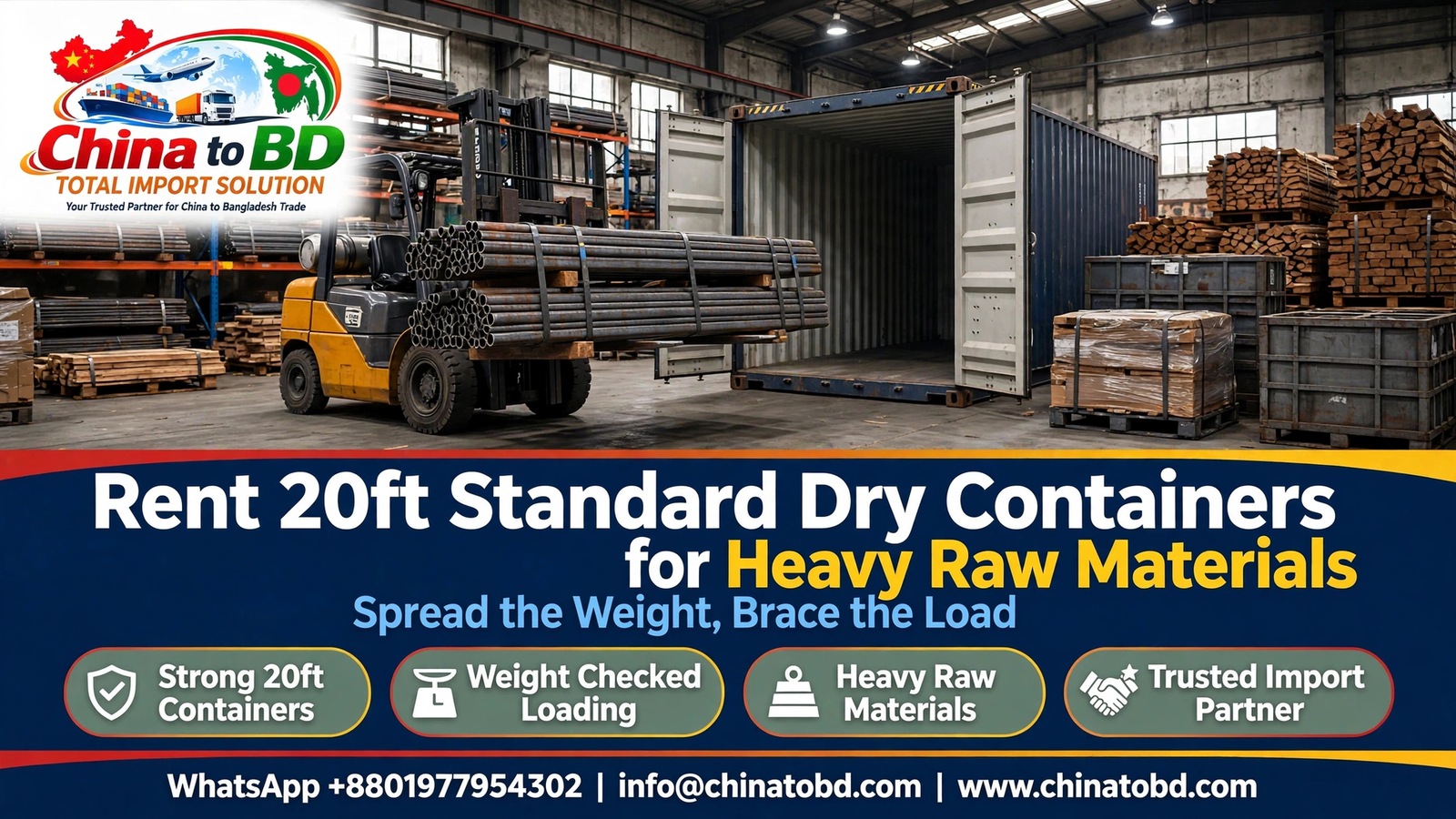
Loading heavy material is a plan, not a rush to fill the box. The heaviest packages should go in first, low on the floor, and spread across the whole floor so the weight is shared, never piled on one side or at one end. Lighter packages go on top, and only where the packing can carry the weight above them. The load should be braced with timber, straps, or packing material so that nothing can roll, slide, or lean during the voyage, because a heavy load that shifts can damage the container, the cargo, and the packages around it.
The equipment must match the load. A forklift that is too small for the heaviest pallet will struggle, and a crane that is not booked will delay the loading day. The importer should confirm the equipment with the loading point before the material arrives: which forklift, which crane, which team, and what time. The loading team should work from the packing list and the loading order, placing each package where the plan says, and should stop if a package does not fit the plan, rather than forcing it in.
Before the doors are closed, the loading team should walk through a short check: every package counted, every mark visible, no package leaning, no gap left where the load can shift, no loose item on the floor, and the loading photos taken. Only then should the doors be closed and the seal fitted. A load that is forced into a container that is too small, or a load that is left loose because the bracing was skipped, will be found in Bangladesh as damaged material, and the damage will be blamed on the voyage when it was caused at loading.
The article Zero Demurrage Shipping: Rent Containers for Extended Offloading explains how a rented container and a planned offloading window help an importer who cannot unload in one short visit, and its guidance on planning the sessions, the labour, and the return applies to heavy loads that need time, equipment, and space to unload safely.
Documents and Customs Checks
Documents are the part of the shipment that most often causes a delay at the port in Bangladesh. A missing paper, a mismatched description, or a name spelled in two different ways can hold a container while the matter is corrected. The importer should therefore prepare the document set before the vessel sails, and should check each document against the material list and the booking.
The commercial invoice describes the goods, the quantity, and the value for customs purposes. The packing list describes how the goods are packed, how many packages there are, and what is inside each package. The bill of lading is the transport document issued by the carrier, and it must match the invoice and the packing list. The certificate of origin, where required, states where the goods were made. Some raw materials also need a product certificate or a test report, depending on the exact material, and the importer should confirm the requirement for the exact material before shipment.
The importer should also keep the import registration, tax identification, and bank documents ready, and confirm with the customs broker which papers must be presented in original and which as a copy. The shipment file should hold every paper in one place, with a copy kept separately, and the container and seal numbers should be recorded in the same file. Before the vessel arrives, review the documents with the customs broker: the invoice, packing list, and bill of lading must agree, the consignee name must be spelled the same way on every document, and the port of discharge and the container and seal numbers must be correct.
| Document or check | Purpose | Common error to avoid |
|---|---|---|
| Commercial invoice | Describes goods, quantity, and value | Value or description that does not match the material |
| Packing list | Describes packages and contents | Package count that does not match the actual load |
| Bill of lading | Transport document from the carrier | Consignee name or port that does not match the booking |
| Certificate of origin | States where goods were made | Missing certificate for goods that require one |
| Product certificate or test report | Confirms standard for the exact material | Certificate that covers a different grade |
| Import registration and tax papers | Confirms the importer is registered | Expired or incomplete registration |
| Customs duty handling | Payment and clearance for the cargo | Duty payment arranged late, after arrival |
| Container and seal numbers | Links the container to the documents | Seal number not recorded at loading |
| Weight and loading note | Records the load as packed | Loading note missing from the shipment file |
Cost Factors to Confirm at Booking
The cost of a heavy raw material shipment in a rented 20ft container is made up of several parts, and each part should be confirmed at booking. Ocean freight is the cost of moving the container from the port in China to the port in Bangladesh. Port charges cover the handling of the container at each port. Customs duty and tax are set by the customs rules for the exact material, and the importer should confirm the duty position with the customs broker before booking. Transport covers the movement of the container from the port to the warehouse or factory in Bangladesh and the return of the empty container. Labour and equipment cover the unloading, sorting, counting, and checking, including the forklift or crane where the load needs it. Warehouse use covers the space and the time that the material occupies. Container rental covers the use of the rented container for the agreed period, including the delivery and return points.
Ask at booking which charges are included in the quotation and which are separate, and what happens if the plan changes. Discuss the allowed period for the container: when it starts and ends, what marks the container as returned, and whether an extension can be requested before arrival. Confirm payment terms as well, because a delayed payment can delay the release of the container. No figure in this article is presented as a price, because the cost depends on the material, the route, the container, the rental period, and the delivery plan. For a figure for a specific shipment, share the material list, the loading point in China, the delivery point in Bangladesh, and the delivery dates with China to BD | Total Import Solution and ask for a written quotation. Contact the helpline at +8801977954302 or email info@chinatobd.com.
Delivery and Unloading in Bangladesh
Delivery in Bangladesh should be planned before the vessel arrives, not after the container is discharged. Name the warehouse or factory, the address, the contact person, and the delivery hours. Check the gate width, the access road, the turning space, and the ground surface, and confirm the check with the transporter, because a 20ft container still needs a truck that can enter, turn, and park. Book the transport from the port, confirm the driver and the route, and book the forklift or crane that the load needs, with the operator named and the time confirmed.
Unloading a heavy load needs the same care as loading it. The warehouse team should work from the packing list and the loading photos, taking out the packages in the planned order, counting each package as it leaves the container, and noting any damage or shortage at once, with a photo and a written note. Heavy packages should be placed on a firm, level surface, and should not be stacked higher than the packing can carry. Mixed material should be stored by type, batch, or buyer, so the factory can find the right material without moving the whole store.
Where the load cannot be unloaded in one short visit, plan the unloading in sessions, with a date, a start time, a named team, and a named task for each session. Between sessions, close and lock the container and record the material that remains inside. Confirm labour, equipment, floor space, and working hours for each session, and name one person in charge of the unloading, known to every party by name and phone number. The empty container should be returned to the named point in the required condition, with a receipt, and the return transport should be booked at the same time as the delivery transport.
Common Mistakes
- Choosing a 20ft container without measuring the longest piece, so a long bar or plank does not fit through the doors. Measure the longest piece before booking.
- Accepting a container without checking the floor, so a weak or damp floor is only found after the heavy load is in. Walk the floor and check it in daylight before loading.
- Piling heavy packages on one side or at one end, so the load is uneven and hard to handle. Spread heavy packages low and evenly across the floor.
- Skipping the bracing, so coils roll, bundles slide, and crates lean during the voyage. Brace the load so nothing can move.
- Loading without confirming the weight position with the provider, so the container or the transport cannot carry the load as packed. Confirm the position before the first package goes in.
- Fitting the seal but never recording the seal number, so no one in Bangladesh can check whether the container was opened on the way. Record the seal number at once and share it before sailing.
- Sending the invoice, the packing list, and the bill of lading with descriptions that do not match each other. Check the three documents against each other before sailing.
- Booking the shipment before the delivery point in Bangladesh is ready to receive it, so the container waits while space, labour, and equipment are arranged. Confirm the delivery plan before confirming the booking.
- Forgetting the return of the empty container. Book the return transport at the same time as the delivery transport, and name the return point and date.
- Relying on verbal agreements for the rental terms, the delivery point, or the return point. Keep every agreement in writing, in one shipment file.
Pre-Shipment Checklist
Copy this table into the shipment file and mark each item as it is completed. Complete the pre-shipment items before the vessel sails, and the delivery items before the container arrives in Bangladesh.
| Check | When | Done |
|---|---|---|
| Material list complete, with grades, quantities, and handling notes | Before booking | |
| Longest piece measured against the container doors and interior | Before booking | |
| Weight position confirmed with the provider | Before booking | |
| Container requested in writing, with size and loading point | Before booking | |
| Container inspected in daylight, floor sound, doors and seals good | Before loading | |
| Loading order agreed, heavy packages low and spread evenly | Before loading | |
| Equipment confirmed: forklift or crane, operator, and time | Before loading | |
| Bracing plan agreed, with timber, straps, or packing material | Before loading | |
| Loading photos taken at each stage | At loading | |
| Seal fitted and seal number recorded and shared | At loading | |
| Invoice, packing list, and bill of lading checked against each other | Before sailing | |
| Product certificate confirmed for the exact material | Before sailing | |
| Customs broker named, with full document set shared | Before sailing | |
| Duty and payment arrangements confirmed | Before arrival | |
| Delivery point named, with address, contact person, and hours | Before arrival | |
| Gate, road, turning space, and ground surface checked | Before arrival | |
| Transport booked, with driver, route, date, and time | Before arrival | |
| Labour and equipment booked for unloading and checking | Before arrival | |
| Full plan shared in writing with every party | Before arrival | |
| Seal checked on arrival before the doors are opened | At delivery | |
| Material counted, checked, and stored by type and batch | At delivery | |
| Empty container returned to the named point, with receipt | After delivery |
Frequently Asked Questions
Q1: Why rent a 20ft container for heavy raw materials?
A 20ft container suits a single heavy material or a single supplier order, because the load is compact, the weight can be spread across a short, strong floor, and the container can enter yards, gates, and warehouses that a longer container cannot reach.
Q2: Which heavy materials suit a 20ft container?
Steel coils, steel sheets and bars, stone slabs and tiles, timber bundles, dense machine parts, heavy bags of granules, and metal parts suit a 20ft container when the load is planned with the weight spread across the floor and the packages braced so they cannot move.
Q3: What should I measure before booking a 20ft container?
Measure the longest piece against the container’s door and interior, and confirm how the heaviest package will be lifted. A piece that is too long for the doors, or a package that the equipment cannot lift, needs a different plan before booking.
Q4: What should I check when the container is offered in China?
Check the floor by walking on it and by eye, check that the doors close fully and the seals sit flat, check the roof and walls for damage, and check that the container is clean, dry, and free of odour. Refuse a container that is damp, damaged, or weak.
Q5: How should heavy material be loaded in a 20ft container?
Place the heaviest packages low on the floor and spread across the whole floor, never piled on one side or at one end. Place lighter packages on top only where the packing can carry the weight, and brace the load so nothing can roll, slide, or lean.
Q6: What is the seal number, and why does it matter?
The seal number is the number on the seal fitted to the container doors at loading. It is recorded at once and shared with the warehouse in Bangladesh. On arrival, the warehouse checks the number before opening the doors. If it does not match the record, the doors stay closed until the matter is checked.
Q7: Should I confirm the weight position before loading?
Yes. Ask what the container and the transport can carry for this load, and confirm the loading plan against that position before the first package goes in. Never load a heavy shipment on an assumed limit.
Q8: Which documents do I need for heavy raw materials from China to Bangladesh?
The main documents are the commercial invoice, the packing list, the bill of lading, and the certificate of origin where required. Some materials also need a product certificate or a test report, so confirm the requirement for the exact material before shipment.
Q9: How do I avoid a document error that delays the container at the port?
Ask the supplier to send a copy of each document before the goods are loaded, and check the copy against the material list. Confirm that the descriptions, package count, consignee name, and port of discharge agree on every document.
Q10: What equipment do I need to load and unload heavy material?
The equipment must match the load: a forklift for pallets, a crane for coils, or a team for bundles. Confirm the equipment with the loading point before the material arrives, and book the same equipment for unloading in Bangladesh, with the operator named and the time confirmed.
Q11: What should the warehouse check first when the container arrives?
The warehouse should check the seal number against the record before opening the doors. Then the material should be counted against the packing list, sorted by the package marking, and checked for damage, with any damage noted at once with a photo and a written note.
Q12: Which cost factors should I confirm before booking?
Confirm the ocean freight, port charges, customs duty and tax, transport, labour and equipment, warehouse use, and container rental. Ask which charges are included in the quotation, which are separate, and what happens if the plan changes.
Q13: Can a heavy load be unloaded in more than one session?
Yes. Plan the unloading in sessions, with a date, a start time, a named team, and a named task for each session. Between sessions, close and lock the container and record the material that remains inside.
Q14: What are the most common mistakes with 20ft containers for heavy material?
The most common mistakes are not measuring the longest piece, accepting a container without checking the floor, piling heavy packages on one side, skipping the bracing, loading without confirming the weight position, and never recording the seal number.
Q15: How do I plan the delivery point in Bangladesh?
Name the warehouse or factory, the address, the contact person, and the delivery hours. Check the gate width, the access road, the turning space, and the ground surface, and confirm the check with the transporter. Book the transport, the labour, and the equipment before arrival.
Q16: How can China to BD | Total Import Solution help with renting a 20ft container for heavy raw materials?
China to BD | Total Import Solution has supported importers from China to Bangladesh since 2016, with sourcing, shipping, customs handling, warehousing, and delivery. The team can help list the material, arrange the container rental, prepare the document checklist, agree the loading order, and plan delivery, unloading, and return in Bangladesh.
Contact China to BD | Total Import Solution
For a written plan and quotation for renting a 20ft standard dry container for heavy raw materials, contact China to BD | Total Import Solution. Share the material list, the loading point in China, the delivery point in Bangladesh, and the delivery dates, so the plan can be based on the actual shipment.
- Brand: China to BD | Total Import Solution
- Company: Total Import Solution, since 2016
- Helpline: +8801977954302
- Email: info@chinatobd.com
- Website: www.chinatobd.com
- Warehouse & Office: House 38A, Mendi Dental College Road, Road 11, Dhanmondi Riverview Model Town, Dhaka 1209
Call the helpline at +8801977954302 or email info@chinatobd.com to discuss a heavy raw material shipment from China, to confirm a 20ft container rental, or to check a document list before the vessel sails.
About the Author