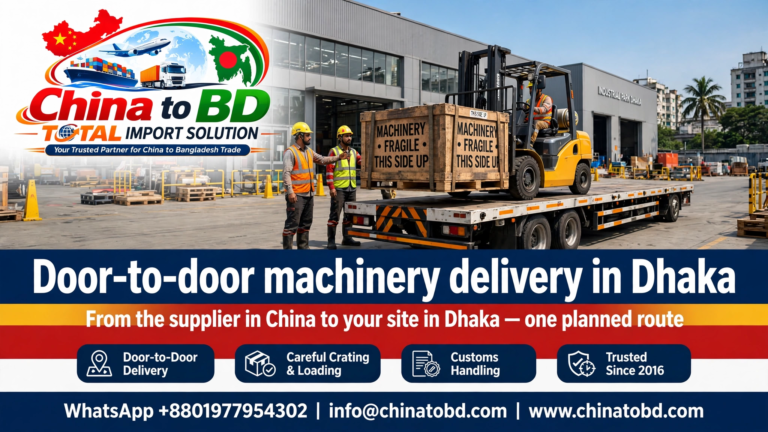
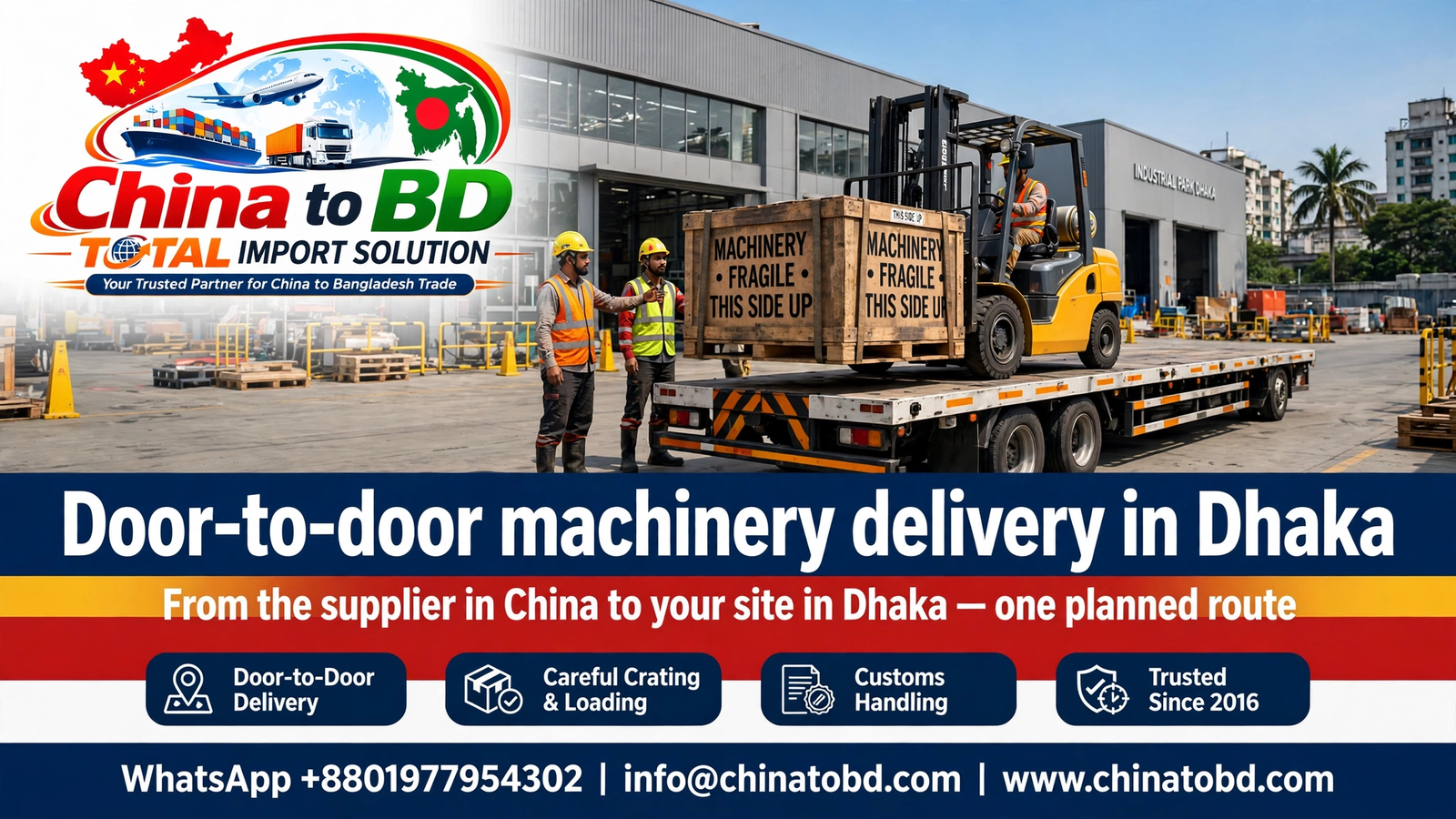
Door-to-door machinery delivery in Dhaka
Door-to-door machinery delivery in Dhaka
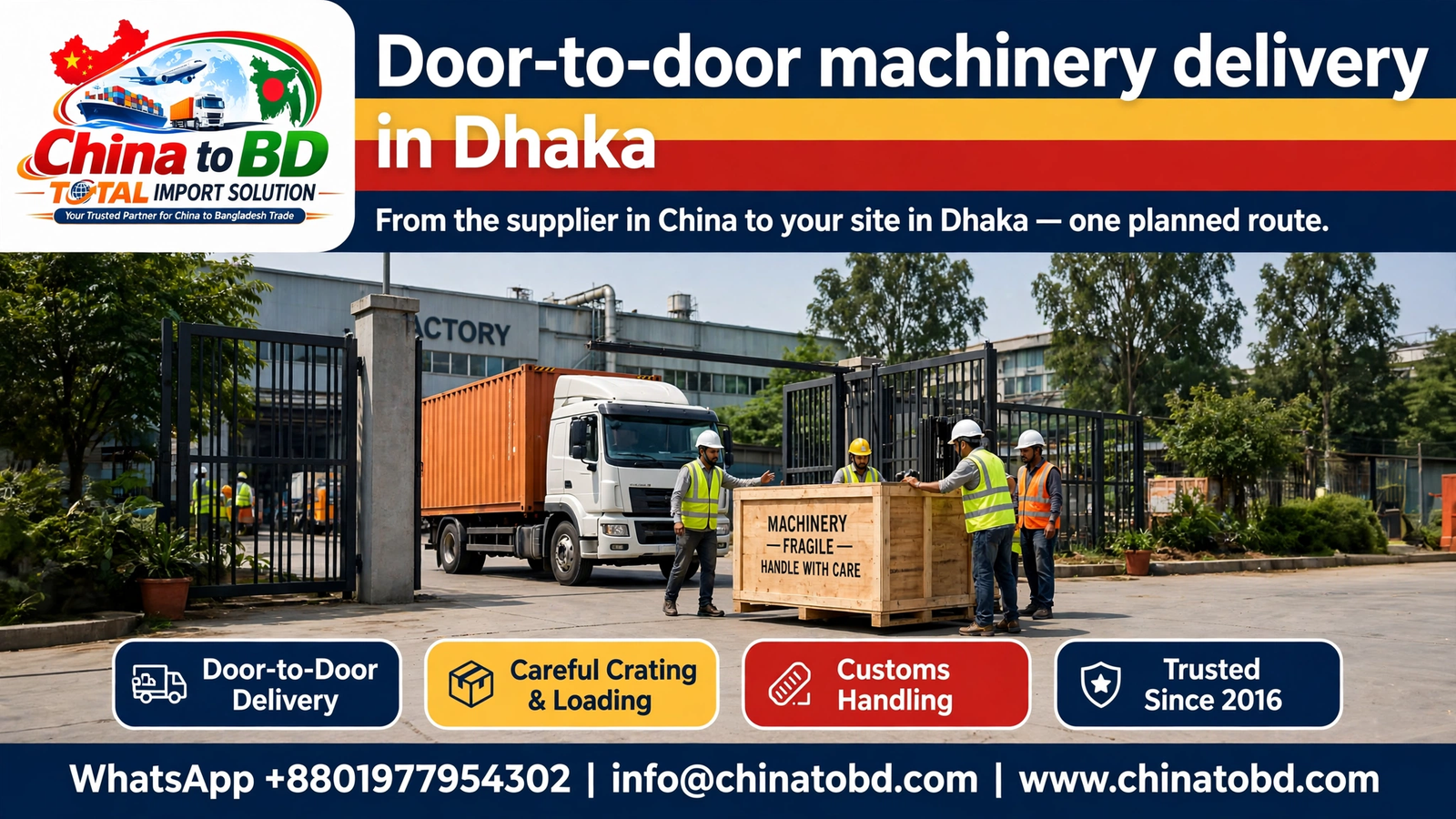
Door-to-door machinery delivery in Dhaka means that a machine is collected from the supplier in China and delivered to the buyer’s site in Dhaka, with every step in between planned as one job. The machine is inspected, packed, crated, loaded, shipped, cleared through customs, transported from the port, and placed at the factory, the workshop, or the project site. When one team plans the whole route, the importer has one plan, one contact, and one shipment file, instead of a chain of separate arrangements where no one person is watching the machine from start to finish.
Machinery is not ordinary cargo. A machine has weight, size, shape, and parts that must arrive in working order. A lathe, a generator, a printing press, a packaging line, a textile machine, or a food processing unit may be heavy on one side, tall in one direction, or fitted with parts that stick out and can be bent or broken. The machine may need a crate, a steel frame, a flat rack, or a special lifting plan. The delivery site in Dhaka may have a narrow gate, a low roof, a weak floor, or no crane. Each of these facts must be known before the machine leaves China, because fixing a problem after arrival takes far more time, labour, and money than planning for it in advance.
This article explains, in practical steps, what door-to-door machinery delivery covers, how to plan the delivery from the supplier to the Dhaka site, how machinery should be packed, crated, and loaded, how shipping, customs clearance, and port handling work, how the machine moves from the port to the site, how to book the delivery, which cost factors to confirm at booking, which mistakes to avoid, and which checks to complete before the machine leaves China.
China to BD | Total Import Solution has supported importers from China to Bangladesh since 2016, with sourcing, shipping, customs handling, warehousing, and delivery. The steps here follow the order used in a real machinery delivery: confirm the machine and the site, confirm the packing and the lifting plan, confirm the papers, and only then confirm the booking. For help, call +8801977954302, email info@chinatobd.com, or visit www.chinatobd.com. The warehouse and office are at House 38A, Mendi Dental College Road, Road 11, Dhanmondi Riverview Model Town, Dhaka 1209.
What Door-to-Door Machinery Delivery Means in Dhaka
Door-to-door means that the service covers the whole route, without a gap where no one is responsible for the machine. The route has eight stages: supplier collection, inspection, packing and crating, loading, shipping, customs clearance, port-to-site transport, and placement at the site. In a door-to-door service, each stage is planned with the next stage in mind. The packing plan considers the lifting. The lifting plan considers the loading. The loading plan considers the offloading. The customs plan considers the arrival. The transport plan considers the site. The site plan considers the placement of the machine.
For the importer, the main benefit is a single point of responsibility. One team holds the machine details, the documents, the booking, the tracking, and the delivery plan, and one contact person can answer a question about any stage. When a problem arises, the importer does not have to find which party is responsible for it. The team that planned the delivery follows the problem through, because the team is responsible for the whole route, not only for one part of it.
Door-to-door does not mean that the importer stops checking. It means that the checks are done in one order, with one shipment file, so that nothing is missed between one stage and the next. The importer should still ask for the inspection report, the crating photos, the loading photos, the document copies, the tracking updates, and the delivery receipt in writing, and should keep them in the shipment file. A service that cannot show its checks in writing is not a service the importer can rely on for a machine.
Planning the Delivery: Site, Access, and Machine Details
Planning starts with two sets of facts: the machine and the site. The machine facts are the length, the width, the height, the weight, the centre of gravity where the supplier can state it, the parts that stick out, the parts that must be removed for transport, and the parts that must travel with the machine, such as the manual, the spares, the tools, and the cables. The supplier should confirm these facts in writing, with a drawing or a photo that shows the machine from the side and from above, so that the packing and the lifting plan are based on the real machine and not on a catalogue picture.
The site facts are the address in Dhaka, the gate width and height, the road width outside the gate, the turning space inside the site, the ground surface, the floor strength where the machine will stand, the roof height, the door width into the building, and the lifting equipment available at the site, such as a forklift, a crane, or a chain block. Measure the gate and the doors with a tape, and do not rely on memory. A machine that fits the road but not the gate cannot be delivered, and a machine that fits the gate but not the door cannot be placed.
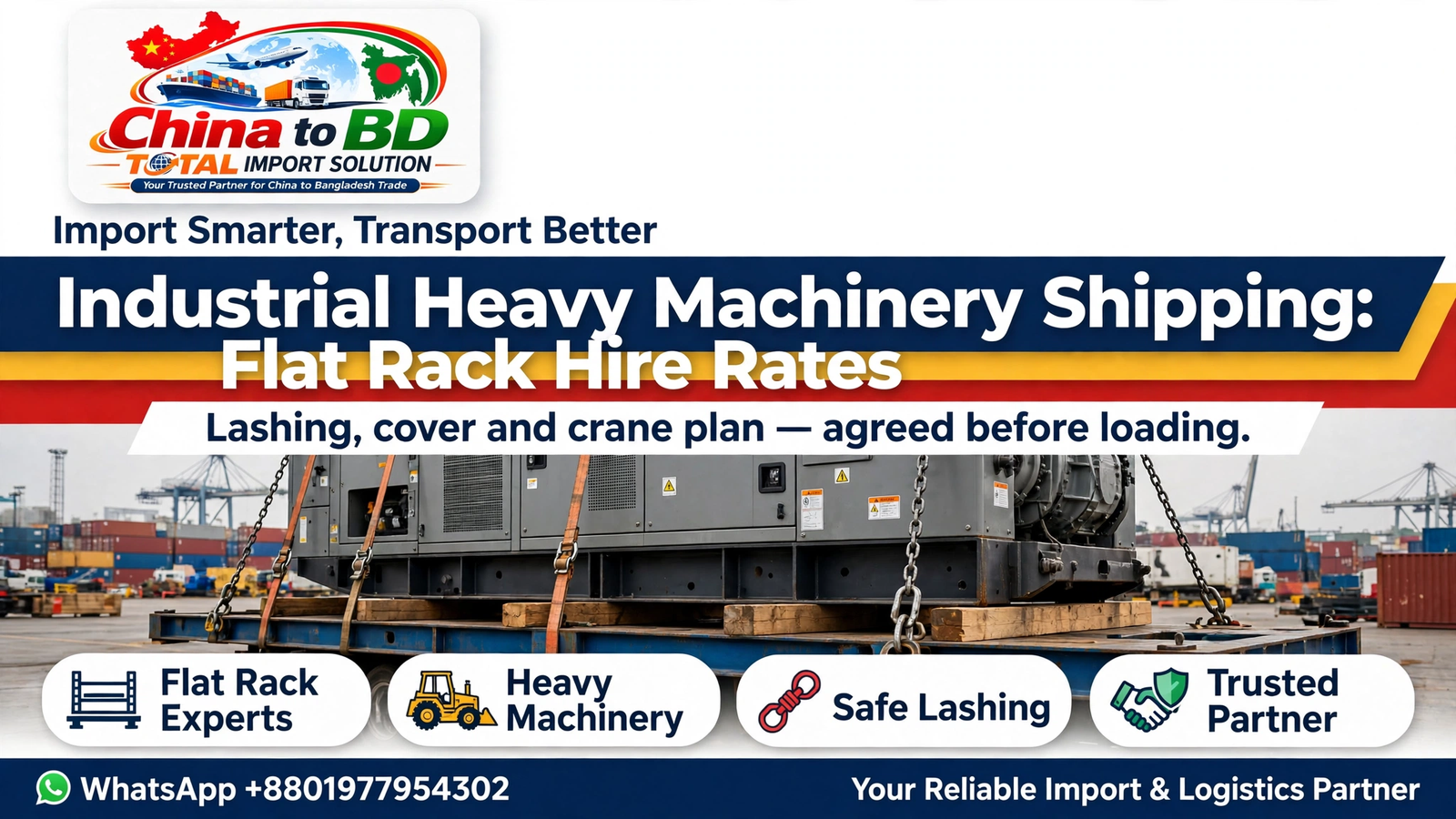
Share the machine facts and the site facts with the delivery team in writing before booking, and ask the team to confirm the plan in writing: the crate or frame, the lifting points, the container or flat rack, the truck, the route, and the placement method. When the machine is oversized or has an unusual shape, the container choice needs extra care, and the article Flat Rack Container Leasing for Project Cargo & OOG Imports explains how flat rack containers are used for project cargo and out-of-gauge loads, including the checks that protect a load that does not fit a standard container.
| Plan item | What to confirm | Why it matters |
|---|---|---|
| Machine size and weight | Length, width, height, weight in writing | Decides the crate, the lifting, and the container |
| Protruding and loose parts | Parts to remove, parts to protect, parts to pack separately | Prevents bending, breakage, and lost parts |
| Manuals, spares, and tools | Full list of what travels with the machine | Prevents a machine that arrives without its parts |
| Gate, road, and turning space | Measured widths, heights, and turning room | Decides whether the truck and the load can enter |
| Floor, roof, and door | Floor strength, roof height, door width | Decides whether the machine can be placed |
| Lifting equipment at the site | Forklift, crane, or chain block available | Decides how the machine is lifted off the truck |
| Power and placement point | Where the machine will stand and connect | Prevents a machine placed where it cannot run |
| Receiver and contact person | Name and phone number at the site | Prevents a delivery with no one to receive it |
Packing, Crating, and Loading Machinery in China
Packing is the stage that decides whether the machine arrives in working order. A machine should travel in a crate or on a frame that holds it still, protects its edges, and spreads its weight. Ask the supplier to use a wooden crate or a steel frame suited to export, with the machine bolted or strapped to the base so that it cannot shift at sea. Loose parts should be packed in marked boxes, fixed inside the crate, with a list of what each box holds. The manual, the spares, and the tools should travel with the machine, in a marked box that is listed on the packing list.
Protection must cover the parts that can be damaged by movement, moisture, or dust. Cover exposed metal with a protective wrap, cover openings so that dust and water cannot enter, and protect control panels, screens, and gauges with padding and a firm cover. Label the crate on the outside with the item name, the consignee name, the package number, and handling notes such as fragile, this side up, keep dry, and do not stack where they apply. Every label should match the packing list, so that the crate can be identified at the warehouse without opening it.
Loading should be done in the order agreed with the supplier, with the lifting plan followed step by step. The lifting points named by the supplier should be used, and no other point should be used for lifting. The crate should be placed in the container or on the flat rack in the position agreed in advance, blocked and braced so that it cannot move, with the weight spread as the plan requires. Ask the supplier for loading photos that show the crate inside the container before the doors are closed, the bracing, and the seal, and keep those photos with the packing list.
Shipping, Customs Clearance, and Port Handling
Shipping is the stage where the container or flat rack moves from China to Bangladesh. The shipping method and the container size should be chosen from the machine list: a standard container for a machine that fits inside it, a flat rack for a machine that is too tall or too wide for a standard container, and a shared container only where the machine is small enough and the packing allows it. The seal number should be recorded at loading, written on the documents, and checked again on arrival in Bangladesh. If the seal number does not match on arrival, stop and record the difference with a photo before opening the container.
Customs clearance is the stage where documents matter most. The commercial invoice describes the machine, the quantity, and the value for customs purposes. The packing list describes how the machine is packed, how many packages there are, and what is inside each package, including the boxes of spares and tools. The bill of lading is the transport document issued by the carrier, and it must match the invoice and the packing list. The certificate of origin, where required, states where the machine was made. Other certificates may be required for specific machines, and the importer should confirm the requirement for the exact machine before shipment.
The importer should keep the import registration, tax identification, and bank documents ready, and confirm with the customs broker which papers must be presented in original and which as a copy. Before the vessel arrives, complete a short document review with the customs broker: confirm that the invoice, the packing list, and the bill of lading agree, that the consignee name is spelled the same way on every document, that the port of discharge is correct, and that the container and seal numbers are recorded. If a document needs a correction, request it from the supplier before the vessel sails. Port handling should also be planned in advance: confirm who will attend the port, who will arrange the truck, and who will check the crate before it leaves the port area.
Transport from the Port to the Dhaka Site
Transport is the stage where the machine moves from the port to the site in Dhaka, and it is the stage where the site plan is tested. Book the truck from the machine list and the site facts: a flatbed or a low-bed truck for a heavy or tall load, a covered truck where the machine needs protection from rain and dust, and a truck with the lifting support the offloading plan requires. Confirm the driver, the route, the delivery address, and the delivery time, and share the truck details with the site so that the gate, the labour, and the lifting equipment are ready when the truck arrives.
The route should be checked in advance for narrow roads, low bridges, sharp turns, and weight limits. A route that suits a small truck may not suit a truck carrying a heavy machine, and a route that is clear in the morning may be blocked later in the day. Share the route with the driver in writing, and name the person at the site who will receive the machine. Tracking runs through the whole route: the importer should know where the machine is at each stage, who will send each update, and how often. A named contact person for the delivery, known to every party by name and phone number, is worth more than a general helpline when a question arises on the road.
At the site, the offloading plan agreed in advance should be followed step by step. The truck should be parked where the lifting equipment can reach the crate, the ground should be firm and level, and the area around the truck should be kept clear. Lift the crate only from the lifting points named in the plan, place it on firm ground or directly in the position agreed for placement, and check the crate for damage before opening it. When the delivery point is a depot or a warehouse with limited space, the loading and offloading plan needs extra care, and the article Side-Opening Shipping Container Rental for Easy Depot Loading explains how side-opening containers help where access is tight, including the checks that make loading and offloading easier at the depot.
| Transport item | What to confirm | Common error to avoid |
|---|---|---|
| Truck type | Flatbed, low-bed, or covered truck matched to the load | Truck that cannot carry the weight or the height |
| Route | Roads, bridges, turns, and weight limits checked | Route that blocks the truck on the day |
| Driver and timing | Driver name, phone number, date, and time | Truck arriving with no one at the site to receive it |
| Lifting at the site | Forklift, crane, or chain block booked and ready | Machine on the truck with no way to lift it off |
| Ground and space | Firm, level ground and clear working area | Offloading on soft ground or in a blocked yard |
| Crate check on arrival | Crate condition checked before opening | Opening a damaged crate without a photo and a note |
| Placement | Machine placed in the agreed position | Machine placed where it cannot be connected |
| Delivery receipt | Signed receipt with count and condition noted | No written record that the machine was received |
Steps to Book a Door-to-Door Machinery Delivery
Follow these steps in order, completing each one before the next is confirmed. A machinery delivery booked in a hurry, with the machine details still unclear or the site still unmeasured, is a delivery where problems are found at the gate instead of at the desk.
- Write the machine details in full. List the machine, the size, the weight, the protruding parts, the spares, the tools, and the manual, and share them with the delivery team in writing.
- Measure the site in Dhaka. Measure the gate, the road, the turning space, the doors, the roof height, and the floor, and share the measurements in writing.
- Confirm the supplier and the inspection plan. Ask for the specification confirmation, the inspection report, and the photos from China.
- Agree the packing, crating, and lifting plan. Confirm the crate or frame, the lifting points, the protection, and the labels with the supplier.
- Choose the shipping method and the container. Match the choice to the machine list and the site access, and confirm the seal number will be recorded at loading.
- Ask for the terms in writing. Confirm what is included, what is separate, who is responsible for each stage, and what happens if the plan changes. Keep a copy with the shipment file.
- Prepare the documents. Use the checklist in the documents section, and keep the originals and the copies in one file. Ask the supplier for a copy of each document before loading.
- Confirm the customs plan. Name the customs broker, confirm the duty handling, and confirm who will attend the port if a physical check is required.
- Confirm the transport and placement plan. Book the truck, confirm the driver and the route, confirm the lifting equipment and the labour at the site, and name the person in charge of the receipt.
- On arrival, follow the plan in order: check the seal number, receive the container, check the crate before opening it, lift the machine only from the agreed points, place it in the agreed position, count the spares and tools against the packing list, and close the shipment file with a signed delivery receipt.
Cost Factors to Confirm at Booking
The cost of a door-to-door machinery delivery is made up of several parts, and each part should be confirmed at booking. Ocean freight is the cost of moving the container from the port in China to the port in Bangladesh. Port charges cover the handling of the container at each port. Customs duty and tax are set by the customs rules for the exact machine, and the importer should confirm the duty position with the customs broker before booking. Transport covers the movement of the machine from the port to the site in Dhaka and the return of the empty container. Labour covers the offloading, the lifting, the placement, and the checking. Crating covers the crate or frame, the protection, and the bracing. Warehouse use covers the space and the time that the machine occupies where storage is needed.
Each part can change if the plan changes, so ask at booking what happens if the plan changes and how a change is charged. Ask which charges are included in the quotation and which are separate, and read the quotation line by line. Confirm payment terms as well, because a delayed payment can delay the release of the container. No figure in this article is presented as a price, because the cost depends on the machine, the route, the container, and the delivery plan. For a figure for a specific delivery, share the machine list, the loading point, the delivery point in Dhaka, and the delivery dates with China to BD | Total Import Solution and ask for a written quotation. Contact the helpline at +8801977954302 or email info@chinatobd.com.
A written quotation also protects the importer when the service is compared with another option. Compare quotations line by line, on the same points, and ask about any line that is unclear. A quotation that lists every charge is more useful than a quotation that gives one total with no detail, because the detail shows where the cost sits and where a change to the plan would change the cost. A door-to-door quotation should list the charge for each stage, so that the importer can see the full job, not only the shipping.
Common Mistakes
- Booking the delivery before the machine details and the site measurements are complete, so the crate, the container, and the truck must all be fixed in a hurry. Confirm the machine and the site before confirming the booking.
- Skipping the inspection in China, so a fault in the machine is only found in Dhaka. Ask for the inspection report and photos.
- Using a crate or frame that does not hold the machine still. Bolt or strap the machine to the base, brace the crate, and ask for loading photos.
- Packing the spares, tools, and manual in unmarked boxes, or leaving them behind. List every box on the packing list and check it on arrival.
- Leaving the documents until after the vessel sails, so an error is only found at the port. Ask the supplier for a copy of each document before loading, and check it against the machine list.
- Choosing a truck or a route that does not fit the load or the site. Check the truck type, the route, the gate, and the turning space before booking.
- Arriving at the site with no lifting equipment booked. Confirm the forklift, crane, or chain block, the labour, and the receiver before the truck leaves the port.
- Opening a damaged crate without a record. Check the crate, take a photo, note the damage on the receipt, and keep a copy.
Pre-Delivery Checklist
Copy this table into the shipment file and mark each item as it is completed. Complete the pre-shipment items before the vessel sails, and the delivery items before the truck reaches the site.
| Check | When | Done |
|---|---|---|
| Machine details written in full | Before booking | |
| Site measured: gate, road, doors, roof, floor | Before booking | |
| Supplier and inspection plan confirmed | Before booking | |
| Packing, crating, and lifting plan agreed | Before booking | |
| Shipping method and container chosen, site access checked | Before booking | |
| Terms received in writing, with inclusions and changes covered | Before booking | |
| Transport booked, with driver, route, date, and time | Before sailing | |
| Customs broker named, with full document set shared | Before sailing | |
| Invoice, packing list, and bill of lading checked against each other | Before sailing | |
| Loading order and lifting points agreed with the supplier | Before loading | |
| Container and seal numbers recorded at loading | At loading | |
| Duty and payment arrangements confirmed | Before arrival | |
| Lifting equipment, labour, and receiver booked at the site | Before arrival | |
| Warehouse space and covered area confirmed where needed | Before arrival | |
| Full plan shared in writing with every party | Before arrival | |
| Seal number checked on arrival, before opening | At arrival | |
| Crate checked before opening, damage noted with photo | At delivery | |
| Machine, spares, tools, and manual counted against the packing list | At delivery | |
| Delivery receipt signed and recorded | After delivery |
Frequently Asked Questions
Q1: What is door-to-door machinery delivery in Dhaka?
It is a service that collects a machine from the supplier in China and delivers it to the buyer’s site in Dhaka, covering inspection, packing and crating, loading, shipping, customs clearance, transport from the port, and placement at the site, planned as one job.
Q2: What information should I share before booking a machinery delivery?
Share the machine size, weight, protruding parts, spares, tools, and manual, and the site measurements: the gate, the road, the turning space, the doors, the roof height, and the floor. The delivery plan is based on these facts.
Q3: Why is the site in Dhaka measured before booking?
A machine that fits the road but not the gate cannot be delivered, and a machine that fits the gate but not the door cannot be placed. Measuring the site in advance decides the truck, the route, and the lifting plan.
Q4: How should machinery be packed for shipping from China?
Use a wooden crate or a steel frame suited to export, bolt or strap the machine to the base, protect exposed metal and openings, pack loose parts in marked boxes, and label the crate to match the packing list.
Q5: What is a flat rack container, and when is it used for machinery?
A flat rack is an open container platform used for a machine that is too tall or too wide for a standard container. The machine is loaded onto the platform, braced, and covered as the plan requires.
Q6: What documents do I need for machinery delivery from China to Dhaka?
The main documents are the commercial invoice, the packing list, the bill of lading, and the certificate of origin where required. Other certificates may be required for specific machines, so confirm the requirement before shipment.
Q7: How can I avoid a document error that causes a delay at the port?
Ask the supplier in China to send a copy of each document before the machine is loaded, and check the copy against the machine list. Confirm that the descriptions, package count, consignee name, and port of discharge are all correct.
Q8: How is a heavy machine lifted at the site in Dhaka?
Lift the machine only from the lifting points named by the supplier, using the forklift, crane, or chain block booked in advance. The ground should be firm and level, and the area around the truck should be kept clear.
Q9: What should I check when the machine arrives at the site?
Check the seal number first, then check the crate for damage before opening it. Count the machine, the spares, the tools, and the manual against the packing list, and note any damage or shortage at once with a photo.
Q10: Can a machine be delivered to a factory outside Dhaka city?
The delivery plan can cover a site outside the city where the road, the gate, and the lifting plan allow it. Share the full site address and measurements before booking so that the truck and the route can be planned.
Q11: What should I do if the crate is damaged on arrival?
Take a photo, note the damage on the delivery receipt, and keep a copy. Do not sign a clean receipt for a damaged crate. Share the note with the supplier and the shipping line on the same day.
Q12: What are the most common mistakes in machinery delivery?
The most common mistakes are booking before the machine and site facts are complete, skipping the inspection in China, using a crate that does not hold the machine still, and arriving at the site with no lifting equipment booked.
Q13: Why is the seal number important in machinery delivery?
The seal number links the container to the documents. Record it at loading in China, write it on the documents, and check it again on arrival in Bangladesh. If it does not match, stop and record the difference with a photo before opening the container.
Q14: Which cost factors should I confirm before booking a machinery delivery?
Confirm the ocean freight, port charges, customs duty and tax, transport, labour, crating, and warehouse use where storage is needed. Ask which charges are included in the quotation, which are separate, and what happens if the plan changes.
Q15: Should the manual and spares travel with the machine?
Yes. The manual, the spares, and the tools should travel with the machine in marked boxes listed on the packing list, so that the machine can be installed and checked on arrival without waiting for a separate shipment.
Q16: How can China to BD | Total Import Solution help with door-to-door machinery delivery in Dhaka?
China to BD | Total Import Solution has supported importers from China to Bangladesh since 2016, with sourcing, shipping, customs handling, warehousing, and delivery. The team can help plan the whole route, from the supplier in China to placement at the site in Dhaka, with one plan and one shipment file.
Contact China to BD | Total Import Solution
For a written plan and quotation for door-to-door machinery delivery in Dhaka, contact China to BD | Total Import Solution. Share the machine list, the loading point in China, the delivery point in Dhaka, and the delivery dates, so the plan can be based on the actual machine and site.
- Brand: China to BD | Total Import Solution
- Company: Total Import Solution, since 2016
- Helpline: +8801977954302
- Email: info@chinatobd.com
- Website: www.chinatobd.com
- Warehouse & Office: House 38A, Mendi Dental College Road, Road 11, Dhanmondi Riverview Model Town, Dhaka 1209
Call the helpline at +8801977954302 or email info@chinatobd.com to discuss a door-to-door machinery delivery in Dhaka, to confirm a plan from the supplier to the site, or to check a document list before the vessel sails.
About the Author