Alibaba supplier verification checklist for Bangladesh importers
Alibaba supplier verification checklist for Bangladesh importers
An Alibaba supplier verification checklist for Bangladesh importers is a written set of checks that an importer completes before sending any payment to a supplier found on Alibaba. The checklist covers the supplier’s business identity, the factory behind the listing, the product specification, the sample, the payment terms, and the shipping documents. Each check is recorded with the date, the person who confirmed it, and the document or photo that proves it, so the importer can show exactly what was checked and when.
Verification matters because a listing on Alibaba is a shop window, not a factory visit. Two listings can show the same product photographs while the businesses behind them are very different: one may be the factory that makes the goods, another may be a trading company that buys from a factory, and a third may be a business with no factory at all. The price, the quality, the packing, and the delivery all depend on which of these the supplier really is, and the only way to know is to check the documents and the goods in writing before the order is placed.
This article gives a practical checklist for Bangladesh importers who buy from Alibaba: how to read a supplier profile, which documents to ask for, how to confirm the factory, how to check a sample, which payment checks to complete, which red flags should stop an order, and how to keep a verification file for every supplier. The checks follow the order used in a real order: confirm the supplier, confirm the goods, confirm the terms, and only then confirm the payment.
China to BD | Total Import Solution has supported importers from China to Bangladesh since 2016, with sourcing, supplier checks, shipping, customs handling, warehousing, and delivery. For help with a supplier check, call +8801977954302, email info@chinatobd.com, or visit www.chinatobd.com. The warehouse and office are at House 38A, Mendi Dental College Road, Road 11, Dhanmondi Riverview Model Town, Dhaka 1209.
Why Supplier Verification Comes Before Payment
Payment to a supplier in another country is difficult to reverse once it has been sent, so the checks that protect an importer must happen before the payment, not after it. A supplier who cannot show a business licence, a factory address, or a sample before payment is a supplier whose goods cannot be checked after payment either. The verification checklist is therefore a gate: an order moves forward only when every item on the list is marked as checked, with the supporting document filed.
Verification also protects the quality of the goods. A factory that makes the product can answer questions about the material, the size, the colour, the packing, and the production run, and can send a sample from its own line. A business that only resells the product often cannot answer those questions in detail, and the sample it sends may come from a different factory. Checking the factory first is the way to find out which kind of supplier the importer is dealing with, while there is still time to change supplier.
For a Bangladesh importer, verification has a third purpose: the documents. The commercial invoice, the packing list, and the certificate of origin must all name the same supplier, the same goods, and the same consignee, or the shipment can face questions at customs in Bangladesh. A supplier whose business name does not match its bank account name, or whose documents carry a different company name from the Alibaba profile, creates a document problem that is found at the port. Checking the names before the order is placed avoids that problem.
| Check at this stage | What it proves | If it fails |
|---|---|---|
| Business licence and company name | The supplier is a registered business | Stop the order and ask for the correct document |
| Factory address and photos | The factory exists and makes the goods | Ask for a live video call from the factory floor |
| Product specification in writing | The goods match what was ordered | Do not pay until the specification is agreed |
| Sample received and checked | The quality matches the listing | Ask for a second sample or change supplier |
| Bank account name matches company name | The payment goes to the right business | Do not send payment to a different name |
Reading an Alibaba Supplier Profile Properly
The supplier profile is the first document to read, and it should be read slowly. Look at how long the supplier has been on the platform, what kind of business it says it is — manufacturer, trading company, or both — and which products it lists as its main products. A manufacturer whose main products are all in one line of goods is a different business from a profile that lists unrelated products across many categories. The profile also shows the location of the business, and that location should match the factory address the supplier gives when asked.
Trade Assurance and verification badges on a profile are useful signals, but they are not a substitute for the importer’s own checks. A badge shows that a particular check was done by the platform at a particular time; it does not show that the goods in this order match the listing, that the packing is right, or that the supplier will ship on the agreed date. Treat the badges as a starting point, and complete the checks in this article in full, even for a supplier with a strong profile.
The transaction history and the reviews on a profile should be read for patterns rather than for single comments. Look for repeat buyers, for reviews that mention the same product the importer wants to buy, and for reviews that mention packing, delivery, or after-sales follow-up. A profile with many orders for one product and few for others usually belongs to a business that specialises in that product. A profile with no reviews for the exact product, or with reviews that only praise the price, deserves a closer look before any payment is discussed.
- Check the business type: manufacturer, trading company, or both, and ask the supplier to confirm it in writing.
- Check that the location on the profile matches the factory address given in messages.
- Check the main products: a narrow, related range usually means a specialist; a wide, unrelated range needs more questions.
- Read reviews for the exact product, not only for the supplier in general.
- Save a copy of the profile page and the listing page in the verification file on the day you read them.
Business Documents to Ask For
Before any payment is discussed, ask the supplier for the business licence and confirm that the company name on the licence matches the name on the Alibaba profile and the name on the bank account. Ask also for the company’s registered address and the name of the contact person who will handle the order. These details should be written down in the verification file, and the same names should appear later on the commercial invoice and the packing list. If the supplier gives a different company name for the bank account, stop and ask for a written explanation before going further.
For goods that need a certificate — electrical goods, machinery, food-contact goods, children’s products — ask which certificate covers the exact product and ask for a copy of the certificate before the order is placed. Check that the certificate names the product and the model the importer is buying, and that it has not expired. A certificate for a different model, or for a different product, does not cover the order. Where the importer is unsure which certificate applies, the supplier should be asked to confirm it in writing, and the importer should check the requirement with the customs broker in Bangladesh before booking.
Keep every document the supplier sends in one file: the licence, the certificates, the quotation, the specification sheet, the sample report, and the messages in which the supplier confirmed each point. A document sent only as a chat message should be saved as a copy in the file, because chat messages are hard to find later when a question arises at the port. The verification file is the record that the checks were done, and it is also the file the customs broker will need when the shipment arrives.
| Document | Ask the supplier for | Check before you file it |
|---|---|---|
| Business licence | Copy of the licence | Company name matches profile and bank account |
| Factory photos or video | Dated photos or a live video call | Address matches the profile location |
| Product certificate | Copy covering the exact model | Certificate names the product and is in date |
| Quotation | Written quotation with full terms | Quantities, packing, and delivery point are stated |
| Specification sheet | Full specification in writing | Material, size, colour, and packing are agreed |
| Sample report | Sample with a written report | Sample matches the specification sheet |
Confirming the Factory Behind the Listing
The factory is the business that makes the goods, and confirming it is the most important check in the list. Ask the supplier for the factory address, the factory name, and recent photographs of the production area, the packing area, and the warehouse. Ask for a live video call from the factory floor, where the importer can see the production line and the goods being made, and can ask the person on the call to show the product and the packing. A supplier who will not arrange a video call, or who only sends old photographs, has not confirmed the factory.
A third-party inspection in China is the strongest factory check, and it should be arranged for any first order of a meaningful size. The inspector visits the factory, checks the goods against the specification, checks the packing and the labels, and sends a written report with photographs before the goods are loaded. The inspection should be booked before the payment terms are finalised, so that the inspection report is a condition of the shipment, not an afterthought. The article Best China Supplier for Bangladesh explains how sourcing support works for Bangladesh importers, and its guidance on confirming the supplier before the order applies to every Alibaba purchase.
Trading companies are not automatically a problem: many reliable suppliers are trading companies that work with a stable factory. The check is not whether the supplier is a factory, but whether the supplier will say so honestly and show the factory. A trading company that names its factory, arranges a visit or a video call, and sends a sample from that factory is a supplier who can be worked with. A business that claims to be a factory but cannot show one is a supplier to avoid, whatever the price.
Samples: The Check That Cannot Be Skipped
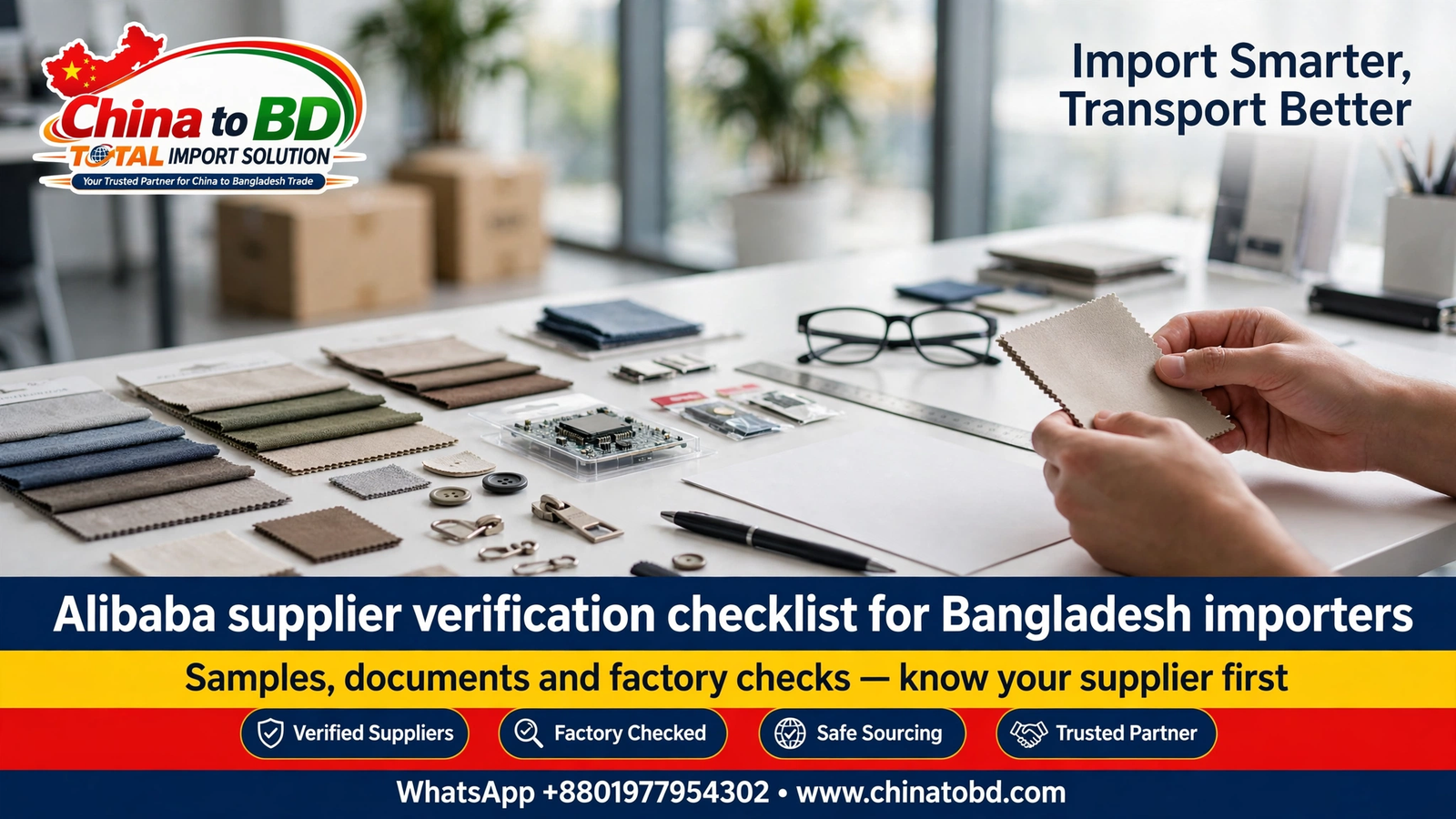
A sample is the only way to know what the goods will actually look and feel like, and no first order should be placed without one. Ask the supplier to send a sample of the exact product, in the exact colour, size, and material agreed in the specification, with the packing the supplier intends to use. When the sample arrives, check it against the specification line by line, and write the result down: what matched, what did not, and what must change before the bulk order is made.
The sample check should cover the product, the packing, and the label. Check the material and the finish, the size and the weight, the colour against the agreed sample colour, and the way the product works if it is a working product. Check the carton, the inner packing, the label, and the marking, because the packing that protects a sample in a courier parcel is not always the packing that protects a full container load. Photograph the sample from every side and keep the photographs in the verification file, so the bulk goods can be compared with the sample on arrival.
If the sample does not match the specification, do not pay for the bulk order until the supplier has sent a corrected sample and the correction has been checked. A supplier who asks for the bulk payment first and promises to fix the sample later is asking the importer to pay for goods that have not yet been shown to be right. The cost of a second sample is small beside the cost of a container of goods that cannot be sold.
- Agree the full specification in writing, including material, size, colour, and packing.
- Ask the supplier to send a sample of the exact product with the intended packing.
- Check the sample against the specification line by line and write the result down.
- Photograph the sample from every side and file the photographs with the specification.
- If anything does not match, ask for a corrected sample before any bulk payment is discussed.
- Only when the sample is approved in writing should the bulk order and the payment terms be finalised.
Price, Payment Terms, and the Quotation
A quotation from an Alibaba supplier should be read as a whole, not as a single price. Ask for the quotation in writing, with the product, the quantity, the unit price basis, the packing, the delivery terms, the payment terms, and the production time all stated. Check which costs are included and which are separate: the goods, the packing, the inspection, the transport to the port, and the shipping. A quotation that only states a unit price, with no packing or delivery terms, is not complete enough to compare with another supplier’s quotation.
Payment terms should be agreed in writing before any money is sent, and the terms should name the method, the timing, and the conditions. Ask the supplier to confirm the bank account name and to confirm that it matches the company name on the licence. Agree what happens if the inspection fails, if the goods are not ready on the agreed date, or if the shipment is short. These points should be written in the order confirmation, not left to chat messages, because the order confirmation is the document both sides will refer to if there is a dispute.
Price comparison between suppliers should compare the same specification, the same packing, and the same delivery terms. A lower unit price with thinner packing, a different material, or a shorter inspection is not the same offer as a higher unit price with the agreed specification. Compare the written quotations side by side, line by line, and ask each supplier the same questions, so the comparison is fair. No figure in this article is presented as a price, because the price depends on the product, the quantity, the material, and the order.
| Quotation line | What to confirm | Why it matters |
|---|---|---|
| Product and quantity | Exact product, model, and quantity | The invoice must match the order |
| Unit price basis | What the price includes | Two quotations can only be compared line by line |
| Packing | Carton, inner packing, and labels | Packing protects the goods in the container |
| Delivery terms | Who arranges transport and to which point | Responsibility changes with the delivery terms |
| Payment terms | Method, timing, and conditions | Payment is difficult to reverse once sent |
| Production time | Date the goods will be ready | The shipping plan depends on the ready date |
Red Flags That Should Stop an Order
Some signs should stop an order at once, whatever the price. A supplier who will not show a business licence, or whose licence name does not match the bank account name, is a supplier whose identity has not been confirmed. A supplier who asks for payment to a personal bank account, or to a company with a different name, is asking the importer to pay a business that is not the business on the listing. A supplier who refuses a video call from the factory, or who only sends photographs that cannot be dated, has not shown the factory.
Other red flags are about pressure and secrecy. A supplier who insists on payment on the same day, who says the price will change tomorrow, or who refuses to send a sample before the bulk payment, is putting pressure on the importer to skip the checks. A supplier who will not put the specification in writing, or who changes the specification after the quotation, is a supplier whose goods cannot be checked against anything. A supplier who asks the importer to move the conversation off the platform and pay by a method with no record is removing the record that protects the importer.
A change of details in the middle of an order is also a red flag. If the bank account, the company name, the factory address, or the contact person changes after the order is agreed, stop and ask for a written explanation, and confirm the new details with the same checks as the original ones. Do not send payment to new details until they have been verified. Record every change in the verification file with the date, so the file shows the full history of the order.
- No business licence, or a licence name that does not match the bank account.
- Payment asked to a personal account or to a different company name.
- No video call from the factory and no dated factory photographs.
- No sample before the bulk payment, or pressure to pay on the same day.
- Specification not put in writing, or changed after the quotation.
- Bank account, company name, or factory address changed mid-order without explanation.
- Conversation moved off the platform with a request to pay by a method with no record.
Documents for the Shipment After Verification
Once the supplier is verified and the sample is approved, the documents for the shipment should be prepared from the verification file, not from memory. The commercial invoice should name the supplier as verified, describe the goods as specified, and state the quantity and the value for customs purposes. The packing list should describe how the goods are packed, how many packages there are, and what is inside each package. The bill of lading, when it is issued, should name the same consignee and the same port of discharge as the booking.
Before the vessel sails, ask the supplier for a copy of each document and check it against the verification file: the company name, the product description, the quantity, the package count, and the consignee name should all agree. If a document needs a correction, ask the supplier for it before loading, because a correction after sailing takes longer and can delay the clearance in Bangladesh. The certificate of origin, where required, should also be checked against the same details.
Keep the shipping documents with the verification file, so the whole order — supplier check, sample approval, order confirmation, inspection report, and shipping documents — is in one place. When the goods arrive, the warehouse team can count the goods against the packing list and compare them with the approved sample, and any difference can be noted at once with a photograph and a written note shared with the supplier on the same day.
| Document | Check against the verification file | Common error to avoid |
|---|---|---|
| Commercial invoice | Supplier name, goods, quantity, value | Description that does not match the specification |
| Packing list | Package count and contents | Package count that does not match the load |
| Bill of lading | Consignee name and port of discharge | Consignee name spelled differently from the booking |
| Certificate of origin | Supplier name and goods | Missing certificate for goods that require one |
| Inspection report | Goods checked against the specification | Inspection done after loading instead of before |
The article Alibaba to Bangladesh Import describes how Alibaba orders are brought into Bangladesh, and its guidance on planning the order from sourcing to delivery applies to any importer using this checklist.
Checklist
| Check | When | Done |
|---|---|---|
| Supplier profile read and saved, with business type and location noted | Before contact | |
| Business licence received; company name matches profile and bank account | Before payment | |
| Factory address confirmed; video call or dated photos received | Before payment | |
| Certificates received for the exact product and checked as in date | Before payment | |
| Full specification agreed in writing: material, size, colour, packing | Before payment | |
| Quotation received in writing with packing, delivery, and payment terms | Before payment | |
| Sample received, checked against the specification, and photographed | Before payment | |
| Sample approved in writing; corrections completed if needed | Before payment | |
| Payment terms agreed in writing, with inspection and failure conditions | Before payment | |
| Bank account name confirmed as the licensed company name | Before payment | |
| Inspection booked in China before loading | Before shipment | |
| Inspection report received and checked against the specification | Before shipment | |
| Invoice, packing list, and bill of lading checked against the file | Before sailing | |
| Certificate of origin checked where required | Before sailing | |
| Bulk goods compared with the approved sample on arrival in Dhaka | At delivery | |
| Verification file closed with delivery receipt and notes | After delivery |
Frequently Asked Questions
Q1: What is an Alibaba supplier verification checklist?
It is a written list of checks an importer completes before paying a supplier found on Alibaba, covering the business licence, the factory, the specification, the sample, the payment terms, and the shipping documents, with each check recorded with its supporting document.
Q2: Why should I verify an Alibaba supplier before paying?
Payment sent to a supplier in another country is difficult to reverse, so the checks that protect the importer must happen before the payment. Verification confirms who the supplier is, what factory makes the goods, and whether the goods match the listing, while there is still time to change supplier.
Q3: How do I check if an Alibaba supplier is a real factory?
Ask for the factory address and name, recent photographs of the production and packing areas, and a live video call from the factory floor. A third-party inspection in China is the strongest check, because the inspector visits the factory and sends a written report with photographs.
Q4: What is the difference between a manufacturer and a trading company on Alibaba?
A manufacturer makes the goods in its own factory, while a trading company buys from a factory and resells. A trading company is not automatically a problem, but it should say so honestly, name its factory, and arrange a factory check or a sample from that factory.
Q5: Which business documents should I ask an Alibaba supplier for?
Ask for a copy of the business licence and check that the company name matches the profile and the bank account. For goods that need one, ask for the product certificate covering the exact model, and check that it names the product and is in date.
Q6: Do I need a sample before placing a bulk order on Alibaba?
Yes. Ask for a sample of the exact product in the agreed colour, size, and material, with the intended packing. Check it against the specification line by line, photograph it, and only approve the bulk order in writing when the sample matches.
Q7: What should a quotation from an Alibaba supplier include?
The quotation should state the product, the quantity, the price basis, the packing, the delivery terms, the payment terms, and the production time in writing. Check which costs are included and which are separate, and compare quotations line by line on the same specification.
Q8: What are the red flags of a risky Alibaba supplier?
No business licence, a licence name that does not match the bank account, payment asked to a personal account, no factory video call, no sample before bulk payment, pressure to pay on the same day, and a specification that is not put in writing are all red flags that should stop an order.
Q9: Should I move the conversation off Alibaba to pay?
No. Moving the conversation off the platform and paying by a method with no record removes the record that protects the importer. Keep the order, the specification, and the payment terms in writing on the platform and in the verification file.
Q10: How do I confirm the supplier’s bank account is correct?
Ask the supplier to confirm the bank account name in writing and check that it matches the company name on the business licence. If the account name is different, or if it changes mid-order, stop and ask for a written explanation before sending any payment.
Q11: What does a third-party inspection in China check?
The inspector visits the factory, checks the goods against the specification, checks the packing and the labels, and sends a written report with photographs before the goods are loaded. The inspection should be booked before the payment terms are finalised.
Q12: How do I compare prices between two Alibaba suppliers?
Compare the written quotations on the same specification, the same packing, and the same delivery terms. A lower unit price with thinner packing or a different material is not the same offer, so ask each supplier the same questions and compare the quotations line by line.
Q13: What documents should match after the supplier is verified?
The commercial invoice, the packing list, the bill of lading, and the certificate of origin where required should all name the same supplier, the same goods, and the same consignee. Ask the supplier for a copy of each document before loading and check it against the verification file.
Q14: What should I do if the sample does not match the specification?
Do not pay for the bulk order until the supplier has sent a corrected sample and the correction has been checked. Record what did not match in writing, with photographs, and only approve the bulk order when the corrected sample matches the specification.
Q15: How do I keep a verification file for a supplier?
Keep one file per supplier holding the profile copy, the licence, the certificates, the quotation, the specification, the sample photographs, the inspection report, the order confirmation, and the shipping documents, each with a date. Reopen the file for repeat orders and re-check the details that can change.
Q16: How can China to BD | Total Import Solution help verify an Alibaba supplier?
China to BD | Total Import Solution has supported importers from China to Bangladesh since 2016, with sourcing, supplier checks, shipping, customs handling, warehousing, and delivery. The team can check a supplier, arrange an inspection, and follow the shipment from loading to delivery in Dhaka.
Contact China to BD | Total Import Solution
For a written plan and quotation for alibaba supplier verification checklist for bangladesh importers, contact China to BD | Total Import Solution. Share the details of your order, your supplier, and your delivery point in Bangladesh, so the plan can be based on the actual shipment.
- Brand: China to BD | Total Import Solution
- Company: Total Import Solution, since 2016
- Helpline: +8801977954302
- Email: info@chinatobd.com
- Website: www.chinatobd.com
- Warehouse & Office: House 38A, Mendi Dental College Road, Road 11, Dhanmondi Riverview Model Town, Dhaka 1209
Call the helpline at +8801977954302 or email info@chinatobd.com to discuss your import, to confirm a plan from sourcing to delivery, or to check a document list before the goods leave China.
About the Author