Groupage cargo from China: shared container guide
Groupage cargo from China: shared container guide
Groupage cargo from China is a way of shipping a smaller order inside a container shared with other importers, instead of booking a whole container for one order. The goods of several importers are loaded into one container in China, the container sails to Bangladesh, and each importer's goods are separated at the destination warehouse and delivered to that importer. For a small order — a few cartons of stock, a first trial order, a restock of one product line — groupage is the way the goods travel without the importer paying for container space that stays empty.
The idea is simple, but the planning behind it is not. A shared container only works when every cargo inside it is packed, labelled, listed, and documented correctly, because one wrong label or one missing document can hold up the whole container, not only the cargo it belongs to. The importer who understands how groupage works can use it regularly and with confidence.
This article explains groupage cargo from China to Bangladesh in practical steps: what groupage means, how it differs from a full container load, which goods suit a shared container, how the space is booked and measured, which documents are needed, how the goods are packed and labelled, how customs clearance works, how delivery and warehouse receipt work in Dhaka, which cost factors to confirm, which mistakes to avoid, and which checks to complete before the goods leave China.
China to BD | Total Import Solution has supported importers from China to Bangladesh since 2016, with sourcing, shipping, customs handling, warehousing, and delivery. The steps here follow the order used in a real groupage shipment: confirm the need, confirm the cargo list, confirm the packing and the labels, confirm the documents, confirm the booking, and only then confirm the loading. For help, call +8801977954302, email info@chinatobd.com, or visit www.chinatobd.com. The warehouse and office are at House 38A, Mendi Dental College Road, Road 11, Dhanmondi Riverview Model Town, Dhaka 1209.
What Groupage Cargo Means
Groupage is the practice of combining the cargo of several importers into one container. Each importer has a separate consignment — a separate cargo list, a separate invoice, a separate packing list, and a separate delivery address — but the container, the vessel space, and the sea journey are shared. At the port of loading in China, the cartons of each importer are loaded into the container in a planned order, with the labels facing out and the loading list recording where each consignment sits. At the port of discharge in Bangladesh, the container is moved to a warehouse, opened, and each consignment is separated and checked against its own packing list before delivery.
The shared container is sometimes called a consolidated container, and the work of combining the cargo is called consolidation. The importer does not need to know the other importers in the container, and does not share their documents. Each consignment keeps its own file, its own customs clearance, and its own delivery plan.
Groupage suits an importer whose order fills only part of a container. A trader bringing a small range of goods for a shop, a factory bringing a spare-parts order, a new importer placing a trial order, or a regular importer restocking one product line will often find that a full container is far more space than the order needs. Groupage lets that importer pay for the space the cargo actually occupies, rather than for a whole container. The saving is in the space, not in the care: the goods still need the same inspection, packing, labelling, and documents as a full container load.
Groupage or a Full Container: How to Decide
The choice between groupage and a full container load is a choice about the size of the order, the timing of the delivery, and the control the importer wants over the container. A full container load means one importer, one consignment, one container, and one delivery. A groupage load means several importers, several consignments, one container, and several deliveries. Neither is better in every case. The right choice depends on the cargo list, the delivery point, and the importer's own plan.
The table below compares the two options on the points that matter most to an importer. Read it with the actual cargo list in hand, not from memory, because the decision changes with the number of cartons, the weight, the size of the goods, and the delivery address.
| Point | Groupage (shared container) | Full container load |
|---|---|---|
| Order size | Small to medium, part of a container | Fills a whole container |
| Space paid for | The space the cargo occupies | The whole container |
| Other cargo in the container | Yes, from other importers | No, only the importer's goods |
| Loading order | Planned by the consolidator | Planned by the importer |
| Separation on arrival | At the warehouse, by consignment | Not needed, one consignment |
| Delivery | Per consignment, after separation | Direct, one delivery |
| Control over sailing | Shared with other consignments | The importer's own booking |
| Documents | Separate file per consignment | One file for the container |
| Best for | Trial orders, restocks, small orders | Large orders, single product lines |
A groupage shipment needs a little more patience than a full container load, because the container is only loaded when enough consignments are ready, and the goods are only delivered after they have been separated and counted at the warehouse. An importer who needs the goods on a fixed date should confirm the loading plan and the separation plan in writing before booking, so that the date is a plan and not a hope. An importer whose order fills most of a container should compare the two options in writing, because the difference in space may be smaller than expected once the packing and the loading order are counted.
Where the order is a small part of a container, groupage is usually the practical choice. The article LCL Shipping from China to Dhaka describes how a smaller load travels from China to Dhaka, and its guidance on packing, labelling, and the separate document file for each consignment applies to every groupage shipment.
Which Goods Suit a Shared Container
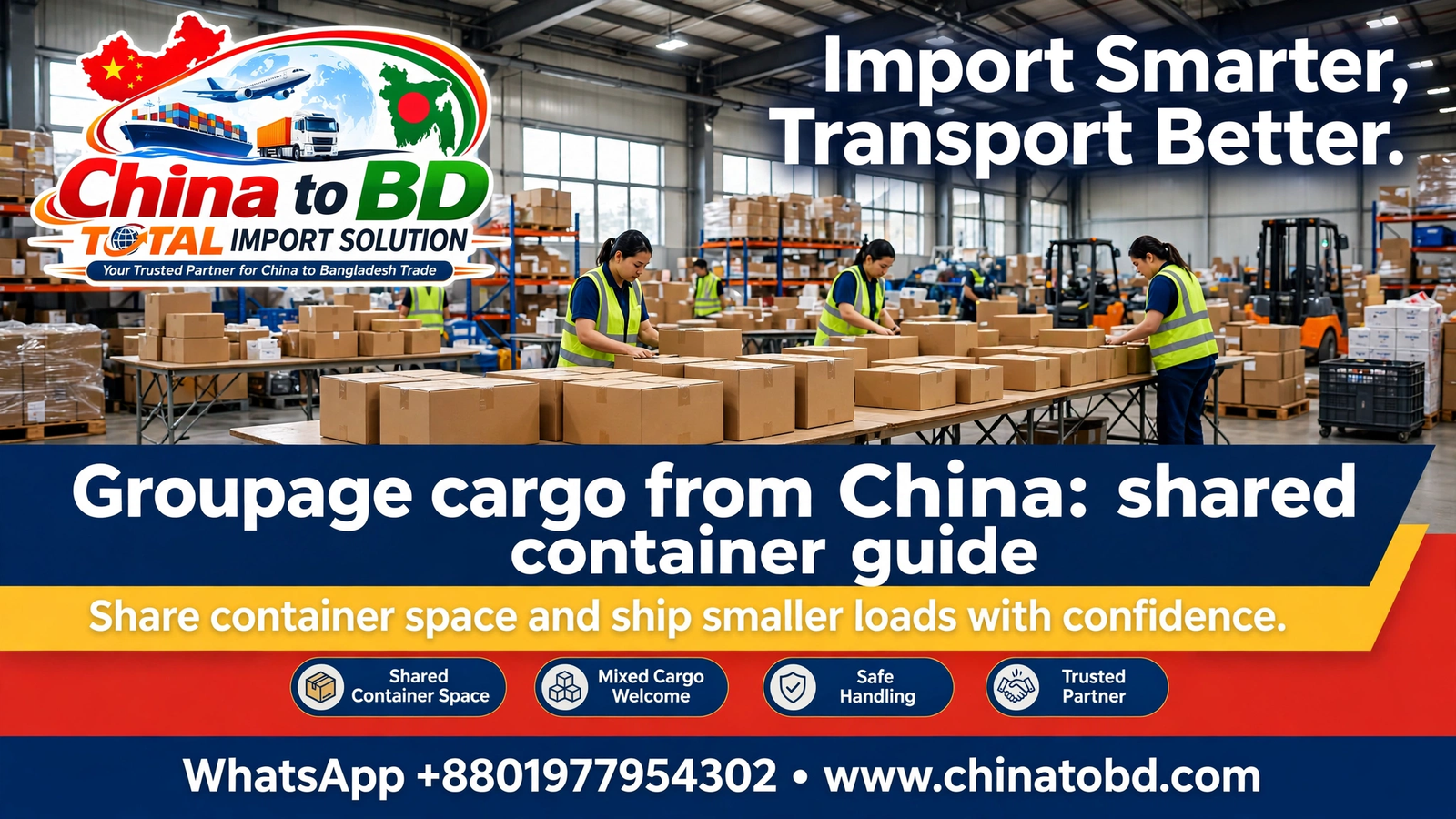
Most ordinary commercial goods suit a shared container: packed cartons of general goods, garments, household items, tools, spare parts, electronics in their retail packing, and similar goods that travel well in cartons. The goods should be packed in strong cartons, labelled clearly, and listed item by item on the packing list, so that the warehouse team can separate them from the other consignments without opening every carton.
Some goods do not suit a shared container, and the importer should ask before booking. Goods that need special temperature control, hazardous goods, very heavy or very large goods, very fragile goods, and goods that need special handling at the port are all cases where a shared container may not be the right choice. The consolidator should confirm in writing whether the goods are accepted for groupage.
The packing matters more in a shared container than in a full container, because the cartons of several importers are loaded together and separated at the warehouse. Each carton should carry the importer's name, the consignment reference, the carton number, and the destination, written clearly and in the same place on every carton. The packing list should list every carton by number, with the contents and the quantity inside each carton, so that a missing or damaged carton can be identified at once.
How Groupage Works Step by Step
Follow these steps in order, completing each one before the next is confirmed. A groupage shipment booked in a hurry, with the cargo list still incomplete or the labels still unwritten, is a shipment where the goods are found at the warehouse instead of at the desk.
- Write the need in full. List the goods, the quantities, the specification, the carton sizes, the weight, and the delivery point, and share them with the consolidator in writing.
- Confirm the goods are accepted for groupage. Ask whether the goods need special handling, and what packing the consolidator requires.
- Confirm the supplier and the inspection plan. Ask for the specification confirmation, the inspection report, and the photos from China.
- Agree the packing and labelling plan. Confirm the carton type, the label format, the carton numbering, and the loading photos with the supplier.
- Prepare the documents. Use the checklist in the documents section, and keep the originals and the copies in one file. Ask the supplier for a copy of each document before loading.
- Book the space. Confirm the loading point, the container, the sailing, and the separation plan at the destination warehouse in writing.
- Confirm the customs plan. Name the customs broker, confirm the duty handling, and confirm who will attend the port if a physical check is required.
- Confirm the warehouse and delivery plan. Confirm the warehouse space, labour, and equipment, and name the person in charge of the receipt and the separation.
- On arrival, follow the plan in order: check the seal number, receive the container, separate the consignments, count each consignment against its packing list, note any damage or shortage at once, and deliver the goods to the shop, factory, or buyer with a signed receipt.
Measuring and Booking the Space
The space in a shared container is booked by the size and the weight of the cargo, not by the number of cartons alone. The consolidator measures the cargo by its volume — the space the packed cartons occupy — and by its weight, and books the space on that basis. The importer should give the exact carton sizes and the exact weight, measured after packing, not estimated from the order. An estimate that is too small leaves cartons without space at loading; an estimate that is too large books space that is not used.
Ask the consolidator, in writing, how the space is measured, what is included in the booking, and what happens if the cargo is larger or heavier than the booking, or not ready on the loading day. A booking that is not in writing is a booking that no one can prove later.
The loading plan is the consolidator’s responsibility, but the importer should ask to see it. The plan shows the order in which the consignments are loaded, so that the consignment that must come out first is loaded last. Ask for the loading photos as well, so that the importer can see how the cartons were loaded and whether the labels are visible.
Packing and Labelling for a Shared Container
Packing for groupage starts with the carton. Use strong cartons that can carry the weight of the cartons above them, seal each carton fully, and strap or tape the cartons that are heavy or that hold fragile goods. Inside each carton, pack the goods so that they do not move, and use packing material where the goods can shift. A carton that arrives crushed is a carton whose goods are damaged, and a carton that arrives open is a carton whose goods may be short.
Labelling for groupage is the part that makes separation possible. Every carton should carry the same label format: the importer’s name, the consignment reference, the carton number, the total number of cartons, and the destination. Write the label in the same place on every carton, large enough to read from a distance, and use a label that will not fall off in the container. If the goods are fragile, mark the carton clearly on every side.
The packing list is the document that ties the cartons together. List every carton by number, with the contents and the quantity inside each carton, and the total quantity for the consignment. The warehouse team separates the goods by the packing list, so a packing list that does not match the cartons is a packing list that slows the separation. Check the packing list against the cartons before the goods leave China, and keep a copy in the shipment file.
| Packing item | What to do | Why it matters |
|---|---|---|
| Carton strength | Strong cartons, fully sealed | Cartons carry the weight above them |
| Carton numbering | Number every carton, with the total count | Separation and counting at the warehouse |
| Labels | Same format, same place, every carton | A carton that cannot be identified cannot be separated |
| Fragile marking | Mark on every side where needed | Handling at loading and at the warehouse |
| Packing list | List every carton by number and contents | The warehouse separates by the packing list |
| Loading photos | Ask for photos of the loaded container | Proof of how the goods were loaded |
Documents for a Groupage Shipment
Documents are the stage where a groupage shipment earns the importer’s trust, because a document error in a shared container is found at the port, not at the desk, and it can hold up the whole container. The commercial invoice describes the goods, the quantity, and the value for customs purposes. The packing list describes how the goods are packed, how many packages there are, and what is inside each package. The bill of lading is the transport document issued by the carrier, and it must match the invoice and the packing list. The certificate of origin, where required, states where the goods were made.
Each consignment in a shared container keeps its own document file. The invoice, the packing list, and the bill of lading for one consignment must not be mixed with those of another consignment, because the customs clearance for each consignment is separate. The importer should keep the import registration, tax identification, and bank documents ready, and the consolidator should confirm which papers must be presented in original and which as a copy.
Before the vessel arrives, complete a short document review with the customs broker: confirm that the invoice, the packing list, and the bill of lading agree, that the consignee name is spelled the same way on every document, that the port of discharge is correct, and that the container and seal numbers are recorded. If a document needs a correction, request it from the supplier before the vessel sails, because a correction after sailing takes longer and costs more.
Customs Clearance for a Shared Container
Customs clearance for a groupage shipment follows the same rules as for any other shipment, but the clearance is done per consignment, not per container. Each importer’s goods are cleared on that importer’s own documents, with that importer’s own duty and tax position. The container itself is not cleared as one load; it is opened, the consignments are separated, and each consignment is cleared on its own file. The description on the invoice, the packing list, and the customs file must be the same, word for word, so that the broker can clear the goods without a query.
The importer should confirm the duty position with the customs broker before booking, because the duty and tax depend on the exact goods, their description, and their classification. The description on the invoice, the packing list, and the customs file must be the same, word for word, so that the broker can clear the goods without a query. A description that differs between documents is a description that invites a query, and a query is a delay.
If customs requires a physical check of the goods, the check is made on the consignment, not on the whole container, but the container must still be opened and the consignment reached. That is why the loading order matters: a consignment loaded at the back of the container takes longer to reach than one loaded near the door. Ask the consolidator where the consignment will sit in the container, and confirm who will attend the port if a physical check is required.
Where the shipment is part of a full door-to-door movement, the end-to-end plan should be written in the same way as for a full container. The article End-to-end import service from China to Bangladesh describes how a full-chain service is planned from sourcing to delivery, and its guidance on one plan, one contact, and one shipment file applies to a groupage shipment just as it applies to a full container load.
Cost Factors to Confirm at Booking
The cost of a groupage shipment is made up of several parts, and each part should be confirmed at booking. The sea freight for the shared container is shared between the consignments by the space each one occupies. Port charges cover the handling of the container at each port and of the consignments at the warehouse. Customs duty and tax are set by the customs rules for the exact goods, and the importer should confirm the duty position with the customs broker before booking. Transport covers the movement of the container from the port to the warehouse, the delivery to the shop, factory, or buyer, and the return of the empty container. Labour covers the separation, counting, and checking of the consignments at the warehouse. Warehouse use covers the space and the time that the goods occupy.
Each part can change if the plan changes, so ask at booking what happens if the plan changes and how a change is charged. Ask which charges are included in the quotation and which are separate, and read the quotation line by line. Confirm payment terms as well, because a delayed payment can delay the release of the goods. No figure in this article is presented as a price, because the cost depends on the cargo, the route, the container, and the delivery plan. For a figure for a specific shipment, share the cargo list, the loading point, the delivery point, and the delivery dates with China to BD | Total Import Solution and ask for a written quotation. Contact the helpline at +8801977954302 or email info@chinatobd.com.
Separation, Warehouse Receipt, and Delivery
Separation is the stage that makes groupage different from a full container load. When the container arrives at the warehouse, it is opened and the consignments are separated one by one, in the order shown on the loading list. Each consignment is counted against its own packing list, and the condition of the cartons is checked before the goods are put away. A carton that is damaged or short is noted at once, with a photo and a written note, and the note is shared with the supplier and the consolidator on the same day.
The warehouse should be ready before the container arrives: the gate, the road, the turning space, the floor space, the sorting space, and the working hours all checked, with labour and equipment booked and a covered area available for sorting and checking. Count each package as it leaves the container, compare it with the packing list, and check the condition of the goods before they are put away. Do not sign a clean receipt for damaged or short goods.
Delivery is the last stage: the goods move from the warehouse to the shop, the factory, or the buyer, with the right vehicle and the right timing. Confirm the vehicle, the driver, the route, the delivery address, and the delivery time, and share the details with the receiver so that the goods can be received and counted on arrival. Where the site cannot take the whole consignment at once, split the delivery into sessions, with each session counted and receipted separately. A delivery receipt, signed and recorded, closes the chain.
Common Mistakes in Groupage Shipments
- Booking groupage before the cargo list is complete, so the space, the packing, and the documents must all be fixed in a hurry. Confirm the need before confirming the booking.
- Giving estimated carton sizes and weights instead of measured ones, so cartons have no space at loading or space is booked that is not used. Measure after packing.
- Labelling cartons in different formats, so the warehouse team cannot separate the consignment quickly. Use one label format on every carton.
- Skipping the inspection in China, so a problem with the goods is only found in Dhaka. Ask for the inspection report and photos.
- Leaving the documents until after the vessel sails, so an error is only found at the port. Ask the supplier for a copy of each document before loading, and check it against the cargo list.
- Choosing groupage for goods that need special handling without asking first. Confirm in writing that the goods are accepted for a shared container.
- Not asking where the consignment sits in the container, so a customs check takes longer than it should. Ask for the loading plan and the loading photos.
- Signing a clean receipt for damaged or short goods. Note the damage or shortage on the receipt, take a photo, and keep a copy.
- Relying on verbal agreements with the consolidator or any other party. Keep every agreement in writing, in one shipment file, and share the same written plan with every party.
Groupage Shipment Checklist
Copy this table into the shipment file and mark each item as it is completed. Complete the pre-shipment items before the vessel sails, and the delivery items before the container arrives.
| Check | When | Done |
|---|---|---|
| Need and cargo list written in full | Before booking | |
| Goods confirmed as accepted for groupage | Before booking | |
| Supplier and inspection plan confirmed | Before booking | |
| Carton sizes and weights measured after packing | Before booking | |
| Packing and labelling plan agreed, one label format | Before booking | |
| Documents prepared, copies checked against cargo list | Before sailing | |
| Space booked in writing, with loading plan confirmed | Before sailing | |
| Customs broker named, with full document set shared | Before sailing | |
| Loading photos requested from the supplier | At loading | |
| Container and seal numbers recorded at loading | At loading | |
| Duty and payment arrangements confirmed | Before arrival | |
| Warehouse space, sorting space, and covered area confirmed | Before arrival | |
| Labour and equipment booked for separation and counting | Before arrival | |
| Full plan shared in writing with every party | Before arrival | |
| Seal number checked on arrival, before opening | At arrival | |
| Consignments separated and counted against packing lists | At delivery | |
| Damage or shortage noted at once, with photo and written note | At delivery | |
| Delivery receipt signed and recorded | After delivery |
Frequently Asked Questions
Q1: What is groupage cargo from China?
Groupage cargo is a shipment in which the goods of several importers are loaded into one shared container in China, sailed to Bangladesh, and separated at the destination warehouse so that each importer receives only their own consignment.
Q2: How is groupage different from a full container load?
In a full container load one importer fills a whole container with one consignment, while in groupage several importers share one container, each with a separate consignment, separate documents, and separate delivery.
Q3: Which orders suit groupage cargo from China?
Groupage suits small to medium orders that fill only part of a container, such as trial orders, restocks of one product line, spare-parts orders, and small ranges of goods for a shop.
Q4: Which goods do not suit a shared container?
Goods that need special temperature control, hazardous goods, very heavy or very large goods, very fragile goods that need a whole container, and goods that need special handling at the port may not suit a shared container. Confirm in writing before booking.
Q5: How is the space in a shared container measured?
The space is booked by the volume the packed cartons occupy and by their weight. Give the exact carton sizes and the exact weight measured after packing, not estimates from the order.
Q6: How are the goods of different importers kept apart?
Each consignment has its own cargo list, invoice, packing list, and delivery address, and every carton carries the importer’s name, consignment reference, and carton number, so the warehouse team can separate the consignments by the loading list and the packing lists.
Q7: What documents do I need for a groupage shipment?
The main documents are the commercial invoice, the packing list, the bill of lading, and the certificate of origin where required. Other certificates may be required for specific goods, so confirm the requirement before shipment.
Q8: Does each importer clear customs separately in groupage?
Yes. Each consignment is cleared on its own documents, with its own duty and tax position. The container is not cleared as one load; it is opened, the consignments are separated, and each one is cleared on its own file.
Q9: How does packing and labelling work for a shared container?
Use strong, fully sealed cartons and one label format on every carton, showing the importer’s name, the consignment reference, the carton number, and the total carton count. List every carton by number and contents on the packing list.
Q10: How long does a groupage shipment take?
The time depends on the loading plan, the sailing, the customs clearance, and the separation at the warehouse. Confirm the loading plan and the separation plan in writing before booking.
Q11: What should I do if my cartons are damaged or short on arrival?
Note the damage or shortage on the receipt, take a photo, and keep a copy. Do not sign a clean receipt for damaged or short goods. Share the note with the supplier and the consolidator on the same day.
Q12: Can I track my consignment inside a shared container?
Yes. Ask at booking how tracking will be shared, who will send each update, and how often. Name one contact person for the shipment, and keep a written record of every update in the shipment file.
Q13: What happens if my cargo is not ready on the loading day?
Ask the consolidator in writing before booking whether the space is held, whether the cargo moves to the next sailing, and how the change is recorded. A change that is not recorded in writing is a change that no one can prove later.
Q14: Which cost factors should I confirm before booking groupage?
Confirm the shared sea freight, port charges, customs duty and tax, transport, warehouse labour for separation, and warehouse use. Ask which charges are included in the quotation and which are separate.
Q15: Can a groupage consignment be delivered in sessions?
Yes. Where the site cannot take the whole consignment at once, the delivery can be split into sessions, with each session counted and receipted separately. Plan the sessions before the vessel sails.
Q16: How can China to BD | Total Import Solution help with groupage cargo from China?
China to BD | Total Import Solution has supported importers from China to Bangladesh since 2016, with sourcing, shipping, customs handling, warehousing, and delivery. The team can plan a groupage shipment from China to delivery in Bangladesh with one plan and one shipment file.
Contact China to BD | Total Import Solution
For a written plan and quotation for groupage cargo from China, contact China to BD | Total Import Solution. Share the cargo list, the loading point in China, the delivery point in Bangladesh, and the delivery dates, so the plan can be based on the actual shipment.
- Brand: China to BD | Total Import Solution
- Company: Total Import Solution, since 2016
- Helpline: +8801977954302
- Email: info@chinatobd.com
- Website: www.chinatobd.com
- Warehouse & Office: House 38A, Mendi Dental College Road, Road 11, Dhanmondi Riverview Model Town, Dhaka 1209
Call the helpline at +8801977954302 or email info@chinatobd.com to discuss groupage cargo from China, to confirm a plan from sourcing to delivery, or to check a document list before the vessel sails.
About the Author