Cold chain logistics for food imports from China
Cold chain logistics for food imports from China
Cold chain logistics for food imports from China is the unbroken chain of cold storage and cold transport that keeps food at the temperature it needs from the moment it is packed in China until it is delivered in Bangladesh. For food, the cold chain is not an extra service: it is the condition that keeps the goods safe to sell and safe to eat. A single break in the chain, at loading, at sea, at the port, or on the road to Dhaka, can spoil a load that looked perfect when it left the factory.
Food imports need more planning than a dry load, because the goods themselves set the rules. Frozen food must stay frozen, chilled food must stay chilled, and food that needs a steady cool temperature must not warm up and cool down again. The packing, the container, the loading order, the port handling, and the delivery all have to protect that temperature, and every stage has to be checked and recorded in writing. This article explains the chain in practical steps, so that an importer can plan it, check it, and prove it.
This article explains, in practical steps, how cold chain logistics works for food imports from China: what the cold chain is, which foods need it, how reefer containers and cold storage are chosen, how food is packed, loaded, and monitored, which documents and food safety checks matter, how customs and port handling work for food, how delivery in Dhaka is planned, which mistakes spoil a load, and which checks to complete before the cargo leaves China. China to BD | Total Import Solution has supported importers from China to Bangladesh since 2016, with sourcing, shipping, customs handling, warehousing, and delivery. For help, call +8801977954302, email info@chinatobd.com, or visit www.chinatobd.com. The warehouse and office are at House 38A, Mendi Dental College Road, Road 11, Dhanmondi Riverview Model Town, Dhaka 1209.
What Cold Chain Logistics Means for Food Imports
The cold chain is the series of cold stages a food shipment passes through: cold storage at the supplier, a pre-cooled container, cold transport to the port, the sea journey in a reefer container, cold handling at the port in Bangladesh, cold transport to the warehouse, and cold storage until delivery. Each stage must hold the temperature the food needs, and the handover between stages must be short, planned, and recorded. A chain is only as strong as its weakest handover.
For food, temperature is a safety matter as well as a quality matter. Food that warms up beyond the range it needs can lose its texture, its colour, and its shelf life, and food that warms up and cools down again can become unsafe even when it looks unchanged. That is why the cold chain is checked with records, not with a look at the cartons: the temperature record, the container record, and the handover record together show whether the chain held.
The importer should agree the temperature need with the supplier in writing before ordering. The supplier knows the product and its storage need, and that need should be written into the order, the packing plan, and the booking, so that every party from the factory to the warehouse in Dhaka works to the same requirement. A temperature need that is only spoken, and never written, is a need that no one can be held to.
Which Food Imports Need a Cold Chain
Frozen food needs a cold chain that holds the goods frozen from packing to delivery, with no warming stage in between. Chilled food needs a cold chain that holds the goods chilled, with the same care at every handover. Food that is packed for a steady cool temperature needs a chain that avoids warming and avoids freezing, because either extreme can damage it. The supplier should state the storage need for the exact product, and that statement should be kept in the shipment file.
Some food imports need the cold chain only for part of the journey, and some need it for the whole journey. The difference matters for the booking: a load that needs cold handling from the factory gate needs a pre-cooled container and a cold loading plan, while a load that is packed cold and loaded quickly still needs the container checked before loading. Ask the supplier which stages need cold handling, and write the answer into the plan.
| Food type | Cold chain need | Check before ordering |
|---|---|---|
| Frozen food | Kept frozen through every stage | Supplier states the frozen storage need in writing |
| Chilled food | Kept chilled through every stage | Supplier states the chilled storage need in writing |
| Cool-temperature food | Steady cool temperature, no warming or freezing | Supplier states the cool range in writing |
| Dried or canned food | Protected from heat and damp | Packing and storage need agreed with the supplier |
| Mixed food load | Each item kept at its own need | Items grouped so no item warms another |
Reefer Containers and Cold Storage
A reefer container is a container that holds a set temperature through the journey, and it is the usual choice for food imports that need a cold chain. The container must be checked before loading: it should be clean, dry, free of odour from a previous load, and pre-cooled to the temperature the food needs before the first carton is loaded. A container that is loaded warm takes time to cool down, and that time is time the food spends outside its proper temperature.
The reefer should be set to the temperature the supplier specifies for the exact product, and the setting should be written on the booking and confirmed by the party that loads the container. The temperature should be recorded through the journey, and the record should be available to the importer. Ask at booking who holds the temperature record, how it is shared, and what happens if the record shows a break in the chain.
Cold storage at each end matters as much as the container. The supplier's cold store should hold the food at its proper temperature before loading, and the warehouse in Dhaka should have cold storage ready before the container arrives, with the space, the power, and the handling booked in advance. A container that arrives in Dhaka with nowhere cold to go is a load that starts warming at the port.
The article Reefer container shipping from China to Bangladesh describes how reefer shipments are planned from China to Bangladesh, and its guidance on checking the container, agreeing the temperature setting, and planning the delivery applies to any food import that travels in a reefer.
Packing, Loading, and Temperature Monitoring
Food packing for a cold chain must protect the food and let the cold air move. Cartons should be strong enough to hold their shape when cold and damp, stacked so that air can flow between them, and labelled with the product, the packing date, and the storage need. The supplier should confirm the carton type, the stacking, and the labels in writing, and the inspection in China should check them before loading.
Loading should be fast and planned. The container should be pre-cooled, the food should come from cold storage straight to the container, the loading order should be agreed so that the cartons are placed and the doors are closed without delay, and the loading photos should be taken and kept. Food left standing in warm air while the container is prepared is food that has already started to warm.
Temperature monitoring is the record that proves the chain held. The importer should ask at booking how the temperature is recorded, who keeps the record, and when the importer sees it. A temperature logger placed with the load, a record from the reefer, and a written handover note at each stage together make the record complete. If the record shows a break, the importer should be told at once, with the time and the stage, so that a decision can be made with the facts in hand.
Food Safety Documents and Certificates
Food imports need the normal customs documents and the food documents that apply to the exact product. The commercial invoice describes the goods, the quantity, and the value. The packing list describes how the goods are packed and what is inside each package. The bill of lading is the transport document, and it must match the invoice and the packing list. The certificate of origin, where required, states where the goods were made. Other certificates may be required for food, such as a health certificate, a test report, or a certificate from the manufacturer, and the agent should confirm the requirement for the exact product before shipment.
The importer should keep the import registration, tax identification, and bank documents ready, and the agent should confirm which papers must be presented in original and which as a copy. Before the vessel arrives, the agent should complete a short document review with the customs broker: confirm that the invoice, the packing list, and the bill of lading agree, that the consignee name is spelled the same way on every document, that the port of discharge is correct, and that the container and seal numbers are recorded.
Food labels matter as well. The labels on the cartons and on the product should carry the information the rules ask for, in the form the rules ask for, and the supplier should confirm the labelling before the goods are packed. A label that is missing or wrong can hold a food shipment at the port even when the temperature record is perfect.
| Document or check | Purpose | Common error to avoid |
|---|---|---|
| Commercial invoice | Describes goods, quantity, and value | Value or description that does not match the cargo |
| Packing list | Describes packages and contents | Package count that does not match the actual load |
| Bill of lading | Transport document from the carrier | Consignee name or port that does not match the booking |
| Certificate of origin | States where goods were made | Missing certificate for goods that require one |
| Health certificate or test report | Confirms the food meets the stated requirement | Certificate that does not cover the exact product |
| Temperature record | Shows the cold chain held through the journey | Record missing, incomplete, or not shared |
| Labelling | Carries the information the rules ask for | Label missing or not matching the product |
| Import registration and tax papers | Confirms the importer is registered | Expired or incomplete registration |
Customs, Port Handling, and Cold Storage in Dhaka
At the port in Bangladesh, food is cleared through customs like other cargo, with the food documents checked alongside the normal file. The agent should name the customs broker, confirm the duty handling, and confirm who will attend the port if a physical check is required. Where a food check is needed, the broker should confirm what the check covers and what papers must be ready, so that the check does not catch the importer unprepared.
Port handling for food should be planned for speed. The container should be moved from the vessel to the cold transport without a long wait in warm air, and the transport to Dhaka should be booked before the vessel arrives, with the driver, the route, and the delivery time confirmed. The warehouse cold storage should be ready, with the space, the power, and the labour booked, so that the food goes from the container into cold storage without delay.
The article Reefer Container Rental in Bangladesh: Cold Chain Import Solutions describes how reefer rental is planned for cold chain imports in Bangladesh, and its guidance on agreeing the rental period, the delivery point, and the return plan before the vessel sails applies to any food shipment that needs cold storage after arrival.
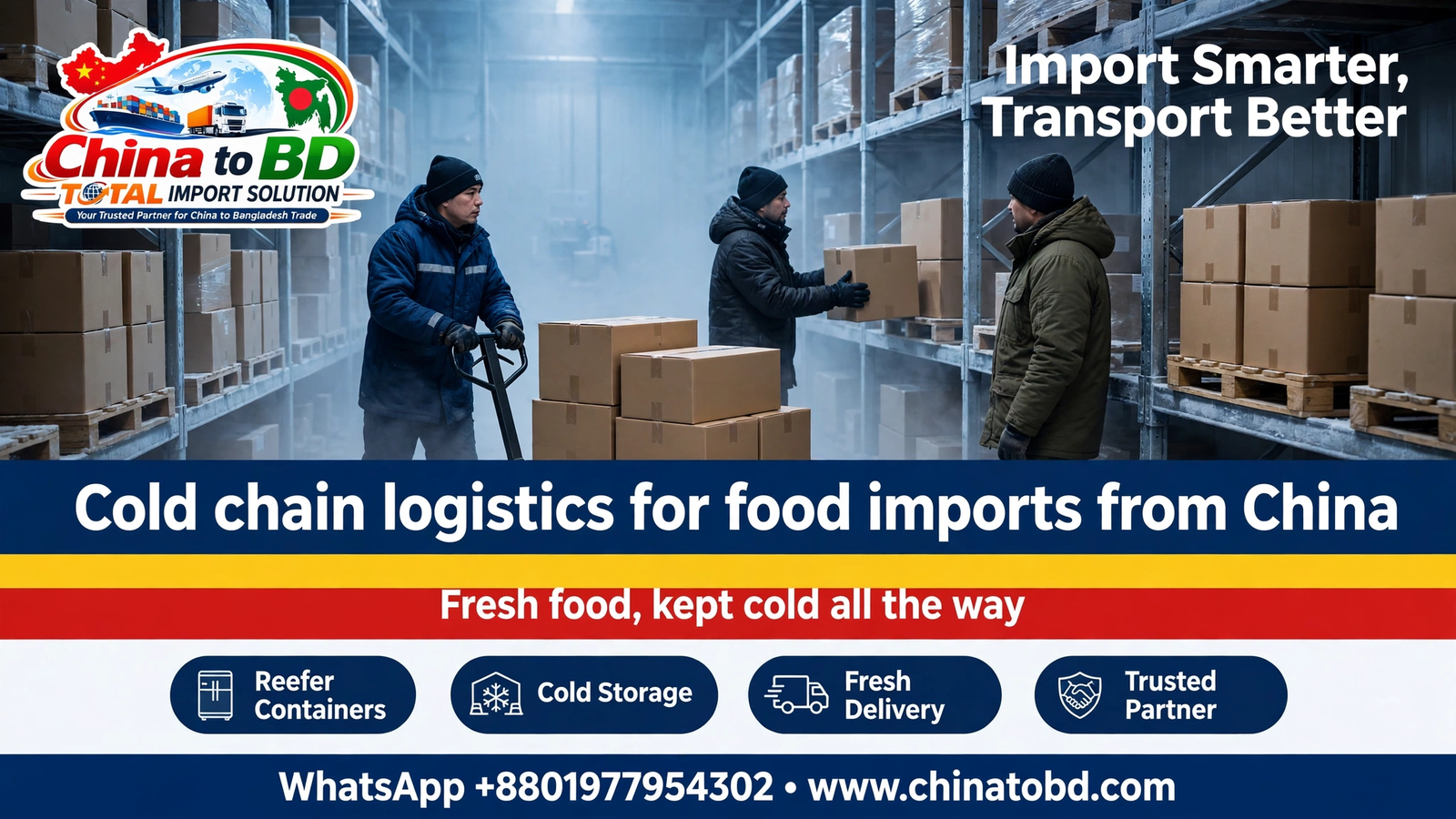
Delivery Planning for Food Imports in Dhaka
Delivery of food in Dhaka should be planned like the rest of the chain: cold, fast, and recorded. The vehicle should be able to hold the temperature the food needs, the loading should be planned so the food moves from cold storage to the vehicle without a long wait, and the receiver should be told the delivery time in advance so the food can be received and put into cold storage on arrival.
Where the receiver cannot take the whole load at once, split the delivery into sessions, with each session counted and receipted separately, and each session kept cold. The sessions should be planned before the vessel sails, and the container rental and return plan agreed in advance where the container is held for more than one session. A delivery receipt, signed and recorded, closes the chain, and the shipment file is then complete: the specification, the inspection report, the loading photos, the temperature record, the documents, the warehouse receipt, and the delivery receipt together.
The warehouse team should know the food and its storage need before the container arrives. Share the product, the quantity, the storage need, and the delivery plan with the warehouse in writing, and name the person in charge of the receipt. A warehouse that is told on the day the container arrives cannot prepare cold space, labour, and equipment in time.
Working with an Agent on Cold Chain Shipments
An agent who handles cold chain food imports can plan the whole chain as one job: confirm the temperature need with the supplier, book the reefer, agree the packing and loading plan, arrange the temperature monitoring, prepare the food documents with the broker, book the cold transport and the cold storage in Dhaka, and follow the load from the factory to the delivery. The importer should still ask for the inspection report, the loading photos, the temperature record, and the delivery receipt in writing, and keep them in the shipment file.
Before the first booking, agree the communication in writing: one contact person for the shipment, known to every party by name and phone number, and one shipment file where every document, update, and receipt is kept. A named contact person is worth more than a general helpline when a question arises at the port, and a temperature question at the port needs an answer at once, not after a delay.
Steps to Plan a Cold Chain Food Import
- Write the need in full. List the food, the quantities, the storage need stated by the supplier, the packing, and the delivery point, and share them with the agent in writing.
- Confirm the temperature need with the supplier in writing, and write it into the order, the packing plan, and the booking.
- Choose the reefer container and agree the pre-cooling, the temperature setting, and the temperature record with the agent before booking.
- Agree the packing and loading plan. Confirm the carton type, the stacking, the airflow path, the labels, and the loading photos with the supplier.
- Ask for the terms in writing. Confirm what is included, what is separate, who is responsible for each stage, and what happens if the plan changes.
- Prepare the documents. Use the checklist in the documents section, confirm the food certificates needed for the exact product, and keep the originals and the copies in one file.
- Confirm the customs plan. Name the customs broker, confirm the duty handling, and confirm who will attend the port if a check is required.
- Confirm the cold transport, cold storage, and delivery plan in Dhaka. Book the vehicle, confirm the driver and route, and confirm the cold storage space, labour, and equipment.
- Load cold and fast. Move the food from cold storage to a pre-cooled container, close the doors without delay, and record the container and seal numbers.
- On arrival, follow the plan in order: check the seal number, move the container to cold transport, count and check the food against the packing list, note any damage or warming at once, deliver to cold storage, and close the shipment file with a delivery receipt.
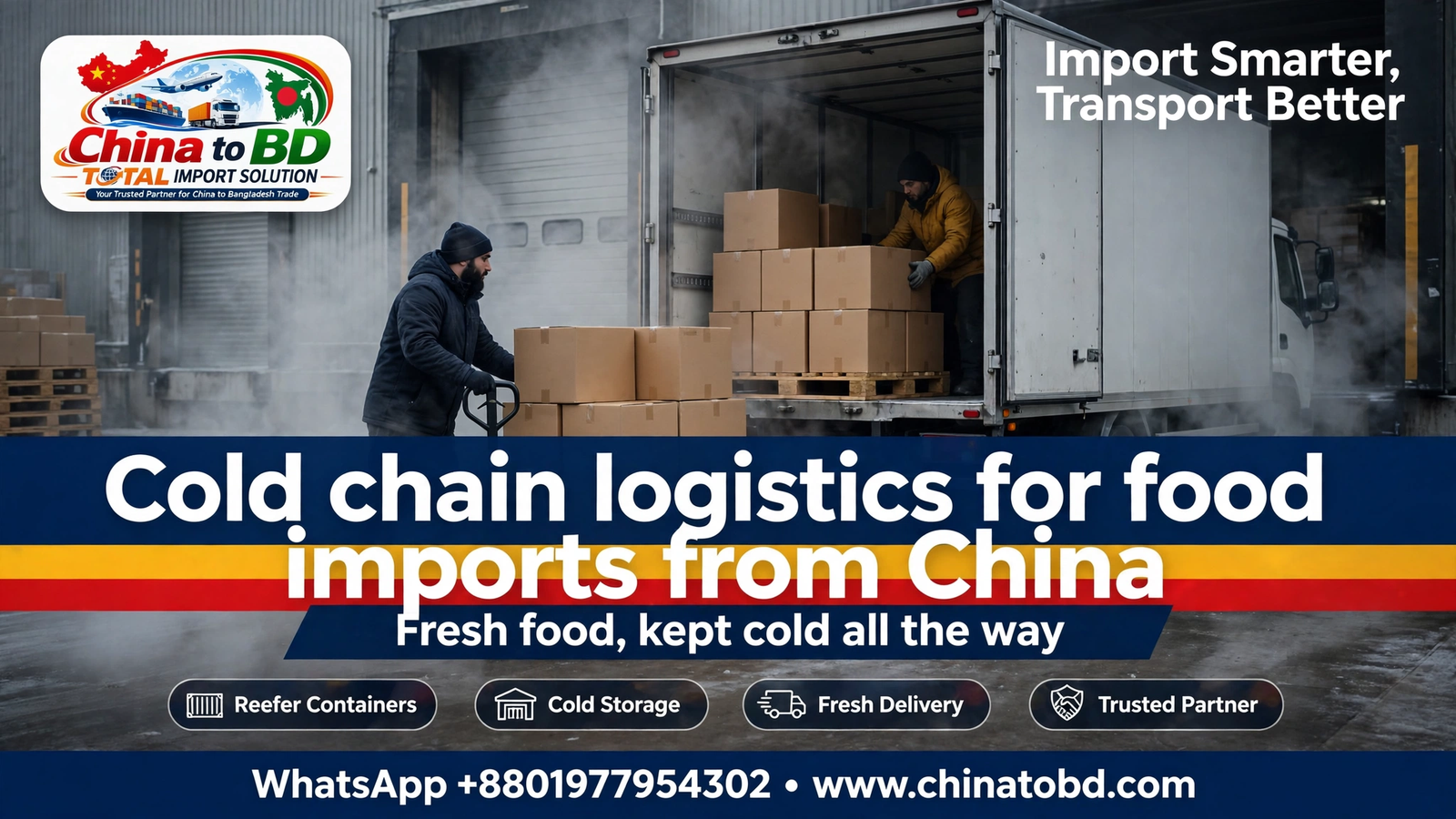
Cost Factors to Confirm at Booking
The cost of a cold chain food shipment is made up of several parts, and each part should be confirmed at booking. Ocean freight is the cost of moving the container from the port in China to the port in Bangladesh. The reefer charge covers the container holding its set temperature through the journey. Port charges cover the handling of the container at each port. Customs duty and tax are set by the customs rules for the exact goods, and the importer should confirm the duty position with the customs broker before booking. Transport covers the movement of the container from the port to the warehouse, the delivery to the shop, factory, or buyer, and the return of the empty container. Labour covers the offloading, sorting, counting, and checking. Cold storage covers the space and the time the food occupies at the temperature it needs. The agent's service charge covers the planning, the booking, the tracking, and the follow-up.
Each part can change if the plan changes, so ask at booking what happens if the plan changes and how a change is charged. Ask which charges are included in the quotation and which are separate, and read the quotation line by line. Confirm payment terms as well, because a delayed payment can delay the release of the container. No figure in this article is presented as a price, because the cost depends on the cargo, the route, the container, and the delivery plan. For a figure for a specific shipment, share the cargo list, the loading point, the delivery point, and the delivery dates with China to BD | Total Import Solution and ask for a written quotation. Contact the helpline at +8801977954302 or email info@chinatobd.com.
| Cost factor | What to confirm |
|---|---|
| Ocean freight | Included in the quotation, and for which container |
| Reefer charge | Container holding its set temperature through the journey |
| Port charges | Handling at the port in China and the port in Bangladesh |
| Customs duty and tax | Position confirmed with the broker before booking |
| Cold transport | Port to warehouse, with the vehicle holding the temperature |
| Cold storage | Space, power, and time at the temperature the food needs |
| Labour | Offloading, sorting, counting, and checking |
| Agent service charge | Planning, booking, tracking, and follow-up |
Common Mistakes
- Loading food into a container that was not pre-cooled. Confirm the pre-cooling before the first carton is loaded.
- Leaving food standing in warm air while the container is prepared. Move the food from cold storage straight to a pre-cooled container.
- Blocking the airflow inside the reefer with tight stacking. Leave the airflow path clear so cold air reaches the centre of the load.
- Skipping the inspection in China, so a packing or labelling problem is only found in Dhaka. Ask for the inspection report and photos.
- Leaving the food certificates until after the vessel sails. Confirm the certificates for the exact product before shipment.
- Not booking cold storage in Dhaka before the vessel arrives. Confirm the cold space, power, labour, and equipment in advance.
- Relying on verbal agreements about the temperature need. Keep the temperature need, the setting, and the record plan in writing.
- Signing a clean receipt for food that has been damaged or warmed. Note the damage at once, with a photo and a written note.
Pre-Shipment and Delivery Checklist
| Check | When | Done |
|---|---|---|
| Food, quantity, and storage need written in full | Before booking | |
| Temperature need confirmed with the supplier in writing | Before booking | |
| Reefer container chosen, pre-cooling and setting agreed | Before booking | |
| Packing, stacking, airflow, and labels agreed | Before booking | |
| Temperature record plan agreed, with who shares it | Before booking | |
| Terms received in writing, with inclusions and changes covered | Before booking | |
| Food certificates confirmed for the exact product | Before booking | |
| Customs broker named, with full document set shared | Before sailing | |
| Invoice, packing list, and bill of lading checked against each other | Before sailing | |
| Cold transport booked, with driver, route, date, and time | Before sailing | |
| Cold storage space, power, labour, and equipment confirmed | Before arrival | |
| Loading order agreed with the supplier, with photos requested | Before loading | |
| Container pre-cooled before loading, doors closed without delay | At loading | |
| Container and seal numbers recorded at loading | At loading | |
| Duty and payment arrangements confirmed | Before arrival | |
| Full plan shared in writing with every party | Before arrival | |
| Seal number checked on arrival, before opening | At arrival | |
| Food counted and checked against the packing list | At delivery | |
| Damage or warming noted at once, with photo and written note | At delivery | |
| Delivery receipt signed and recorded | After delivery |
Frequently Asked Questions
Q1: What is cold chain logistics for food imports?
Cold chain logistics is the unbroken chain of cold storage and cold transport that keeps food at the temperature it needs from packing in China until delivery in Bangladesh. Every stage, from the supplier's cold store to the reefer container, the port handling, and the cold storage in Dhaka, must hold the temperature the food needs.
Q2: Which foods need a cold chain when imported from China?
Frozen food, chilled food, and food that needs a steady cool temperature all need a cold chain. The supplier should state the storage need for the exact product in writing, and that need should be written into the order, the packing plan, and the booking so every party works to the same requirement.
Q3: What is a reefer container?
A reefer container is a container that holds a set temperature through the journey, and it is the usual choice for food imports that need a cold chain. It must be clean, dry, free of odour from a previous load, and pre-cooled to the temperature the food needs before the first carton is loaded.
Q4: Why must a reefer container be pre-cooled before loading?
A container that is loaded warm takes time to cool down, and that time is time the food spends outside its proper temperature. Pre-cooling means the food moves from cold storage into a container that is already at the temperature it needs, so the chain is not broken at loading.
Q5: How is the temperature monitored during the journey?
The temperature is recorded through the journey, and the importer should ask at booking who holds the record and how it is shared. A temperature logger placed with the load, a record from the reefer, and a written handover note at each stage together make the record complete.
Q6: What happens if the cold chain breaks during the journey?
If the record shows a break, the importer should be told at once, with the time and the stage, so that a decision can be made with the facts in hand. Ask the agent before booking how a break is reported, what record is shared, and what decision is made with the supplier.
Q7: How should food be packed for a cold chain shipment?
Cartons should be strong enough to hold their shape when cold and damp, stacked so that air can flow between them, and labelled with the product, the packing date, and the storage need. The supplier should confirm the carton type, the stacking, and the labels in writing before loading.
Q8: What documents are needed for a food import from China?
The main documents are the commercial invoice, the packing list, the bill of lading, and the certificate of origin where required. Other certificates may be needed for food, such as a health certificate or a test report, so confirm the requirement for the exact product with the agent and the broker before shipment.
Q9: How is food cleared through customs in Bangladesh?
Food is cleared through customs like other cargo, with the food documents checked alongside the normal file. The agent should name the customs broker, confirm the duty handling, and confirm who will attend the port if a check is required, and the broker should confirm what a food check covers and what papers must be ready.
Q10: How should food be handled at the port in Bangladesh?
Port handling for food should be planned for speed, with the container moved to cold transport without a long wait in warm air. The transport to Dhaka and the cold storage space should be booked before the vessel arrives, so the food goes from the container into cold storage without delay.
Q11: What should I check when food arrives in Dhaka?
Count each package as it leaves the container, compare it with the packing list, and check the condition of the food and the packing before it is put away. Note any damage, warming, or shortage at once, with a photo and a written note, and share the note with the supplier and the shipping line on the same day.
Q12: Can a food load be delivered in sessions instead of all at once?
Yes. Where the receiver cannot take the whole load at once, the delivery can be split into sessions, with each session counted and receipted separately and each session kept cold. The sessions should be planned before the vessel sails, and the container rental and return plan agreed in advance where needed.
Q13: What is the importer's role in a cold chain shipment?
The importer should confirm the temperature need with the supplier, ask for the inspection report, the loading photos, and the temperature record in writing, and keep them in the shipment file. The importer should also confirm the cold storage and delivery plan in Dhaka before the vessel arrives.
Q14: Which cost factors should I confirm before booking a cold chain shipment?
Confirm the ocean freight, the reefer charge, port charges, customs duty and tax, cold transport, cold storage, labour, and the agent's service charge. Ask which charges are included in the quotation, which are separate, and what happens if the plan changes.
Q15: What is the most common mistake in cold chain food imports?
The most common mistake is a break at a handover: food left standing in warm air, a container that was not pre-cooled, or cold storage in Dhaka that was not booked before arrival. Each handover should be planned, short, and recorded, with the temperature need written down and shared with every party.
Q16: How can China to BD | Total Import Solution help with cold chain food imports?
China to BD | Total Import Solution has supported importers from China to Bangladesh since 2016, with sourcing, shipping, customs handling, warehousing, and delivery. The team can plan a cold chain food import from China to delivery in Dhaka, with the reefer booking, the temperature record, the food documents, the cold transport, and the cold storage in one plan and one shipment file.
Contact China to BD | Total Import Solution
For a written plan and quotation for cold chain logistics for food imports from China, contact China to BD | Total Import Solution. Share the cargo list, the loading point in China, the delivery point in Bangladesh, and the delivery dates, so the plan can be based on the actual shipment.
- Brand: China to BD | Total Import Solution
- Company: Total Import Solution, since 2016
- Helpline: +8801977954302
- Email: info@chinatobd.com
- Website: www.chinatobd.com
- Warehouse & Office: House 38A, Mendi Dental College Road, Road 11, Dhanmondi Riverview Model Town, Dhaka 1209
Call the helpline at +8801977954302 or email info@chinatobd.com to discuss cold chain logistics for food imports from China, to confirm a plan from sourcing to delivery, or to check a document list before the vessel sails.
About the Author