
Hardtop vs Open Top Containers: Which Fits Your Machinery?
Hardtop vs Open Top Containers: Which Fits Your Machinery?
Machinery rarely fits neatly into a standard closed container. A tall machine may be too high for the door, a wide machine may be too wide, and a heavy machine may need to be lowered in from above by crane rather than pushed in through a door. When machinery cannot be loaded through a standard door, the importer has two main choices: a hardtop container, or an open top container. Both load from above, but they protect the cargo in different ways, and the right choice depends on the machine.
An open top container has no fixed roof. Instead it has a removable tarpaulin cover, and roof bows that hold the cover in place. The machine is lowered in from above by crane, and the cover is then fitted over the top. A hardtop container has a solid steel roof that can be lifted off. The machine is lowered in from above in the same way, and the solid roof is then fitted back on, giving the cargo the protection of a closed steel box.
The difference sounds small, but it decides how the machine is protected during the voyage, how the loading is done, and what the importer must check before booking. This article compares the two container types in practical terms, so that an importer bringing machinery from China to Bangladesh can choose the one that fits the machine. It covers what each container is, how they differ, which machinery suits each one, how loading is planned, which documents to prepare, which cost factors to confirm, which mistakes to avoid, and which checks to complete before the shipment leaves.
China to BD | Total Import Solution has supported importers from China to Bangladesh since 2016, with sourcing, shipping, customs handling, warehousing, and delivery. The steps here follow the order used in a real shipment: confirm the machine size and weight, choose the container, agree the loading and cover plan, prepare the papers, and only then confirm the booking. For help, call +8801977954302, email info@chinatobd.com, or visit www.chinatobd.com. The warehouse and office are at House 38A, Mendi Dental College Road, Road 11, Dhanmondi Riverview Model Town, Dhaka 1209.
What a Hardtop Container Is
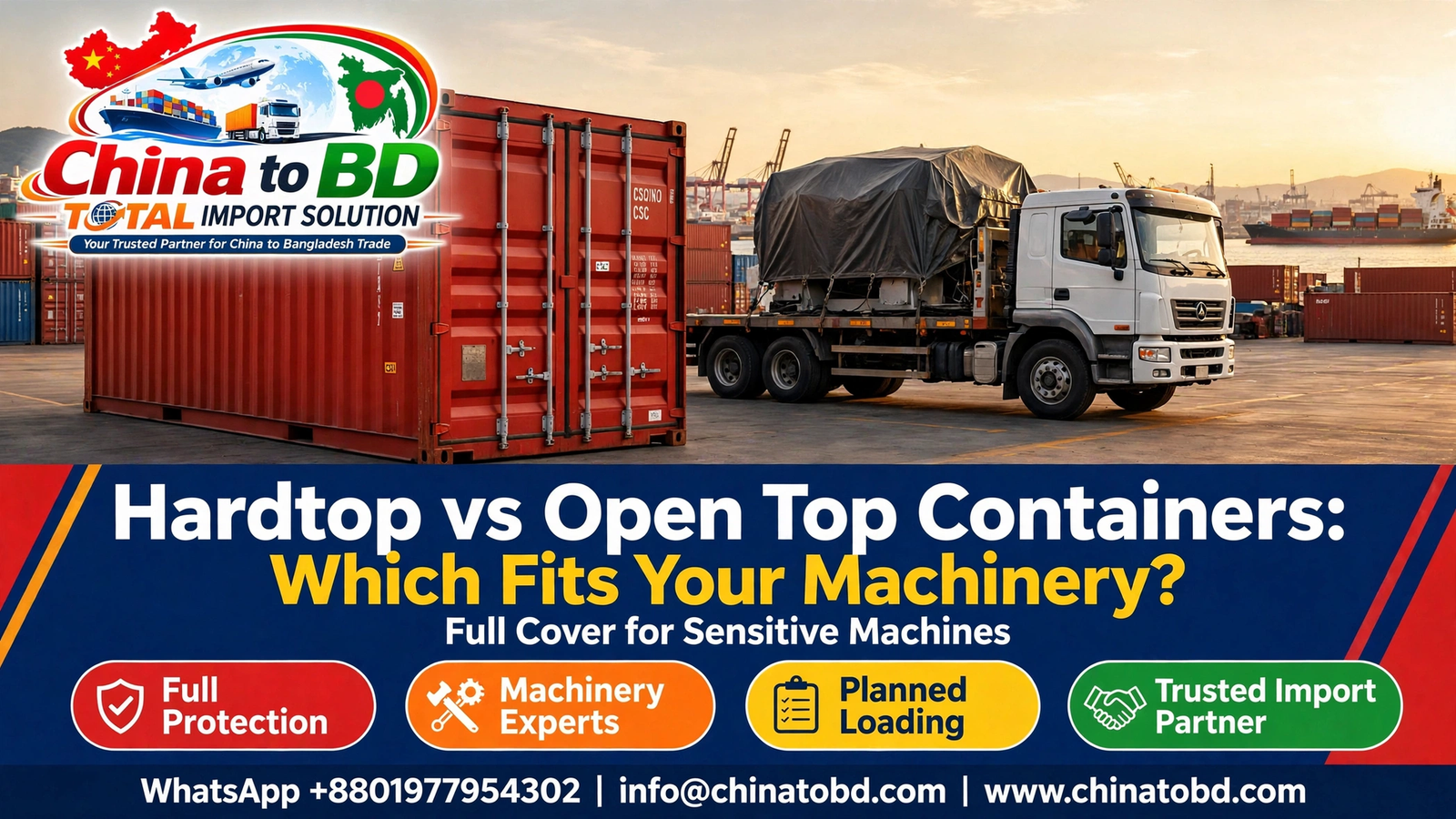
A hardtop container is a standard container with a solid steel roof that can be removed. The roof is lifted off by crane or by forklift, the machine is lowered into the container from above, and the roof is then lifted back on and locked in place. Once the roof is on, the container is a closed steel box, and the cargo inside is protected from rain, sea spray, dust, and sun in the same way as cargo in a standard container.
The solid roof is the main strength of the hardtop. It gives the machine full protection during the voyage, and it allows the container to be stacked like a standard container. The roof also keeps the load secure: once it is locked, the container cannot be opened from above without removing the roof, which needs lifting equipment. The importer should confirm that the roof fits correctly after loading, that every lock is engaged, and that the seals are in place.
The hardtop also has limits. The roof must be lifted off and put back on, which needs a crane or a forklift and a team that knows the work. The roof is heavy, and it must be placed safely on the ground while the machine is loaded, and lifted back on with care so that it is not damaged. The importer should confirm that the loading point has the equipment to handle the roof, and that the roof will be stored safely during loading. The hardtop also has a fixed inside height, so a machine that is taller than the inside of the container will not fit, even with the roof off.
What an Open Top Container Is
An open top container is a container with no fixed roof. In place of a roof it has a set of removable roof bows, which are steel bars that run across the top of the container, and a heavy tarpaulin cover that fits over the bows. The machine is lowered in from above by crane, the bows are fitted, and the tarpaulin is pulled over the top and tied down. The tarpaulin keeps rain and dust off the cargo, but it is a fabric cover, not a solid steel roof.
The open top is the most common choice for machinery that must be loaded from above. The loading is simple: the roof bows and the tarpaulin are removed, the machine is lowered in, and the cover is fitted again. There is no heavy steel roof to lift and store, and the loading team can work quickly. The open top also suits machinery that is slightly taller than a standard container, because the tarpaulin can be fitted over a load that rises a little above the top of the container walls, where the carrier agrees.
The open top also has limits. The tarpaulin is not as strong as a steel roof, and it can be torn by wind, by handling, or by a sharp edge on the cargo. The importer should agree the cover in advance, check the tarpaulin for tears before loading, and make sure that every tie-down is fixed firmly. The load should also be checked so that no sharp edge presses against the tarpaulin from inside. Where the machine is tall, the importer should confirm with the carrier that the height is accepted, and should agree the cover plan in writing.
Hardtop vs Open Top: The Differences That Matter
The two container types differ in protection, in loading, in height, and in stacking, and the table below sets out the differences side by side so that the importer can compare them against the machine.
| Point of comparison | Hardtop container | Open top container |
|---|---|---|
| Roof | Solid steel roof, lifted off and fitted back on | No fixed roof; tarpaulin cover over roof bows |
| Protection from weather | Full protection of a closed steel box | Tarpaulin keeps rain and dust off, but is fabric |
| Loading method | Machine lowered in from above by crane | Machine lowered in from above by crane |
| Roof handling | Heavy steel roof needs crane or forklift to lift | No heavy roof; bows and tarpaulin handled by the team |
| Height of cargo | Machine must fit the fixed inside height | Load can rise a little above the walls, where agreed |
| Stacking | Stacks like a standard container | Stacking depends on the load and the cover |
| Security | Roof locked; needs lifting gear to open from above | Tarpaulin tied down; easier to open from above |
| Cover check | Check the roof fit, the locks, and the seals | Check the tarpaulin for tears, and every tie-down |
The choice is rarely about which container is better in general. It is about which container fits the machine. A machine that needs full protection from rain and dust, and that fits the inside height, suits a hardtop. A machine that is slightly taller than a standard container, or that must be loaded quickly without roof handling, suits an open top. A machine with sharp edges that could tear a tarpaulin needs a hardtop, or needs the edges to be padded and covered before loading into an open top.
The importer should also consider the unloading point in Bangladesh. A hardtop needs the same crane or forklift at the unloading point to lift the roof off again, and a place to store the roof while the machine is unloaded. An open top needs only the team to remove the bows and the tarpaulin. If the unloading point has limited lifting equipment, the open top may be the simpler choice, and the importer should confirm the equipment at both ends before booking.
Which Machinery Suits Each Container
Machinery comes in many shapes, and the shape decides the container. Tall machines, such as vertical lathes, tall presses, and printing machines, often need top loading, and the choice between hardtop and open top depends on the height and the need for protection. Wide machines, such as wide looms and wide cutting tables, may also need top loading, because they cannot be pushed through a standard door without damage.
Heavy machines, such as generators, compressors, and engines, need a crane for loading, and the container must have a floor that can carry the weight. Both hardtop and open top containers have a strong floor, and the importer should confirm the floor strength and the weight spread with the carrier before booking. Sensitive machines, such as machines with exposed parts or with a finished surface, need protection from rain and dust, and a hardtop gives that protection more fully than a tarpaulin.
The table below lists the kinds of machinery that commonly travel in hardtop and open top containers from China to Bangladesh, and which container suits each kind.
| Machinery type | Which container suits it | Check before booking |
|---|---|---|
| Tall presses and vertical machines | Hardtop where the height fits; open top where it is taller | Full height, and the cover plan |
| Printing and textile machines | Hardtop for full protection; open top for quick loading | Height, width, and protection needs |
| Generators and engines | Either, where the floor strength and lifting points suit | Floor strength, lifting points, and weight spread |
| Wide looms and cutting tables | Open top for easy top loading of a wide load | Full width, and the crane plan |
| Machines with sharp edges | Hardtop, or open top with edges padded and covered | Edge protection, and tarpaulin check |
| Sensitive machines with finished surfaces | Hardtop for full protection from rain and dust | Roof fit, locks, and seals |
| Mixed machinery for one project | Either, matched to the tallest and widest item | Item list, and the loading order |
Before booking, measure the machine in full: length, width, height, and weight, including any base frame, cradle, or packing. Measure twice, and share the measurements with the carrier and the loading team in writing. A measurement that is wrong by a small amount can mean that the machine does not fit the container, or that the cover cannot be fitted. Photographs of the machine, with a measuring tape beside it, help the carrier and the loading team understand the real size of the load.
The importer should also confirm whether the machine can be taken apart. Some machines can be split into parts that fit a standard container, and that may be simpler than top loading. Other machines cannot be split without a specialist, and for those the hardtop or the open top is the right choice. For machinery that cannot be containerised at all, the planning is different again: the article Breakbulk Shipping from China to Bangladesh explains how oversized cargo is handled, and its guidance on planning the route, the equipment, and the handling in advance applies here as well. Ask the supplier in China whether the machine can be dismantled, and what tools and time that would need, before deciding on the container type.
Loading Planning for Machinery
Loading machinery from above needs a crane, a lifting plan, and a team that knows the work. The loading plan should be agreed before the day of loading, and it should name the machine, the lifting points, the crane, the slings or chains, the loading order, and the person in charge. The machine should be lifted slowly, with the load balanced, and lowered gently into the container, with a person guiding it from each side.
The machine should be placed so that its weight sits evenly on the floor, with the centre of gravity over the middle of the container where possible. Heavy parts should sit low, and the load should be supported with timber or dunnage where the plan calls for it, so that the weight is spread and the floor is protected. The machine should be lashed to the lashing points on the floor, with enough straps or chains to hold it against movement in every direction. The lashing should be tight, checked by hand, and checked again after the first movement of the container.
For a hardtop, the roof is lifted off before loading, stored safely on the ground, and lifted back on after the machine is lashed. The roof must fit correctly, every lock must be engaged, and the seals must be in place. For an open top, the roof bows and the tarpaulin are removed before loading, and fitted again after the machine is lashed. The tarpaulin must be checked for tears, pulled tight, and tied down firmly, with no sharp edge pressing against it from inside.
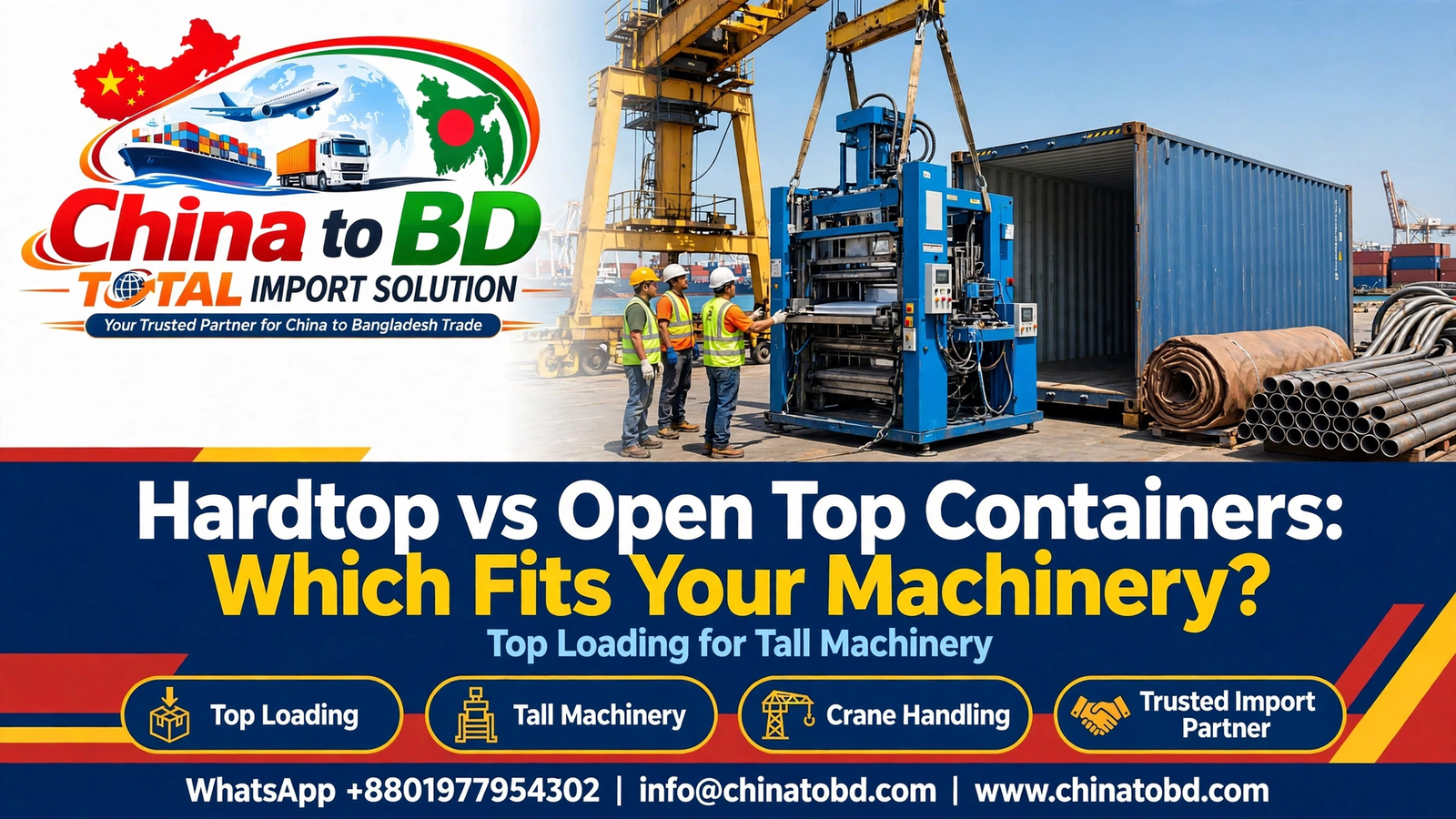
The supplier should send loading photos showing the machine in the container, the lashing, and the cover, from several angles. Keep these photos with the packing list, so the team in Bangladesh knows what to expect when the container arrives, and can prepare the right crane, labour, and floor space. The photos also serve as a record of the condition of the machine at loading, which is useful if a question about damage arises later.
Unloading in Bangladesh needs the same care. The unloading point must have a crane that can lift the full weight of the machine, a firm and level surface, and enough space for the truck, the crane, and the machine once it is out of the container. For a hardtop, the unloading point must also have the equipment to lift the roof off and store it safely. The team should agree the lifting points in advance, lift slowly, and check that the load is balanced before moving it. The machine should be placed on timber or on a prepared surface, counted and checked against the packing list at once, with any damage or shortage noted in writing and photographed.
Before the vessel arrives, confirm the unloading depot as well. In Bangladesh, containers are commonly unloaded at Chittagong off-dock ICDs or at Dhaka inland depots, and the right choice depends on where the machine is going and what equipment the depot has. Ask the transporter to confirm the depot in writing, check that it has the crane, the floor space, and the roof storage the machine needs, and share the depot name and the unloading date with the warehouse and the customs broker in advance.
Documents and Customs Checks
Machinery in a hardtop or open top container needs the same core documents as any import from China to Bangladesh. The commercial invoice describes the goods, the quantity, and the value for customs purposes. The packing list describes how the goods are packed, how many packages there are, and what is inside each package. The bill of lading is the transport document issued by the carrier, and it must match the invoice and the packing list. The certificate of origin, where required, states where the goods were made.
For machinery, the documents should also show the full dimensions and the weight of each machine, because customs and the port need to know what is being handled. The packing list should name the base frame, cradle, or support timber as separate items where they travel with the machine. If the machine needs a special permit, a technical certificate, or an inspection for the exact type of machine, the importer should confirm the requirement with the customs broker before shipment, and should allow time for the paper to be issued.
| Document or check | Purpose | Common error to avoid |
|---|---|---|
| Commercial invoice | Describes goods, quantity, and value | Value or description that does not match the machine |
| Packing list | Describes packages, dimensions, and contents | Dimensions or weight missing for a machine |
| Bill of lading | Transport document from the carrier | Consignee name or port that does not match the booking |
| Certificate of origin | States where goods were made | Missing certificate for goods that require one |
| Dimension and weight sheet | Shows the full size and weight of each machine | Measurements that do not match the actual machine |
| Loading and lashing plan | Shows how the machine is secured | Plan not shared with the carrier before loading |
| Import registration and tax papers | Confirms the importer is registered | Expired or incomplete registration |
| Customs duty handling | Payment and clearance for the cargo | Duty position not confirmed before arrival |
The importer should also keep the import registration, tax identification, and bank documents ready, and confirm with the customs broker which papers must be presented in original and which as a copy. The shipment file should hold every paper in one place, with a copy kept separately.
Customs checks in Bangladesh follow the documents. An officer may check the papers, ask for a clarification, or ask for a physical check of the machine. The customs broker should have the full document set and the contact numbers of the importer and the warehouse, and the importer should be ready to answer questions about the machine, the supplier, and its intended use. Before the vessel arrives, complete a short document review with the customs broker: confirm that the invoice, the packing list, and the bill of lading agree, that the consignee name is spelled the same way on every document, that the port of discharge is correct, and that the dimensions and weight on the papers match the machine.
Cost Factors to Confirm at Booking
The cost of a hardtop or open top shipment is made up of several parts, and each part should be confirmed at booking. Ocean freight is the cost of moving the container from the port in China to the port in Bangladesh. Port charges cover the handling of the container at each port, and top-loaded cargo may need extra handling that should be confirmed in advance. Customs duty and tax are set by the customs rules for the exact goods, and the importer should confirm the duty position with the customs broker before booking. Transport covers the movement of the container from the port to the unloading point and the return of the empty container. Crane charges cover the lifting of the machine and, for a hardtop, the lifting of the roof. Labour covers the lashing, securing, covering, and checking. Container rental covers the use of the container for the agreed period.
Each part can change if the plan changes, so ask at booking what happens if the machine size changes, if the loading date moves, or if the unloading point changes. Ask which charges are included in the quotation and which are separate, and read the quotation line by line. No figure in this article is presented as a price, because the cost depends on the machine, the route, the container, the rental period, and the handling plan. For a figure for a specific shipment, share the machine list with dimensions and weight, the loading point, the unloading point, and the loading dates with China to BD | Total Import Solution and ask for a written quotation. Contact the helpline at +8801977954302 or email info@chinatobd.com.
Planning the return of the empty container in advance, and booking the transport before the vessel sails, saves time at the port. The article Zero Demurrage Shipping: Rent Containers for Extended Offloading explains how time at the port is planned so that the container is not left waiting, and its guidance on booking transport, labour, and the return in advance applies to machinery shipments as well.
Common Mistakes
- Booking the container before the machine is measured in full, so the machine does not fit the container or the cover cannot be fitted. Measure the machine first, and share the measurements in writing.
- Choosing an open top for a machine with sharp edges, without padding the edges. Pad every sharp edge, or choose a hardtop.
- Not checking the tarpaulin for tears before loading an open top, so rain reaches the machine. Check the tarpaulin, and ask for another one if it is torn.
- Not confirming that the unloading point can lift the hardtop roof off again. Check the crane and the roof storage at both ends before booking.
- Loading the machine off centre, so the weight sits unevenly on the floor and the load can shift. Place the weight evenly, with the centre of gravity over the middle of the container.
- Using too few straps or chains, or lashing to weak points. Use the lashing points on the floor, and check every lashing by hand.
- Forgetting the return of the empty container. Book the return transport at the same time as the delivery transport, and name the return point and date.
- Not sharing a change with every party. Share any change at once, in writing, with the supplier, the carrier, the transporter, the warehouse, and the customs broker.
Pre-Shipment and Loading Checklist
Copy this table into the shipment file and mark each item as it is completed. Complete the pre-shipment items before the vessel sails, and the loading items before the container leaves the loading point.
| Check | When | Done |
|---|---|---|
| Machine measured in full, with dimensions and weight in writing | Before booking | |
| Container type chosen: hardtop or open top, matched to the machine | Before booking | |
| Roof handling confirmed: crane for the hardtop roof at both ends | Before booking | |
| Tarpaulin checked for tears, where an open top is used | Before booking | |
| Lashing and securing plan agreed, with gear named | Before booking | |
| Rental terms received in writing, with period and return point | Before booking | |
| Transport and crane booked in Bangladesh, with date and time | Before sailing | |
| Customs broker named, with full document set shared | Before sailing | |
| Invoice, packing list, and bill of lading checked against each other | Before sailing | |
| Loading order and lifting points agreed with the supplier | Before loading | |
| Loading photos requested, from several angles | At loading | |
| Roof or tarpaulin fitted and checked, with seals in place | At loading | |
| Machine counted and checked on arrival, with damage noted at once | At unloading | |
| Empty container returned to the named point, with receipt | After unloading |
Frequently Asked Questions
Q1: What is a hardtop container?
A hardtop container is a standard container with a solid steel roof that can be removed. The roof is lifted off by crane or forklift, the machine is lowered in from above, and the roof is then lifted back on and locked, giving the cargo the protection of a closed steel box.
Q2: What is an open top container?
An open top container has no fixed roof. It has removable roof bows and a heavy tarpaulin cover. The machine is lowered in from above by crane, the bows are fitted, and the tarpaulin is pulled over the top and tied down.
Q3: Which container gives better protection from rain?
A hardtop gives the full protection of a closed steel box, because its roof is solid steel. An open top gives the protection of a tarpaulin, which keeps rain and dust off but is fabric, not steel, and can be torn.
Q4: Which container suits a machine that is taller than a standard container?
An open top suits a machine that is slightly taller than a standard container, because the tarpaulin can be fitted over a load that rises a little above the top of the container walls, where the carrier agrees. A hardtop needs the machine to fit the fixed inside height.
Q5: How is machinery loaded into a hardtop or open top container?
The machine is lowered in from above by crane, with a lifting plan that names the lifting points, the crane, the slings or chains, and the person in charge. The machine is then lashed to the lashing points on the floor, and the roof or the tarpaulin is fitted.
Q6: What should I check on the tarpaulin of an open top container?
Check the tarpaulin for tears before loading, pull it tight after loading, and tie down every fixing firmly. Make sure no sharp edge on the machine presses against the tarpaulin from inside, and pad any sharp edge before loading.
Q7: What should I check on the roof of a hardtop container?
Confirm that the roof fits correctly after loading, that every lock is engaged, and that the seals are in place. Confirm that the loading point and the unloading point both have the equipment to lift the roof off and store it safely.
Q8: Which machinery suits a hardtop container?
Machines that need full protection from rain and dust, and that fit the inside height, suit a hardtop. Sensitive machines with finished surfaces, and machines with sharp edges that could tear a tarpaulin, also suit a hardtop.
Q9: Which machinery suits an open top container?
Machines that are slightly taller than a standard container, wide machines that need top loading, and machines where quick loading without roof handling matters, suit an open top. The tarpaulin must be checked, and sharp edges must be padded.
Q10: What documents do I need for a machinery shipment to Bangladesh?
The main documents are the commercial invoice, the packing list, the bill of lading, and the certificate of origin where required. The papers should also show the full dimensions and weight of each machine, and any special permit or certificate for the exact machine.
Q11: How should I plan unloading machinery in Bangladesh?
The unloading point must have a crane that can lift the full weight, a firm and level surface, and enough space for the truck, the crane, and the machine. For a hardtop, the unloading point must also have the equipment to lift the roof off and store it safely.
Q12: Can a machine be taken apart instead of using a hardtop or open top container?
Some machines can be split into parts that fit a standard container, and that may be simpler than top loading. Ask the supplier whether the machine can be dismantled, and what tools and time that would need, before deciding on the container type.
Q13: What happens if the machine is measured wrongly?
A wrong measurement can mean that the machine does not fit the container, that the roof or the tarpaulin cannot be fitted, or that the load cannot be accepted for the vessel. Measure the machine in full, measure twice, and share the measurements in writing.
Q14: Which cost factors should I confirm before booking a hardtop or open top shipment?
Confirm the ocean freight, port charges, customs duty and tax, transport, crane charges, labour, and container rental. Ask which charges are included in the quotation, which are separate, and what happens if the plan changes.
Q15: What are the most common mistakes with hardtop and open top shipments?
The most common mistakes are booking before the machine is measured, choosing an open top for a machine with sharp edges without padding them, not checking the tarpaulin, not confirming roof handling at the unloading point, and forgetting the return of the empty container.
Q16: How can China to BD | Total Import Solution help choose between a hardtop and an open top container?
China to BD | Total Import Solution has supported importers from China to Bangladesh since 2016, with sourcing, shipping, customs handling, warehousing, and delivery. The team can help measure the machine, compare the two container types, agree the loading and cover plan, and plan transport and unloading.
Contact China to BD | Total Import Solution
For a written plan and quotation for hardtop or open top container leasing for machinery, contact China to BD | Total Import Solution. Share the machine list with dimensions and weight, the loading point in China, the unloading point in Bangladesh, and the loading dates, so the plan can be based on the actual shipment.
- Brand: China to BD | Total Import Solution
- Company: Total Import Solution, since 2016
- Helpline: +8801977954302
- Email: info@chinatobd.com
- Website: www.chinatobd.com
- Warehouse & Office: House 38A, Mendi Dental College Road, Road 11, Dhanmondi Riverview Model Town, Dhaka 1209
Call the helpline at +8801977954302 or email info@chinatobd.com to discuss a shipment from China to Bangladesh, to confirm a hardtop or open top container for machinery, or to check a document list before the vessel sails.
Get a Quotation for Your Shipment
To plan a hardtop or open top container shipment for machinery, share the machine list with dimensions and weight, the loading point in China, the unloading point in Bangladesh, and the loading dates with China to BD | Total Import Solution, and ask for a written quotation.
WhatsApp +8801977954302 | Call +8801977954302 | Email info@chinatobd.com
About the Author