ISO Tank Container Hire for Chemical & Liquid Cargo to Bangladesh
ISO Tank Container Hire for Chemical & Liquid Cargo to Bangladesh
Liquid cargo does not travel the way dry cargo travels. A chemical, an edible oil, a solvent, a resin, or a liquid raw material cannot be packed into cartons and stacked in a dry container. It needs a sealed tank that holds it safely, keeps it clean, and allows it to be loaded and discharged without spillage or contamination. For importers bringing liquid cargo from China to Bangladesh, the ISO tank container is the equipment built for this work.
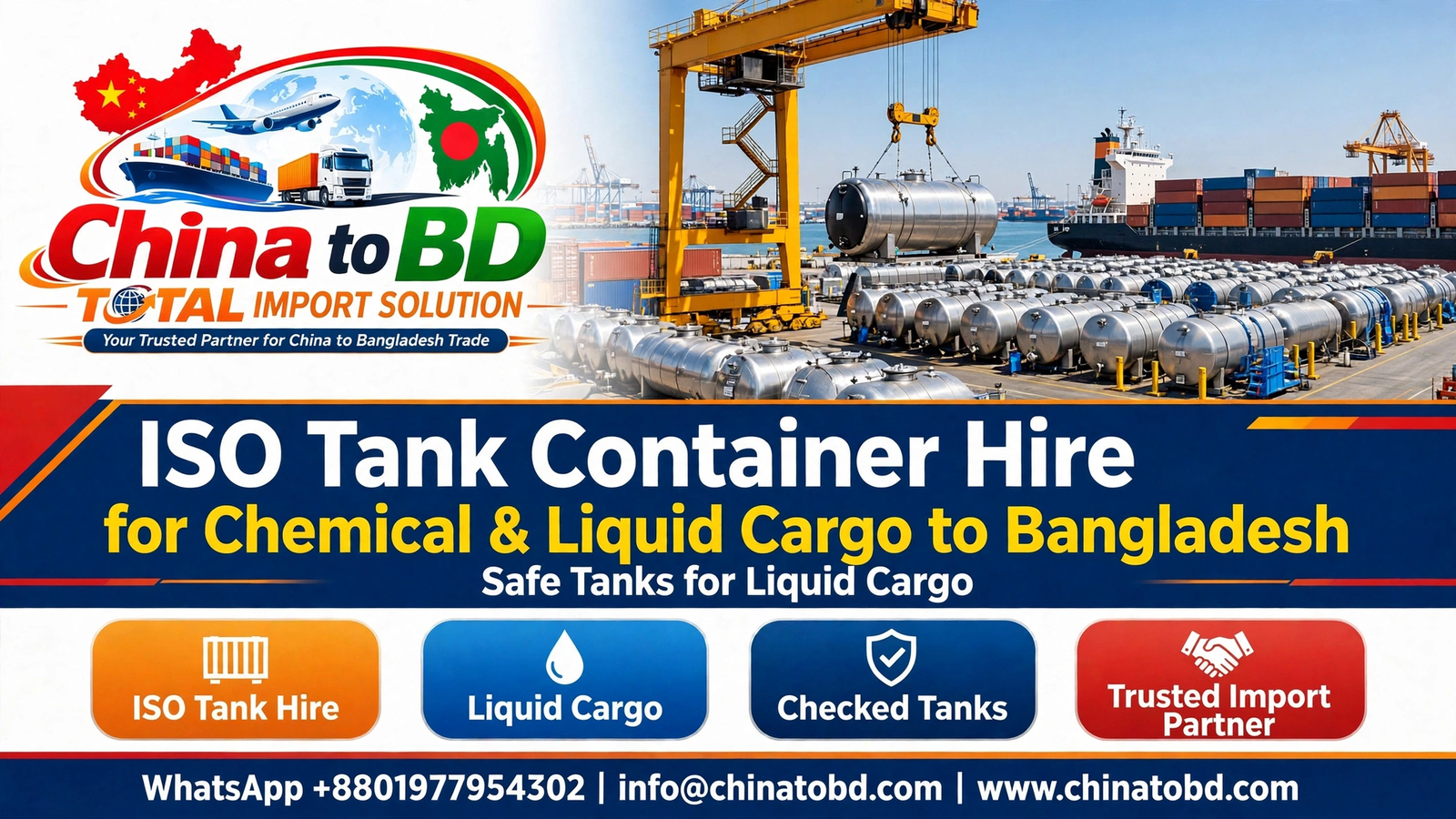
An ISO tank container is a tank mounted inside a steel frame that has the same outside size as a standard container. The tank holds the liquid, and the frame lets the tank be lifted, stacked, and carried by truck, rail, and vessel in the same way as a normal container. The tank has a manhole on top for loading and inspection, a valve at the bottom for discharge, and fittings that the loading and discharge teams use to connect hoses and check the tank.
Hiring an ISO tank, rather than buying one, suits importers who move liquid cargo from time to time, or who move different liquids that need different tanks. The importer hires the tank for one shipment, or for a short series of shipments, and returns it when the cargo is discharged. This article explains, in practical steps, what an ISO tank is, which liquids travel in one, why hiring suits liquid cargo, which tank options exist, which documents and checks to confirm, how loading and discharge are planned, which cost factors to confirm, which mistakes to avoid, and which checks to complete before the shipment leaves China for Bangladesh.
China to BD | Total Import Solution has supported importers from China to Bangladesh since 2016, with sourcing, shipping, customs handling, warehousing, and delivery. The steps here follow the order used in a real shipment: confirm the liquid and its handling needs, choose the tank, agree the cleaning and loading plan, prepare the papers, and only then confirm the booking. For help, call +8801977954302, email info@chinatobd.com, or visit www.chinatobd.com. The warehouse and office are at House 38A, Mendi Dental College Road, Road 11, Dhanmondi Riverview Model Town, Dhaka 1209.
What an ISO Tank Container Is
An ISO tank container is a cylindrical tank held inside a rectangular steel frame. The frame gives the tank its container shape, so that it can be handled with the same cranes, trucks, and stacking equipment used for standard containers. The tank itself is made of a material chosen to suit the liquid it will carry, and the importer should confirm with the tank provider that the tank material suits the exact liquid before booking.
The tank has several parts that the importer should know by name. The manhole on the top is the opening used for loading, inspection, and cleaning. The bottom valve is used for discharge, and it is fitted with a cap and a seal. The frame carries the lifting points used by cranes, and it carries the plates and marks that identify the tank. The tank may also have a heating or cooling arrangement, and a pressure relief fitting, where the cargo needs them. The importer does not need to set these fittings, but should ask the tank provider to confirm that the tank is fitted for the exact cargo, and that the fittings have been checked.
The most important fact about an ISO tank is that it is dedicated to the cargo it carries. A tank that carried one liquid cannot simply be filled with another liquid. It must be cleaned, and the cleaning must be recorded, before it is used again. The importer should ask for the cleaning record of the tank before loading, and should confirm that the previous cargo is named on the record. A tank with no cleaning record, or a record that does not name the previous cargo, should not be accepted.
The tank should also be inspected before loading. The inspection checks the tank shell, the valves, the seals, the manhole, the frame, and the fittings, and it confirms that the tank is clean, dry, and odour free. The inspection should be done by the loading team or by the tank provider, and the result should be noted in writing. A tank that shows damage, a leaking valve, or a smell from a previous cargo should be refused, and another tank should be requested.
Which Liquids Travel in ISO Tanks
Many kinds of liquid cargo travel from China to Bangladesh in ISO tanks. Chemicals for factories, resins for manufacturing, solvents, liquid raw materials for garments and textiles, edible oils, food ingredients in liquid form, and liquid additives for agriculture are all common. The common point is that the cargo is liquid, and that it needs a sealed, clean tank rather than a dry box.
Liquids differ from each other in ways that matter for the tank. Some liquids need a tank made of a particular material. Some need the tank to be heated or kept cool during the voyage. Some need the tank to be filled to a particular level, and not to the brim. Some need the discharge to be done with a particular kind of pump or hose. The importer should therefore share the full details of the liquid with the tank provider and the carrier before booking: the name of the liquid, the safety data sheet provided by the manufacturer, the handling notes, and any instruction from the supplier about temperature, filling, or discharge.
The table below lists the kinds of liquid cargo that commonly travel in ISO tanks, and what the importer should check for each kind.
| Liquid cargo type | Why it needs an ISO tank | Check before booking |
|---|---|---|
| Industrial chemicals | Sealed tank protects the liquid and the handlers | Safety data sheet, tank material, and handling notes |
| Resins and liquid raw materials | Clean tank keeps the product free of contamination | Cleaning record, previous cargo, and tank condition |
| Solvents | Sealed tank prevents spillage and vapour loss | Valve and seal condition, and discharge method |
| Edible oils | Clean, food-safe tank protects the product | Cleaning record, previous cargo, and odour check |
| Liquid food ingredients | Sealed tank keeps the product clean and safe | Cleaning record, and the rules for the exact product |
| Liquid additives for agriculture | Tank suits bulk liquid in one load | Tank material, filling level, and discharge plan |
| Liquid cargo for garments and textiles | Bulk liquid arrives ready for use | Handling notes from the supplier, and tank condition |
Before booking a tank, the importer should also confirm whether the liquid is classed as hazardous. Some liquids are classed as hazardous, and some are not, and the classification decides which rules apply to the shipment, which documents are needed, and which handling applies at the port. The importer should ask the supplier for the classification of the exact liquid, and should confirm it with the carrier and the customs broker. Do not guess the classification, and do not book a tank for a liquid whose classification has not been confirmed in writing.
Why Hire an ISO Tank for Liquid Cargo
Liquid cargo is usually ordered in bulk, and the volume varies from order to order. One order may fill a tank, the next may need two tanks, and the order after that may be a different liquid that needs a different tank. Buying a tank for this pattern ties up money in equipment that may not suit the next liquid, and the importer must also arrange cleaning, inspection, maintenance, and storage for the tank between orders. Hiring fits this pattern: the importer hires the tank that suits the exact liquid for that shipment, and returns it when the cargo is discharged.
Hiring also puts the cleaning and inspection of the tank in the hands of the tank provider, who cleans and checks the tank as part of the hire. The importer still has a duty to ask for the cleaning record and to check the tank before loading, but the work of cleaning and maintaining the tank is not the importer's own work. The importer should confirm at booking what the hire covers: the tank, the cleaning, the inspection, the delivery to the loading point, and the return after discharge.
For importers who also move oversized cargo, the planning habit is the same: share the full details early, and confirm the equipment in writing. The article Breakbulk Shipping from China to Bangladesh explains how oversized cargo is planned with the carrier and the port in advance, and the same habit of early, written confirmation applies to liquid cargo in an ISO tank.
ISO Tank Options and Hire Steps
ISO tanks are not all the same. The right choice depends on the liquid, the volume, the handling needs, and the route. The main options are listed in the table below, and the importer should compare them against the liquid details before booking.
| Tank option | Suits | Check before booking |
|---|---|---|
| Standard ISO tank | General liquid cargo in one bulk load | Tank material, cleaning record, and valve condition |
| Tank with heating arrangement | Liquid that must be kept warm for discharge | Heating method, and who controls it during the voyage |
| Tank with cooling arrangement | Liquid that must be kept cool during the voyage | Cooling method, and how it is checked |
| Tank with a lined interior | Liquid that needs extra protection from the tank shell | Lining condition, and the cleaning record |
| Tank for food-grade liquid | Edible oils and liquid food ingredients | Cleaning record, previous cargo, and odour check |
| Tank for a single product type | Liquid that needs a dedicated tank | Previous cargo record, and the cleaning method |
| Larger volume tank | Bigger single orders of liquid cargo | Fill level, weight, and discharge plan |
Follow these steps in order, completing each one before the next is confirmed.
- List the liquid in full. Write the name of the liquid, the volume, the safety data sheet from the manufacturer, and any handling note from the supplier. Share this list with the tank provider and the carrier.
- Confirm whether the liquid is classed as hazardous. Ask the supplier for the classification, and confirm it with the carrier and the customs broker. Do not book until the classification is confirmed in writing.
- Choose the tank type. Match the choice to the liquid, the volume, and the handling needs. Confirm the tank material, the fittings, and the cleaning record in writing.
- Ask for the cleaning record. Confirm the previous cargo, the cleaning method, and the date of cleaning. Refuse a tank with no record, or a record that does not name the previous cargo.
- Inspect the tank before loading. Check the shell, the valves, the seals, the manhole, the frame, and the fittings. Note the result in writing, and refuse a tank that shows damage, a leak, or a smell.
- Agree the loading plan. Name the loading point, the team, the hoses, the pump, and the person in charge. Confirm the fill level agreed with the carrier.
- Ask for the hire terms in writing. Confirm the hire period, the delivery point in China, the return point in Bangladesh, the required condition on return, and the contact person for changes.
- Prepare the documents. Use the checklist in the documents section, and keep the originals and the copies in one file. Do not leave a document to be collected on the day of loading.
- Confirm the discharge plan in Bangladesh. Book the discharge team, the pump, the hoses, and the receiving tank or storage, and share the date and time with the warehouse.
- Share the full plan with every party: the same liquid details, dates, addresses, and contact numbers to the supplier, the carrier, the transporter, the warehouse, and the customs broker.
When the liquid needs special handling, or when the discharge needs a particular kind of pump or storage, the planning steps are the same, but the checks need more time. The article Zero Demurrage Shipping: Rent Containers for Extended Offloading explains how time at the port is planned so that the container is not left waiting, and its guidance on booking transport, labour, and the return of the empty container in advance applies to ISO tanks as well.
Documents and Checks Before Booking
Liquid cargo in an ISO tank needs the same core documents as any import from China to Bangladesh, and a few extra checks because the cargo is liquid. The commercial invoice describes the goods, the quantity, and the value for customs purposes. The packing list describes the goods and the volume. The bill of lading is the transport document issued by the carrier, and it must match the invoice and the packing list. The certificate of origin, where required, states where the goods were made.
For liquid cargo, the documents should also include the safety data sheet provided by the manufacturer, which describes the liquid, its handling, and what to do if there is a spill. If the liquid is classed as hazardous, the importer should confirm with the carrier and the customs broker which extra documents are required for the exact liquid, and should allow time for them to be prepared. If the liquid is a food product, the importer should confirm which extra checks apply for the exact product, and should allow time for them as well. Do not assume that the documents for one liquid are the same as the documents for another.
| Document or check | Purpose | Common error to avoid |
|---|---|---|
| Commercial invoice | Describes goods, quantity, and value | Value or description that does not match the cargo |
| Packing list | Describes goods and volume | Volume that does not match the tank and the fill level |
| Bill of lading | Transport document from the carrier | Consignee name or port that does not match the booking |
| Certificate of origin | States where goods were made | Missing certificate for goods that require one |
| Safety data sheet | Describes the liquid and its handling | Sheet missing, or for a different product |
| Hazard classification | States how the liquid is classed | Classification guessed, not confirmed in writing |
| Tank cleaning record | Shows the previous cargo and the cleaning | Record missing, or previous cargo not named |
| Import registration and tax papers | Confirms the importer is registered | Expired or incomplete registration |
| Customs duty handling | Payment and clearance for the cargo | Duty position not confirmed before arrival |
The importer should also keep the import registration, tax identification, and bank documents ready, and confirm with the customs broker which papers must be presented in original and which as a copy. The shipment file should hold every paper in one place, with a copy kept separately.
Customs checks in Bangladesh follow the documents. An officer may check the papers, ask for a clarification, or ask for a sample or a check of the cargo. The customs broker should have the full document set, the safety data sheet, and the contact numbers of the importer and the discharge team, and the importer should be ready to answer questions about the liquid, the supplier, and its intended use. Before the vessel arrives, complete a short document review with the customs broker: confirm that the invoice, the packing list, and the bill of lading agree, that the consignee name is spelled the same way on every document, that the port of discharge is correct, and that the volume on the papers matches the tank and the fill level.
Loading and Discharge Planning
Loading an ISO tank is done through the manhole on top, or through a loading connection, depending on the tank and the liquid. The loading team connects the hoses, checks the seals, and fills the tank to the fill level agreed with the carrier. The tank should not be filled beyond that level, because the liquid needs space inside the tank, and the loading team should confirm the level as the filling proceeds. The loading should be done slowly, with the team watching for leaks at every connection.
The loading team should check the tank before filling: the shell, the valves, the seals, the manhole, and the fittings. The tank should be clean, dry, and odour free, and the cleaning record should name the previous cargo. If the tank shows damage, a leaking valve, or a smell from a previous cargo, the loading should stop, and another tank should be requested. The supplier should send loading photos showing the tank, the connections, and the seals, and these photos should be kept with the packing list.
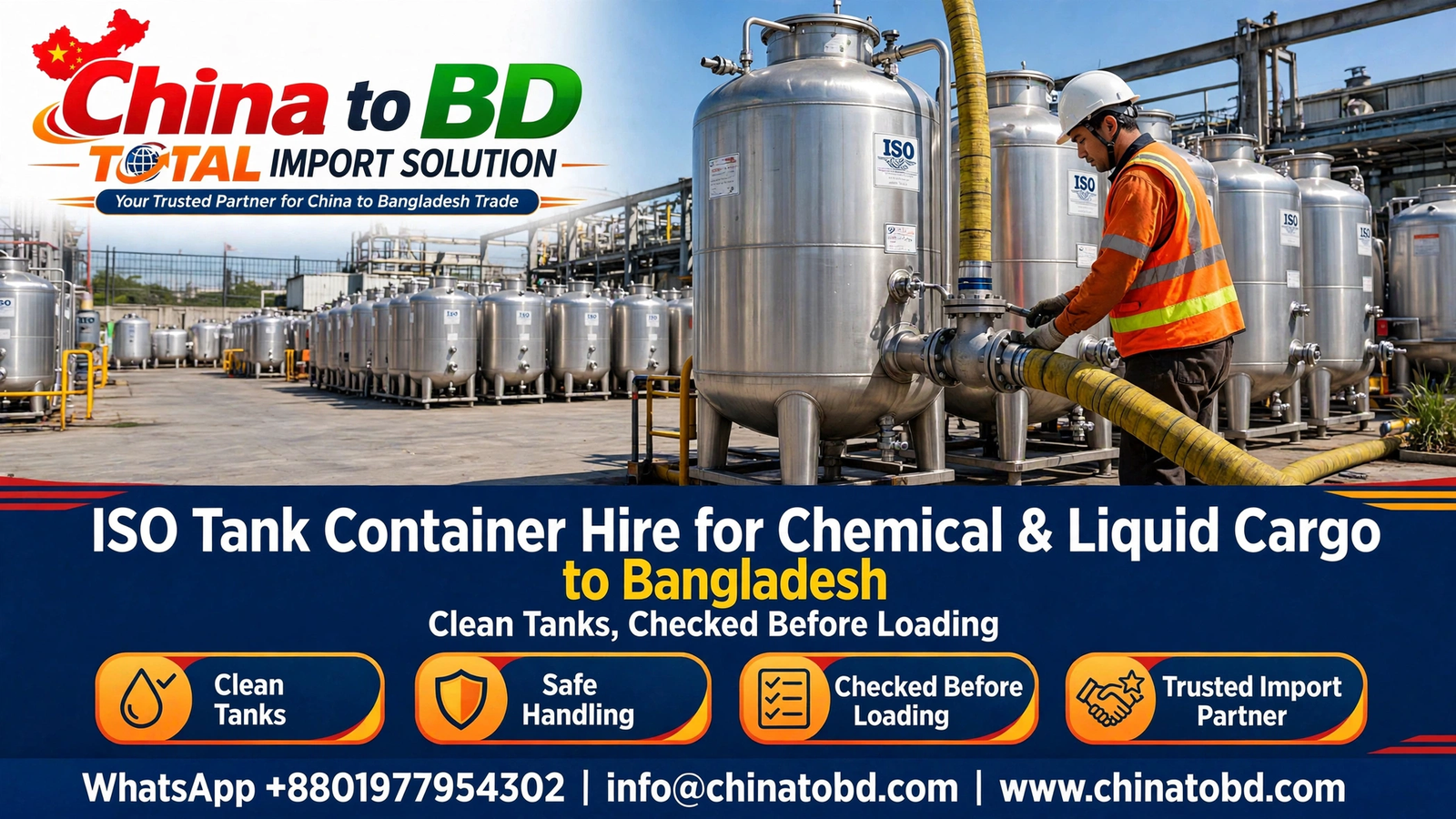
Discharge in Bangladesh needs the same care. The discharge point must have the pump, the hoses, and the receiving tank or storage ready before the ISO tank arrives. The discharge team connects the bottom valve, checks the seals, and discharges the liquid into the receiving storage. The discharge should be done slowly, with the team watching for leaks at every connection, and with a spill kit and a named person in charge of safety at the site. The receiving storage should be clean, dry, and ready for the exact liquid, and its capacity should be confirmed before the discharge begins.
After discharge, the tank should be checked again. The discharge team should confirm that the tank is empty, that the valves are closed, and that the seals are in place. The empty tank should then be returned to the named point, in the required condition, with a receipt for the return. The importer should keep a note of the volume discharged, and should compare it with the volume on the papers. Any difference should be noted in writing at once, with the discharge team informed on the same day.
Cost Factors to Confirm at Booking
The cost of an ISO tank shipment is made up of several parts, and each part should be confirmed at booking. Ocean freight is the cost of moving the tank from the port in China to the port in Bangladesh. Port charges cover the handling of the tank at each port, and liquid cargo may need extra handling that should be confirmed in advance. Customs duty and tax are set by the customs rules for the exact goods, and the importer should confirm the duty position with the customs broker before booking. Transport covers the movement of the tank from the port to the discharge point and the return of the empty tank. Loading and discharge charges cover the pump, the hoses, the team, and the receiving storage. Tank hire covers the use of the tank for the agreed period, including cleaning and inspection where the hire terms say so.
Each part can change if the plan changes, so ask at booking what happens if the volume changes, if the loading date moves, or if the discharge point changes. Ask which charges are included in the quotation and which are separate, and read the quotation line by line. No figure in this article is presented as a price, because the cost depends on the liquid, the volume, the route, the tank, the hire period, and the handling plan. For a figure for a specific shipment, share the liquid details with the safety data sheet, the volume, the loading point, the discharge point, and the loading dates with China to BD | Total Import Solution and ask for a written quotation. Contact the helpline at +8801977954302 or email info@chinatobd.com.
Common Mistakes
- Booking the tank before the liquid is confirmed in full, so the tank material or the fittings do not suit the exact liquid. Share the liquid details and the safety data sheet first.
- Accepting a tank with no cleaning record, or a record that does not name the previous cargo. Ask for the record, and refuse a tank that does not have one.
- Guessing whether the liquid is classed as hazardous, instead of confirming the classification in writing with the supplier, the carrier, and the customs broker.
- Filling the tank beyond the agreed fill level. Confirm the level with the carrier, and check it as the filling proceeds.
- Leaving the discharge plan until the tank arrives, so the pump, the hoses, and the receiving storage are not ready. Book the discharge team and the storage before the vessel sails.
- Not checking the valves and seals before loading and before discharge. Check every seal and valve, and note the result in writing.
- Forgetting the return of the empty tank. Book the return transport at the same time as the delivery transport, and name the return point and date.
- Not sharing a change with every party. Share any change at once, in writing, with the supplier, the carrier, the transporter, the warehouse, and the customs broker.
Pre-Shipment and Discharge Checklist
Copy this table into the shipment file and mark each item as it is completed. Complete the pre-shipment items before the vessel sails, and the discharge items before the tank arrives.
| Check | When | Done |
|---|---|---|
| Liquid listed in full, with safety data sheet from the manufacturer | Before booking | |
| Hazard classification confirmed in writing | Before booking | |
| Tank type chosen, and tank material confirmed for the exact liquid | Before booking | |
| Tank cleaning record received, with previous cargo named | Before booking | |
| Hire terms received in writing, with period and return point | Before booking | |
| Discharge team, pump, hoses, and receiving storage booked | Before sailing | |
| Customs broker named, with full document set shared | Before sailing | |
| Invoice, packing list, and bill of lading checked against each other | Before sailing | |
| Tank inspected before loading, with result noted in writing | At loading | |
| Fill level confirmed with the carrier, and checked during filling | At loading | |
| Loading photos requested, showing the tank and the seals | At loading | |
| Volume discharged compared with the volume on the papers | At discharge | |
| Empty tank returned to the named point, with receipt | After discharge |
Frequently Asked Questions
Q1: What is an ISO tank container?
An ISO tank container is a tank mounted inside a steel frame that has the same outside size as a standard container. The tank holds the liquid, and the frame lets the tank be lifted, stacked, and carried by truck, rail, and vessel in the same way as a normal container.
Q2: Which liquids can travel in an ISO tank?
Industrial chemicals, resins, solvents, edible oils, liquid food ingredients, liquid additives for agriculture, and liquid raw materials for garments and textiles commonly travel in ISO tanks. The tank must suit the exact liquid, so share the liquid details with the tank provider before booking.
Q3: Why should I hire an ISO tank instead of buying one?
Hiring suits importers who move liquid cargo from time to time, or who move different liquids that need different tanks. The importer hires the tank that suits the exact liquid for that shipment and returns it when the cargo is discharged, instead of owning a tank that may not suit the next liquid.
Q4: How do I know if my liquid is classed as hazardous?
Ask the supplier for the classification of the exact liquid, and confirm it with the carrier and the customs broker. Do not guess the classification, and do not book a tank for a liquid whose classification has not been confirmed in writing.
Q5: Why is the tank cleaning record important?
A tank that carried one liquid cannot simply be filled with another liquid. It must be cleaned, and the cleaning must be recorded, before it is used again. Ask for the cleaning record, confirm that it names the previous cargo, and refuse a tank with no record.
Q6: What should I check when the tank is inspected before loading?
Check the tank shell, the valves, the seals, the manhole, the frame, and the fittings. The tank should be clean, dry, and odour free. Note the result in writing, and refuse a tank that shows damage, a leaking valve, or a smell.
Q7: How full should an ISO tank be filled?
The tank should be filled to the fill level agreed with the carrier, and not beyond it, because the liquid needs space inside the tank. Confirm the level with the carrier, and check it as the filling proceeds.
Q8: What documents do I need for an ISO tank shipment to Bangladesh?
The main documents are the commercial invoice, the packing list, the bill of lading, and the certificate of origin where required. The papers should also include the safety data sheet for the exact liquid, and any extra documents required for its classification, confirmed with the carrier and the customs broker.
Q9: How is an ISO tank loaded in China?
Loading is done through the manhole on top, or through a loading connection, depending on the tank and the liquid. The loading team connects the hoses, checks the seals, and fills the tank to the agreed level, watching for leaks at every connection.
Q10: How is an ISO tank discharged in Bangladesh?
Discharge is done through the bottom valve, with a pump and hoses, into receiving storage that is clean, dry, and ready for the exact liquid. The discharge team checks the seals, discharges slowly, and watches for leaks at every connection.
Q11: What should the discharge point have ready before the tank arrives?
The discharge point should have the pump, the hoses, the receiving storage, a spill kit, and a named person in charge of safety ready before the tank arrives. The capacity of the receiving storage should be confirmed before discharge begins.
Q12: What happens if the tank is not cleaned before loading?
A tank that is not cleaned can contaminate the new liquid with the previous cargo. Ask for the cleaning record before loading, confirm that it names the previous cargo, and refuse a tank that has no record or that still smells of a previous cargo.
Q13: Can one ISO tank carry different liquids on different trips?
Yes, but only after the tank is cleaned and the cleaning is recorded. The tank provider cleans and checks the tank as part of the hire, and the importer should ask for the cleaning record and check the tank before each loading.
Q14: Which cost factors should I confirm before booking an ISO tank shipment?
Confirm the ocean freight, port charges, customs duty and tax, transport, loading and discharge charges, and tank hire. Ask which charges are included in the quotation, which are separate, and what happens if the plan changes.
Q15: What are the most common mistakes with ISO tank shipments?
The most common mistakes are booking before the liquid is confirmed, accepting a tank with no cleaning record, guessing the hazard classification, filling beyond the agreed level, leaving the discharge plan until arrival, and forgetting the return of the empty tank.
Q16: How can China to BD | Total Import Solution help with ISO tank hire for chemical and liquid cargo?
China to BD | Total Import Solution has supported importers from China to Bangladesh since 2016, with sourcing, shipping, customs handling, warehousing, and delivery. The team can help confirm the liquid details, choose the tank, check the cleaning record, and plan loading, discharge, and return.
Contact China to BD | Total Import Solution
For a written plan and quotation for ISO tank container hire for chemical and liquid cargo to Bangladesh, contact China to BD | Total Import Solution. Share the liquid details with the safety data sheet, the volume, the loading point in China, the discharge point in Bangladesh, and the loading dates, so the plan can be based on the actual shipment.
- Brand: China to BD | Total Import Solution
- Company: Total Import Solution, since 2016
- Helpline: +8801977954302
- Email: info@chinatobd.com
- Website: www.chinatobd.com
- Warehouse & Office: House 38A, Mendi Dental College Road, Road 11, Dhanmondi Riverview Model Town, Dhaka 1209
Call the helpline at +8801977954302 or email info@chinatobd.com to discuss a shipment from China to Bangladesh, to confirm an ISO tank hire for chemical or liquid cargo, or to check a document list before the vessel sails.
About the Author