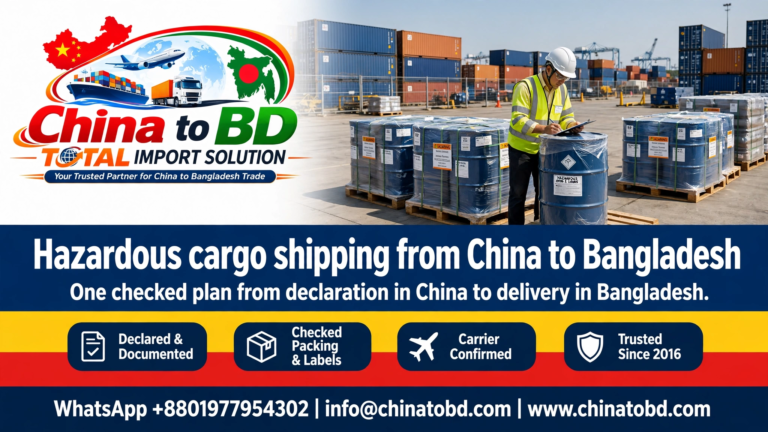
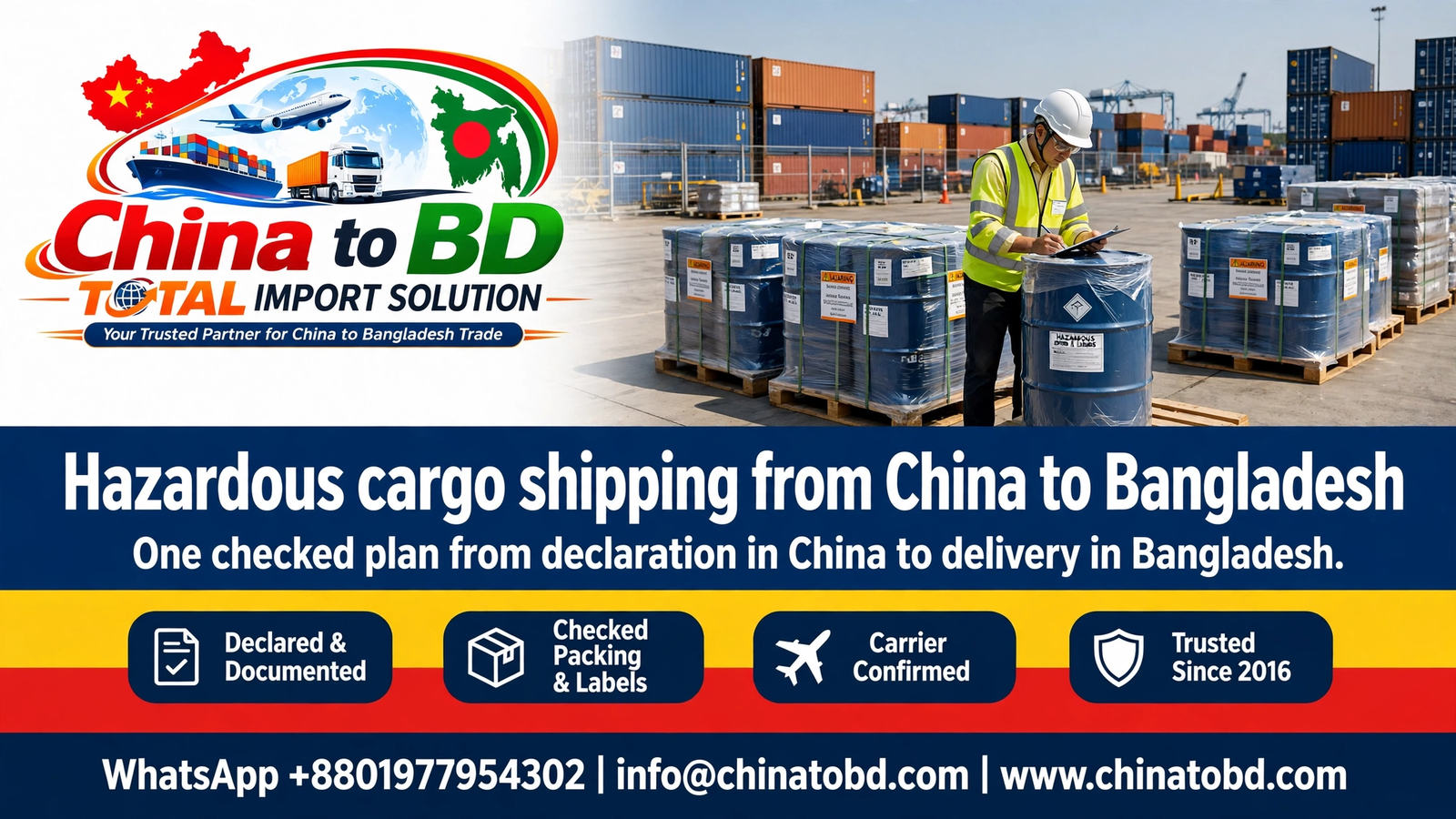
Hazardous cargo shipping from China to Bangladesh
Hazardous cargo shipping from China to Bangladesh
Hazardous cargo shipping from China to Bangladesh means that goods classed as hazardous travel under a planned, declared, and documented process, from the supplier in China to delivery in Bangladesh. The cargo is identified, declared, packed, labelled, and loaded under the checks that apply to it, the carrier confirms the booking in writing, and the documents, the customs clearance, and the delivery are planned as one job. When one team plans the whole process, the importer has one plan, one contact, and one shipment file, instead of a chain of separate arrangements where no one person is watching the declaration, the packing, and the delivery together.
Hazardous cargo is not ordinary cargo. A wrong declaration, a wrong label, a wrong packing, or a missing document can stop the shipment at the port, lead to the cargo being refused, or create a risk for the people who handle it. The checks that apply to hazardous cargo are written checks: the declaration, the safety data sheet, the packing confirmation, the labelling check, the carrier confirmation, and the document review. Each check must be completed and recorded before the next step is confirmed, and no step should be skipped because the shipment is in a hurry.
This article explains, in practical steps, what hazardous cargo shipping covers, how to plan a shipment from the declaration and the written confirmations, how hazardous cargo should be packed, labelled, and loaded, how shipping, stowage, and carrier checks work, how customs clearance and delivery in Bangladesh are planned, how to book the shipment, which cost factors to confirm at booking, which mistakes to avoid, and which checks to complete before the cargo leaves China.
China to BD | Total Import Solution has supported importers from China to Bangladesh since 2016, with sourcing, shipping, customs handling, warehousing, and delivery. The steps here follow the order used in a real hazardous cargo shipment: confirm the cargo and the declaration, confirm the packing and the labelling, confirm the papers and the carrier, and only then confirm the booking. For help, call +8801977954302, email info@chinatobd.com, or visit www.chinatobd.com. The warehouse and office are at House 38A, Mendi Dental College Road, Road 11, Dhanmondi Riverview Model Town, Dhaka 1209.
What Hazardous Cargo Shipping Means
Hazardous cargo is cargo that is classed as hazardous under the rules that apply to its transport, and it must be declared as such from the very first step. The declaration states what the cargo is, how it is classed, how it is packed, and which documents travel with it. The carrier, the port, the customs broker, and the delivery team all work from the same declaration, and any change to the cargo must be shared with every party in writing before the cargo is loaded. A shipment where the declaration and the cargo do not match is a shipment that should not sail.
For the importer, the main benefit of planning hazardous cargo shipping as one job is a single point of responsibility. One team holds the cargo list, the declaration, the safety data sheet, the packing and labelling checks, the documents, the booking, and the delivery plan, and one contact person can answer a question about any stage. When a question arises about the declaration or a document, the importer does not have to find which party is responsible for it. The team that planned the shipment follows the question through, because the team is responsible for the whole process, not only for one part of it.
Hazardous cargo shipping does not mean that the importer stops checking. It means that the checks are done in one order, with one shipment file, so that nothing is missed between one stage and the next. The importer should still ask for the declaration, the safety data sheet, the packing and labelling photos, the carrier confirmation, the document copies, and the delivery receipt in writing, and should keep them in the shipment file. A service that cannot show its checks in writing is not a service the importer can rely on for hazardous cargo.
Planning a Shipment: Declaration, Documents, and Written Confirmations
Planning starts with the cargo and the declaration. The importer writes the cargo list: what the goods are, how many packages there are, how they are packed, and what the supplier states about the nature of the goods. The supplier in China is asked to confirm, in writing, the declaration for the cargo, and to provide the safety data sheet and any other document that applies to the exact goods. The declaration should be agreed from the facts of the exact goods, not copied from another shipment without checking, because different goods need different declarations, packing, and documents.
The safety data sheet should be read before booking, and the handling notes in it should be shared with the delivery team in writing. The packing, the labelling, and the loading plan should be agreed from the declaration and the safety data sheet, and the carrier should be asked to confirm in writing that the cargo, as declared and packed, is accepted for the booking. If the carrier asks for a further document or a further check, complete it before loading, and keep the carrier confirmation with the shipment file. Do not book a hazardous cargo shipment on a verbal acceptance: ask for the acceptance in writing.
Share the cargo list, the declaration, and the safety data sheet with the delivery team in writing before booking, and ask the team to confirm the plan in writing: the packing, the labelling, the container, the stowage, the documents, the port handling, the truck, and the warehouse receipt. For chemical and liquid cargo, the container choice needs extra care, and the article ISO Tank Container Hire for Chemical & Liquid Cargo to Bangladesh explains how ISO tank containers are used for chemical and liquid cargo, including the checks that apply before such cargo is booked for shipment to Bangladesh.
| Plan item | What to confirm | Why it matters |
|---|---|---|
| Cargo list | Goods, quantities, packing, supplier statement | Decides the declaration, the packing, and the documents |
| Declaration | Declaration agreed in writing for the exact goods | Every party works from the same facts |
| Safety data sheet | Sheet received, read, and shared with the team | Handling notes guide the packing and loading plan |
| Packing and labelling | Packing and labels agreed from the declaration | Prevents a load that the carrier will not accept |
| Carrier confirmation | Acceptance confirmed in writing before loading | Prevents a refused booking at the port |
| Segregation check | Cargo kept apart from goods it must not travel with | Prevents a load mixed in a way the rules do not allow |
| Documents | Full document set listed and checked | Prevents a delay at customs after arrival |
| Receiver and contact person | Name and phone number at the warehouse | Prevents a delivery with no one to receive it |
Packing, Labelling, and Loading Checks
Packing is the stage that decides whether hazardous cargo is accepted for shipment. Use the packing that the declaration and the safety data sheet call for, suited to export, strong enough to hold its shape through the journey, and closed in the way the packing instruction requires. Each package should be marked with the item name, the quantity inside, and the handling notes that apply. Every package should carry a label that identifies it as part of the shipment, with the consignee name and a package number that matches the packing list, and the labels that the declaration calls for should be fixed where they can be seen and checked.
Labelling should be checked package by package before loading. Confirm that each label matches the declaration, that the labels are fixed firmly, that they are not covered by tape or strapping, and that damaged or unclear labels are replaced before loading. Ask the supplier for photos of the packed and labelled cargo, and keep those photos with the shipment file. A label that cannot be read at the port is a label that will be questioned, and a questioned label can stop the shipment.
Loading should be done in the order agreed with the supplier, with the packing and labelling checks completed first. The cargo should be placed in the container in the position agreed in advance, blocked and braced so that it cannot move, with the weight spread as the plan requires. The segregation check should be completed before loading: confirm in writing that the cargo is not loaded with goods it must not travel with. Ask the supplier for loading photos that show the inside of the container before the doors are closed, the bracing, and the seal, and keep those photos with the packing list. The seal number should be recorded at loading, written on the documents, and checked again on arrival in Bangladesh.
Shipping, Stowage, and Carrier Checks
Shipping is the stage where the container moves from China to Bangladesh, and the carrier checks are the work that keeps the booking sound through the journey. The shipping method and the container size should be chosen from the cargo list and the declaration: a full container for a larger load, and a shared container only where the cargo, the declaration, and the packing allow it. Ask at booking what the carrier requires for the exact cargo, who will send each update, and how often, and ask for the carrier confirmation and the booking details in writing. A named contact person for the shipment, known to every party by name and phone number, is worth more than a general helpline when a question arises at sea or at the port.
Stowage should be agreed with the carrier before loading. Confirm in writing where the container will be placed, which goods it will travel near, and which checks the carrier will carry out. The segregation check completed before loading should be shared with the carrier in writing, so that the carrier works from the same facts as the supplier and the delivery team. If the carrier asks for a change to the stowage or the loading plan, record the change in writing and share it with every party before the container is loaded.
At the port in Bangladesh, the container should be handled under the plan agreed in advance. Confirm who will attend the port, who will arrange the truck, and who will check the container before it leaves the port area. The seal number should be checked on arrival, before the container is opened, and the check should be recorded. If the seal number does not match the plan, stop and record the difference with a photo before opening the container. The declaration and the documents should be ready for the port and customs checks before the vessel arrives, so that no check is left to the last hour.
Customs Clearance and Delivery in Bangladesh
Customs clearance is the stage where documents matter most, and for hazardous cargo the document review must be completed before the vessel arrives. The commercial invoice describes the goods, the quantity, and the value for customs purposes. The packing list describes how the goods are packed, how many packages there are, and what is inside each package. The bill of lading is the transport document issued by the carrier, and it must match the invoice and the packing list. The certificate of origin, where required, states where the goods were made. The declaration and the safety data sheet travel with the document set, and other certificates may be required for specific goods, so confirm the requirement for the exact goods before shipment.
The importer should keep the import registration, tax identification, and bank documents ready, and confirm with the customs broker which papers must be presented in original and which as a copy. Before the vessel arrives, complete a short document review with the customs broker: confirm that the invoice, the packing list, the bill of lading, and the declaration agree, that the consignee name is spelled the same way on every document, that the port of discharge is correct, and that the container and seal numbers are recorded. If a document needs a correction, request it from the supplier before the vessel sails, because a correction after arrival costs time at the port.
Transport is the stage where the container moves from the port to the warehouse, and the delivery plan should be agreed in advance. Book the truck from the cargo list and the warehouse facts, confirm the driver, the route, the delivery address, and the delivery time, and share the truck details with the warehouse so that the gate, the labour, and the storage area are ready when the truck arrives. At the warehouse, count each package as it leaves the container, compare it with the packing list, and check the condition of the goods before they are put away. Note any damage or shortage at once, with a photo and a written note, and share the note with the supplier and the shipping line on the same day. When the load is oversized or needs special handling, the same planning discipline applies, and the article Breakbulk Shipping from China to Bangladesh explains how oversized cargo is handled, including the checks that keep the route, the equipment, and the handling planned in advance.
| Delivery item | What to confirm | Common error to avoid |
|---|---|---|
| Document review | Invoice, packing list, bill of lading, and declaration agree | Document error found only at the port |
| Customs broker | Broker named, full document set shared | Broker working from an incomplete document set |
| Port attendance | Person named to attend the port and check the container | Container leaving the port with no check recorded |
| Seal check on arrival | Seal checked before opening, difference recorded | Opening the container without a recorded check |
| Truck and route | Truck, driver, route, and time confirmed | Truck arriving with no one at the warehouse to receive it |
| Warehouse storage | Storage area, labour, and equipment booked and ready | Goods waiting with no planned storage area |
| Count and condition check | Packages counted and checked against the list | Damage or shortage found only after putaway |
| Delivery receipt | Signed receipt with count and condition noted | No written record that the goods were received |
Steps to Book Hazardous Cargo Shipping
Follow these steps in order, completing each one before the next is confirmed. A hazardous cargo shipment booked in a hurry, with the declaration still unclear or the carrier confirmation still unwritten, is a shipment where problems are found at the port instead of at the desk.
- Write the cargo list in full. List the goods, the quantities, the packing, and the supplier statement about the nature of the goods, and share them with the delivery team in writing.
- Agree the declaration in writing. Confirm the declaration for the exact goods with the supplier, and record it in the shipment file with the safety data sheet.
- Read the safety data sheet. Share the handling notes with the delivery team in writing, and agree the packing and labelling plan from the declaration and the sheet.
- Confirm the supplier and the inspection plan. Ask for the specification confirmation, the inspection report, and the photos from China.
- Agree the packing, labelling, and loading plan. Confirm the packing, the labels, the segregation check, and the loading photos with the supplier.
- Ask for the carrier confirmation in writing. Confirm that the cargo, as declared and packed, is accepted for the booking, and complete any further check the carrier asks for.
- Ask for the terms in writing. Confirm what is included, what is separate, who is responsible for each stage, and what happens if the plan changes. Keep a copy with the shipment file.
- Prepare the documents. Use the checklist in the documents section, and keep the originals and the copies in one file. Ask the supplier for a copy of each document before loading.
- Confirm the customs, transport, and warehouse plan. Name the customs broker, book the truck, confirm the storage area, labour, and equipment, and name the person in charge of the receipt.
- On arrival, follow the plan in order: check the seal number, receive the container, count the packages and check their condition, note any damage or shortage at once, move the goods to the planned storage area, and close the shipment file with a delivery receipt.
Cost Factors to Confirm at Booking
The cost of hazardous cargo shipping is made up of several parts, and each part should be confirmed at booking. Ocean freight is the cost of moving the container from the port in China to the port in Bangladesh. Port charges cover the handling of the container at each port, including any handling that the declaration calls for. Customs duty and tax are set by the customs rules for the exact goods, and the importer should confirm the duty position with the customs broker before booking. Transport covers the movement of the container from the port to the warehouse and the return of the empty container. Labour covers the offloading, sorting, counting, and checking. Packing covers the packing, the labelling, and the bracing that the declaration calls for. Warehouse use covers the space and the time that the goods occupy.
Each part can change if the plan changes, so ask at booking what happens if the plan changes and how a change is charged. Ask which charges are included in the quotation and which are separate, and read the quotation line by line. Confirm payment terms as well, because a delayed payment can delay the release of the container. No figure in this article is presented as a price, because the cost depends on the cargo, the route, the container, and the delivery plan. For a figure for a specific shipment, share the cargo list, the loading point, the delivery point, and the delivery dates with China to BD | Total Import Solution and ask for a written quotation. Contact the helpline at +8801977954302 or email info@chinatobd.com.
A written quotation also protects the importer when the service is compared with another option. Compare quotations line by line, on the same points, and ask about any line that is unclear. A quotation that lists every charge is more useful than a quotation that gives one total with no detail, because the detail shows where the cost sits and where a change to the plan would change the cost. A hazardous cargo quotation should list the charge for each stage, so that the importer can see the full job, not only the shipping.
Common Mistakes
- Booking the shipment before the declaration is agreed in writing, so the packing, the labelling, and the carrier booking must all be fixed in a hurry. Confirm the declaration before confirming the booking.
- Copying a declaration from another shipment without checking it against the exact goods. Agree the declaration from the facts of the exact goods.
- Skipping the safety data sheet, so the handling notes are never shared with the delivery team. Read the sheet and share its notes in writing.
- Using packing or labels that do not match the declaration. Agree the packing and the labels from the declaration, and check them package by package before loading.
- Booking on a verbal acceptance from the carrier. Ask for the carrier confirmation in writing, and complete any further check the carrier asks for before loading.
- Loading the cargo with goods it must not travel with. Complete the segregation check in writing before loading.
- Leaving the documents until after the vessel sails, so an error is only found at the port. Ask the supplier for a copy of each document before loading, and check it against the cargo list.
- Opening the container without a recorded seal check. Check the seal first, take a photo where there is a difference, and note it on the receipt.
Pre-Shipment and Delivery Checklist
Copy this table into the shipment file and mark each item as it is completed. Complete the pre-shipment items before the vessel sails, and the delivery items before the container arrives.
| Check | When | Done |
|---|---|---|
| Cargo list written in full | Before booking | |
| Declaration agreed in writing | Before booking | |
| Safety data sheet received, read, and shared | Before booking | |
| Supplier and inspection plan confirmed | Before booking | |
| Packing and labelling plan agreed from the declaration | Before booking | |
| Segregation check completed in writing | Before loading | |
| Carrier confirmation received in writing | Before loading | |
| Shipping method and container size chosen | Before booking | |
| Terms received in writing, with inclusions and changes covered | Before booking | |
| Transport booked, with driver, route, date, and time | Before sailing | |
| Customs broker named, with full document set shared | Before sailing | |
| Invoice, packing list, bill of lading, and declaration checked | Before sailing | |
| Loading order agreed with the supplier, with photos requested | Before loading | |
| Container and seal numbers recorded at loading | At loading | |
| Duty and payment arrangements confirmed | Before arrival | |
| Storage area, labour, and equipment booked | Before arrival | |
| Full plan shared in writing with every party | Before arrival | |
| Seal number checked on arrival, before opening | At arrival | |
| Goods counted and checked against the packing list | At delivery | |
| Delivery receipt signed and recorded | After delivery |
Frequently Asked Questions
Q1: What is hazardous cargo shipping from China to Bangladesh?
It is shipping where goods classed as hazardous travel under a planned, declared, and documented process, from the supplier in China through the sea journey, port handling, and customs clearance to delivery in Bangladesh.
Q2: What is a declaration in hazardous cargo shipping?
The declaration states what the cargo is, how it is classed, how it is packed, and which documents travel with it. The carrier, the port, the customs broker, and the delivery team all work from the same declaration.
Q3: What is a safety data sheet, and why does it matter?
The safety data sheet is the document from the supplier that describes the goods and their handling notes. It should be read before booking, and its handling notes should be shared with the delivery team in writing.
Q4: Why must the declaration match the exact goods?
Different goods need different declarations, packing, and documents. A declaration copied from another shipment without checking can lead to a refused booking, a delay at the port, or a load that does not meet the checks that apply.
Q5: How should hazardous cargo be packed and labelled?
Use the packing that the declaration and the safety data sheet call for, label each package to match the declaration, fix the labels where they can be seen and checked, and replace any damaged or unclear label before loading.
Q6: What documents do I need for hazardous cargo shipping from China to Bangladesh?
The main documents are the commercial invoice, the packing list, the bill of lading, the declaration, the safety data sheet, and the certificate of origin where required. Other certificates may be required for specific goods, so confirm the requirement before shipment.
Q7: How can I avoid a document error that causes a delay at the port?
Ask the supplier in China to send a copy of each document before the cargo is loaded, and check the copy against the cargo list. Confirm that the descriptions, package count, consignee name, declaration, and port of discharge are all correct.
Q8: Why is carrier confirmation needed in writing?
The carrier confirms in writing that the cargo, as declared and packed, is accepted for the booking. A verbal acceptance leaves no record, and a booking without a written confirmation can be refused at the port.
Q9: What is a segregation check in hazardous cargo shipping?
It is the written check that the cargo is not loaded with goods it must not travel with. The check should be completed before loading and shared with the carrier in writing.
Q10: What should I check when the container arrives in Bangladesh?
Check the seal number first, before opening the container. If it does not match the plan, stop and record the difference with a photo before opening. Then count the packages and check their condition against the packing list.
Q11: What should I do if goods are damaged or short on arrival?
Note the damage or shortage on the receipt, take a photo, and keep a copy. Do not sign a clean receipt for damaged or short goods. Share the note with the supplier and the shipping line on the same day.
Q12: What are the most common mistakes in hazardous cargo shipping?
The most common mistakes are booking before the declaration is agreed, copying a declaration from another shipment, skipping the safety data sheet, and booking on a verbal acceptance from the carrier.
Q13: Why is the seal number important in hazardous cargo shipping?
The seal number links the container to the documents. Record it at loading in China, write it on the documents, and check it again on arrival in Bangladesh. If it does not match, stop and record the difference with a photo before opening the container.
Q14: Which cost factors should I confirm before booking hazardous cargo shipping?
Confirm the ocean freight, port charges including any handling the declaration calls for, customs duty and tax, transport, labour, packing and labelling, and warehouse use. Ask which charges are included in the quotation and which are separate.
Q15: Can a small hazardous cargo order use a shared container?
A shared container is possible only where the cargo, the declaration, and the packing allow it. Confirm with the delivery team and the carrier in writing that the shared load suits the exact goods before booking.
Q16: How can China to BD | Total Import Solution help with hazardous cargo shipping from China to Bangladesh?
China to BD | Total Import Solution has supported importers from China to Bangladesh since 2016, with sourcing, shipping, customs handling, warehousing, and delivery. The team can help plan the shipment as one job, from the declaration in China to delivery in Bangladesh, with one plan and one shipment file.
Contact China to BD | Total Import Solution
For a written plan and quotation for hazardous cargo shipping from China to Bangladesh, contact China to BD | Total Import Solution. Share the cargo list, the loading point in China, the delivery point in Bangladesh, and the delivery dates, so the plan can be based on the actual cargo and declaration.
- Brand: China to BD | Total Import Solution
- Company: Total Import Solution, since 2016
- Helpline: +8801977954302
- Email: info@chinatobd.com
- Website: www.chinatobd.com
- Warehouse & Office: House 38A, Mendi Dental College Road, Road 11, Dhanmondi Riverview Model Town, Dhaka 1209
Call the helpline at +8801977954302 or email info@chinatobd.com to discuss hazardous cargo shipping from China to Bangladesh, to confirm a plan from declaration to delivery, or to check a document list before the vessel sails.
About the Author