
Reliable freight forwarder Uttara Dhaka
Reliable freight forwarder Uttara Dhaka
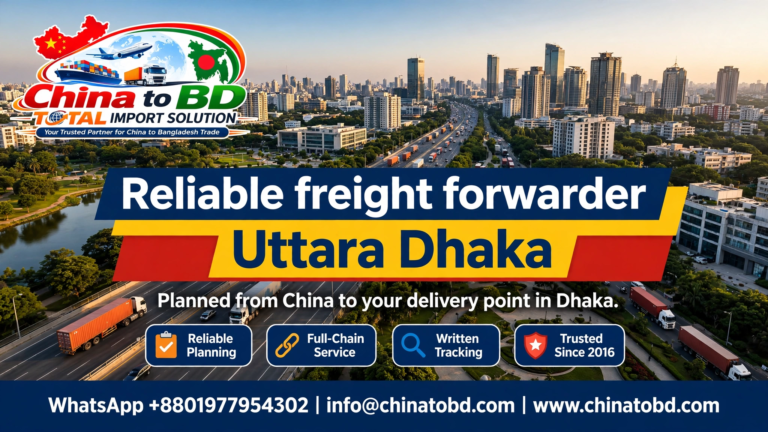
A reliable freight forwarder is the party that plans and follows a shipment from the supplier in China to the delivery point in Bangladesh, so that the importer does not have to arrange each stage alone. For an importer based in Uttara, in the northern part of Dhaka, that work matters in a practical way: the goods still arrive through the same ports and the same customs process as any other shipment from China, but the planning has to fit the delivery point, the roads around it, the warehouse space, and the working hours of the business receiving the goods. A forwarder who understands that last part of the journey is worth more than a forwarder who only books the sea freight and leaves the rest to chance.
Uttara is a large residential and commercial area of Dhaka, with offices, shops, showrooms, warehouses and small factories spread across its sectors, and with road links that connect it to the rest of the city and to the highways out of Dhaka. Many importers keep an office or a showroom in Uttara while their warehouse sits elsewhere in or around Dhaka, so a shipment may need one plan for the office paperwork and another plan for the physical delivery. The forwarder should know which address is for documents, which address is for delivery, and who is present at each address to receive the goods and sign for them.
This article explains, in practical steps, what a freight forwarder does, which services matter for an importer working from Uttara, how to judge whether a forwarder is reliable before booking, which documents and checks to complete, how the shipment is planned from China to Bangladesh, which cost factors to confirm at booking, which mistakes to avoid, and which checks to finish before the goods leave China. It does not name a forwarder office in Uttara for the company in this article, because the warehouse and office of China to BD | Total Import Solution are at House 38A, Mendi Dental College Road, Road 11, Dhanmondi Riverview Model Town, Dhaka 1209, and that is the address to use for the company. Uttara is described here as a Dhaka area where importers work and receive goods, not as the site of a company office.
China to BD | Total Import Solution has supported importers from China to Bangladesh since 2016, with sourcing, shipping, customs handling, warehousing, and delivery. The steps here follow the order used in a real shipment: confirm the need, confirm the supplier, confirm the inspection and packing, confirm the papers, and only then confirm the booking. For help, call +8801977954302, email info@chinatobd.com, or visit www.chinatobd.com.
What a Reliable Freight Forwarder Does
A freight forwarder arranges the movement of goods from one place to another, but a reliable forwarder does more than book a container. The forwarder plans the whole chain: the pickup or loading in China, the shipping, the arrival in Bangladesh, the customs clearance, the transport from the port, the warehouse receipt, and the delivery to the shop, the factory, or the buyer. Each stage is planned with the next stage in mind, so that the loading order agreed in China fits the offloading plan in Bangladesh, and the documents prepared in China match the papers the customs broker needs at the port.
For an importer in Uttara, the forwarder also has to plan the Dhaka part of the journey with care. The truck route from the port to the delivery point, the timing of the arrival, the size of the vehicle that can reach the delivery point, and the space for turning and offloading all need to be confirmed before the container sails. A container that arrives without a confirmed truck, a confirmed driver, and a confirmed delivery time will wait, and waiting at the port or at the warehouse gate costs time and money that a written plan would have saved.
Reliability shows in writing, not in promises. A reliable forwarder gives the plan in writing, names one contact person for the shipment, shares the booking details, the tracking updates, and the document copies, and keeps a shipment file that the importer can check at any stage. The importer should ask for the inspection report from China, the loading photos, the seal number, the document copies before loading, and the delivery receipt after delivery, and should keep all of them in one file. A forwarder who cannot show the checks in writing is a forwarder the importer cannot check, and a shipment that cannot be checked is a shipment that can go wrong without warning.
Services a Forwarder Should Cover for an Uttara Importer
The services an importer needs depend on the goods, the order size, and the delivery point, but the list below covers the stages that a full service should include. When comparing forwarders, ask each one to confirm in writing which of these services are included, which are separate, and who is responsible for each stage. A service that covers only the sea freight is not the same as a service that covers the whole chain, and the difference shows at the port, at the warehouse gate, and at the delivery point.
An importer who brings goods in regularly should also ask how repeat shipments are handled: whether the same contact person follows each shipment, whether the shipment file from the last order is used to plan the next one, and whether the packing, labelling, and document checks stay the same from one order to the next. Regular shipments run well when the plan is repeated with care, and they run badly when each order starts from nothing and the same questions are asked again.
For importers who want the whole chain planned as one job, from sourcing in China to delivery in Bangladesh, the article End-to-end import service from China to Bangladesh describes how each stage is planned with the next stage in mind, and its guidance on one plan, one contact, and one shipment file applies directly to a shipment received through Uttara.
| Service | What it covers | Why it matters for an Uttara importer |
|---|---|---|
| Sourcing support | Confirming the supplier, the specification, and the order | Goods that match the order reduce disputes after arrival |
| Inspection in China | Checking goods before packing, with a written report | Problems are fixed in China, not after arrival in Dhaka |
| Packing and loading | Export packing, labelling, loading order, seal number | Loading order decides how easy offloading will be |
| Sea freight booking | Container booking, shipping line, sailing plan | The booking must fit the delivery date and the warehouse plan |
| Customs clearance | Documents, duty handling, broker coordination | Errors in documents are the main cause of port delays |
| Transport from the port | Truck, driver, route, delivery time | The route and vehicle must fit the Uttara delivery point |
| Warehouse receipt | Offloading, counting, checking, sorting | Counting at receipt protects the importer against shortage |
| Delivery | Delivery to shop, factory, or buyer, with receipt | A signed receipt closes the shipment file |
| Tracking and updates | Written updates at each stage, one contact person | The importer should know where the goods are at each stage |
How to Judge Whether a Forwarder Is Reliable
Reliability can be judged before booking, by asking a short list of questions and reading the answers in writing. A forwarder who answers clearly, in writing, and without delay is showing the same care that the shipment will need. A forwarder who answers in general words, who will not put the plan in writing, or who cannot name the person responsible for each stage is showing the importer how the shipment will be handled, and the importer should take the warning seriously.
Ask for the plan in writing before paying anything. The plan should list the stages, the documents, the charges that are included, the charges that are separate, the payment terms, and what happens if the plan changes. Ask who the contact person is, how tracking updates will be shared, and how often. Ask how a problem is handled: who is called, who decides, and how the importer is told. Ask for the loading photos, the seal number, and the document copies as a normal part of the service, not as a favour. The answers should be specific to the shipment, not a general description copied from a brochure.
Check the delivery planning as carefully as the shipping. Ask how the truck is booked, how the driver is confirmed, how the route to the Uttara delivery point is chosen, and what happens if the truck cannot reach the delivery point on the planned day. Ask whether the warehouse or the delivery point has been checked for gate width, turning space, ground surface, and working hours. A forwarder who has not asked about the delivery point has not planned the delivery, and the importer should not book until that part of the plan is written down.
| Check | What to look for | Warning sign |
|---|---|---|
| Written plan | Stages, documents, charges, and responsibilities listed | Only verbal answers, nothing in writing |
| Named contact | One person, with phone number, for the whole shipment | A general helpline with no named person |
| Document copies | Invoice, packing list, and bill of lading shared before loading | Documents shown only after the vessel sails |
| Loading photos | Photos from inside the container before the doors close | No photos, or photos that do not show the load |
| Seal number | Recorded at loading and checked again on arrival | Seal number not recorded or not shared |
| Delivery plan | Truck, driver, route, and delivery time confirmed | No delivery plan until the container arrives |
| Tracking updates | Written updates at each stage, with dates | Updates only when the importer asks for them |
| Charges in writing | Each charge listed, with inclusions and changes covered | One total with no detail, or charges added later |
Planning a Shipment Through Uttara: Documents and Coordination
Documents decide whether a shipment clears customs without delay, and the importer should treat the document check as part of the booking, not as a task for after the vessel sails. The commercial invoice describes the goods, the quantity, and the value for customs purposes. The packing list describes how the goods are packed, how many packages there are, and what is inside each package. The bill of lading is the transport document issued by the carrier, and it must match the invoice and the packing list. The certificate of origin, where required, states where the goods were made. Other certificates may be required for specific goods, and the importer should confirm the requirement for the exact goods before shipment.
Before the vessel arrives, complete a short document review with the customs broker: confirm that the invoice, the packing list, and the bill of lading agree, that the consignee name is spelled the same way on every document, that the port of discharge is correct, and that the container and seal numbers are recorded. If a document needs a correction, request it from the supplier before the vessel sails, because a correction requested at the port takes longer and may need the supplier, the shipping line, and the broker to act together. Keep the import registration, tax identification, and bank documents ready, and confirm with the broker which papers must be presented in original and which as a copy.
Coordination is the other half of the planning. Share the same written plan with every party: the same dates, addresses, and contact numbers to the supplier, the shipping line, the transporter, the warehouse, and the customs broker. For a shipment received through Uttara, confirm which address is for the office paperwork and which is for the physical delivery, and name the person who will be present at each address. Confirm the working hours of the delivery point, the gate width, the turning space, and the ground surface, and confirm that labour and equipment are booked for the offloading and counting. A plan shared in writing with every party is a plan that every party can follow; a plan kept in one person’s head is a plan that fails when that person is not there.
Steps to Work with a Freight Forwarder in Uttara
Follow these steps in order, completing each one before the next is confirmed. A shipment booked in a hurry, with the need still unclear or the documents still unchecked, is a shipment where problems are found at the port instead of at the desk.
- Write the need in full. List the goods, the quantities, the specification, the packing, the delivery point in Uttara, and the business need, and share them with the forwarder in writing.
- Confirm the supplier and the inspection plan. Ask for the specification confirmation, the inspection report, and the photos from China.
- Agree the packing and loading plan. Confirm the carton type, the labels, the loading order, and the loading photos with the supplier.
- Choose the shipping method and the container size. Match the choice to the cargo list and to the delivery point, and check the site access before booking.
- Ask for the terms in writing. Confirm what is included, what is separate, who is responsible for each stage, and what happens if the plan changes. Keep a copy with the shipment file.
- Prepare the documents. Use the checklist in the documents section, keep the originals and the copies in one file, and ask the supplier for a copy of each document before loading.
- Confirm the customs plan. Name the customs broker, confirm the duty handling, and confirm who will attend the port if a physical check is required.
- Confirm the transport and delivery plan. Book the truck, confirm the driver and the route to the Uttara delivery point, confirm the warehouse or delivery space, labour, and equipment, and name the person in charge of the receipt.
- Share the full plan with every party: the same dates, addresses, and contact numbers to the supplier, the shipping line, the transporter, the warehouse, and the customs broker.
- On arrival, follow the plan in order: check the seal number, receive the container, offload and count the goods, note any damage or shortage at once, deliver the goods to the shop, factory, or buyer, and close the shipment file with a delivery receipt.
When the container needs a side opening for easy loading at the depot, the loading and offloading plan must be agreed before the vessel sails. The article Side-Opening Shipping Container Rental for Easy Depot Loading explains how side-opening containers are planned for depot loading, and its guidance on agreeing the loading order, the delivery point, and the return plan in advance applies to any shipment received through Uttara that cannot be offloaded through the end doors alone.
Cost Factors to Confirm Before Booking
The cost of a shipment is made up of several parts, and each part should be confirmed at booking. Ocean freight is the cost of moving the container from the port in China to the port in Bangladesh. Port charges cover the handling of the container at each port. Customs duty and tax are set by the customs rules for the exact goods, and the importer should confirm the duty position with the customs broker before booking. Transport covers the movement of the container from the port to the delivery point, the delivery to the shop, factory, or buyer, and the return of the empty container. Labour covers the offloading, sorting, counting, and checking. Warehouse use covers the space and the time that the goods occupy.
Each part can change if the plan changes, so ask at booking what happens if the plan changes and how a change is charged. Ask which charges are included in the quotation and which are separate, and read the quotation line by line. Confirm payment terms as well, because a delayed payment can delay the release of the container. No figure in this article is presented as a price, because the cost depends on the cargo, the route, the container, and the delivery plan. For a figure for a specific shipment, share the cargo list, the loading point, the delivery point in Uttara, and the delivery dates with China to BD | Total Import Solution and ask for a written quotation. Contact the helpline at +8801977954302 or email info@chinatobd.com.
A written quotation also protects the importer when the service is compared with another option. Compare quotations line by line, on the same points, and ask about any line that is unclear. A quotation that lists every charge is more useful than a quotation that gives one total with no detail, because the detail shows where the cost sits and where a change to the plan would change the cost. A quotation for a shipment received through Uttara should list the transport charge to the delivery point as its own line, so that the importer can see the full job, not only the shipping.
Common Mistakes
- Booking the shipment before the need and the specification are complete, so the packing, the container size, and the documents must all be fixed in a hurry. Confirm the need before confirming the booking.
- Choosing a forwarder on a single total figure with no written plan. Ask for the plan and the charge for each stage in writing.
- Skipping the inspection in China, so a problem with the goods is only found in Dhaka. Ask for the inspection report and photos.
- Leaving the documents until after the vessel sails, so an error is only found at the port. Ask the supplier for a copy of each document before loading.
- Choosing a container size that does not fit the delivery point in Uttara. Check the gate, the road, the turning space, and the equipment before choosing the container.
- Not recording the seal number at loading. Record the seal number, write it on the documents, and check it again on arrival.
- Relying on verbal agreements. Keep every agreement in writing, in one shipment file, and share the same written plan with every party.
- Signing a clean receipt for damaged or short goods. Note the damage or shortage on the receipt, take a photo, and keep a copy.
Pre-Booking and Delivery Checklist
Copy this table into the shipment file and mark each item as it is completed. Complete the pre-booking items before the booking is confirmed, and the delivery items before the container arrives.
| Check | When | Done |
|---|---|---|
| Need and specification written in full | Before booking | |
| Delivery point in Uttara confirmed, with office and delivery addresses separated | Before booking | |
| Supplier and inspection plan confirmed | Before booking | |
| Packing and loading plan agreed, photos requested | Before booking | |
| Shipping method and container size chosen, site access checked | Before booking | |
| Terms received in writing, with inclusions and changes covered | Before booking | |
| Forwarder contact person named, with phone number | Before booking | |
| Transport booked, with driver, route, date, and time | Before sailing | |
| Customs broker named, with full document set shared | Before sailing | |
| Invoice, packing list, and bill of lading checked against each other | Before sailing | |
| Loading order agreed with the supplier, with photos requested | Before loading | |
| Container and seal numbers recorded at loading | At loading | |
| Duty and payment arrangements confirmed | Before arrival | |
| Labour and equipment booked for offloading and counting | Before arrival | |
| Delivery space, sorting space, and covered area confirmed | Before arrival | |
| Full plan shared in writing with every party | Before arrival | |
| Seal number checked on arrival, before opening | At arrival | |
| Goods counted and checked against the packing list | At delivery | |
| Damage or shortage noted at once, with photo and written note | At delivery | |
| Delivery receipt signed and recorded | After delivery |
Frequently Asked Questions
Q1: What does a reliable freight forwarder do?
A reliable freight forwarder plans and follows a shipment from the supplier in China to the delivery point in Bangladesh: sourcing support, inspection, packing and loading, shipping, customs clearance, transport, warehouse receipt, delivery, and tracking, with one plan, one contact person, and one shipment file.
Q2: Why does the Uttara delivery point need its own plan?
Because the goods arrive through the same ports and customs process as any shipment, but the last part of the journey depends on the delivery point: the road, the gate width, the turning space, the vehicle size, and the working hours. A plan that ignores the delivery point leaves the hardest part of the journey unplanned.
Q3: How do I judge whether a forwarder is reliable before booking?
Ask for the plan in writing, with the stages, the documents, the charges, and the responsibilities listed. Check that one contact person is named, that document copies and loading photos are shared as a normal part of the service, and that the delivery plan is confirmed before booking.
Q4: What services should a forwarder cover for an Uttara importer?
The full chain: sourcing support, inspection in China, packing and loading, sea freight booking, customs clearance, transport from the port, warehouse receipt, delivery, and tracking. Ask in writing which services are included and which are separate.
Q5: Which documents do I need for a shipment from China to Bangladesh?
The main documents are the commercial invoice, the packing list, the bill of lading, and the certificate of origin where required. Other certificates may be required for specific goods, so confirm the requirement before shipment.
Q6: How can I avoid a document error that causes a delay at the port?
Ask the supplier in China to send a copy of each document before the goods are loaded, and check the copy against the cargo list. Confirm that the descriptions, package count, consignee name, and port of discharge are all correct, and review the set with the customs broker before the vessel arrives.
Q7: How should goods be packed for a shipment received in Uttara?
Use export cartons with internal protection for fragile items, label each carton with the item name and quantity, and label every package with the consignee name and a package number that matches the packing list. Agree the loading order so that goods needed first come out first.
Q8: What should I check at the delivery point before the container arrives?
Check the gate width, access road, turning space, ground surface, floor space, sorting space, and working hours. Confirm that labour and equipment are booked and a covered area is available for sorting and checking.
Q9: How do I track a shipment from China to Uttara?
Ask at booking how tracking will be shared, who will send each update, and how often. Name one contact person for the shipment, known to every party by name and phone number, and keep a written record of every update.
Q10: What should I do if goods are damaged or short on arrival?
Note the damage or shortage on the receipt, take a photo, and keep a copy. Do not sign a clean receipt for damaged or short goods. Share the note with the supplier and the shipping line on the same day.
Q11: What are the most common mistakes when working with a forwarder?
The most common mistakes are booking before the need is complete, choosing on a single total figure with no written plan, skipping the inspection in China, leaving documents until after sailing, and signing a clean receipt for damaged goods.
Q12: Why is the seal number important?
The seal number links the container to the documents. Record it at loading in China, write it on the documents, and check it again on arrival in Bangladesh. If it does not match, stop and record the difference with a photo before opening the container.
Q13: Which cost factors should I confirm before booking?
Confirm the ocean freight, port charges, customs duty and tax, transport to the Uttara delivery point, labour, and warehouse use. Ask which charges are included in the quotation, which are separate, and what happens if the plan changes.
Q14: Can a forwarder handle regular shipments to Uttara?
Yes, and regular shipments run well when the same contact person follows each order and the shipment file from the last order is used to plan the next one. Confirm the packing, labelling, and document checks stay the same from one order to the next.
Q15: What if the truck cannot reach my delivery point in Uttara?
Raise it before booking, not after arrival. Confirm the vehicle size, the route, the gate width, and the turning space in the written plan, and agree in advance what happens if the delivery point cannot be reached by the planned vehicle.
Q16: How can China to BD | Total Import Solution help with a reliable freight forwarder in Uttara Dhaka?
China to BD | Total Import Solution has supported importers from China to Bangladesh since 2016, with sourcing, shipping, customs handling, warehousing, and delivery. The team can help plan a shipment received through Uttara, from sourcing in China to delivery in Bangladesh, with one plan, one contact person, and one shipment file.
Contact China to BD | Total Import Solution
For a written plan and quotation for a shipment from China to Bangladesh received through Uttara, contact China to BD | Total Import Solution. Share the cargo list, the loading point in China, the delivery point in Bangladesh, and the delivery dates, so the plan can be based on the actual shipment.
- Brand: China to BD | Total Import Solution
- Company: Total Import Solution, since 2016
- Helpline: +8801977954302
- Email: info@chinatobd.com
- Website: www.chinatobd.com
- Warehouse & Office: House 38A, Mendi Dental College Road, Road 11, Dhanmondi Riverview Model Town, Dhaka 1209
Call the helpline at +8801977954302 or email info@chinatobd.com to discuss a shipment from China to Bangladesh, to confirm a plan for a delivery through Uttara, or to check a document list before the vessel sails.
About the Author