China to Bangladesh freight cost per CBM
China to Bangladesh freight cost per CBM
Freight cost per CBM is a way of looking at the cost of moving goods from China to Bangladesh in relation to the volume of the goods. CBM stands for cubic metre, and it is the unit used to measure how much space a shipment takes up. When a forwarder or a shipping line talks about freight cost per CBM, the figure is built from the volume of the cargo, the route, the type of goods, and the services included in the quotation. An importer who understands how CBM is measured, and which factors change the cost, can read a quotation line by line and ask the right questions before booking.
The volume of a shipment is not a guess. It is measured from the packages themselves: the length, the width, and the height of each package, measured in metres, multiplied together to give the volume of that package in cubic metres, and added across all the packages in the shipment. A shipment with many small packages and a shipment with a few large packages can have the same total volume, but they may need different packing, different handling, and different loading plans. The CBM figure is the starting point for the quotation, not the whole quotation, and the importer should ask which charges are included in it and which are separate.
This article explains, in practical steps, what freight cost per CBM means, how CBM is measured and calculated, which factors change the freight cost per CBM, which documents and details to share for a written quotation, how to get a clear quotation step by step, how to compare quotations line by line, which mistakes to avoid, and which checks to finish before the goods leave China. No figure in this article is presented as a price or a rate, because the cost depends on the cargo, the route, the container, and the delivery plan. For a figure for a specific shipment, share the cargo list, the measurements, the loading point, and the delivery point with China to BD | Total Import Solution and ask for a written quotation.
China to BD | Total Import Solution has supported importers from China to Bangladesh since 2016, with sourcing, shipping, customs handling, warehousing, and delivery. The steps here follow the order used in a real shipment: confirm the need, confirm the supplier, confirm the inspection and packing, confirm the measurements, confirm the papers, and only then confirm the booking. For help, call +8801977954302, email info@chinatobd.com, or visit www.chinatobd.com. The warehouse and office are at House 38A, Mendi Dental College Road, Road 11, Dhanmondi Riverview Model Town, Dhaka 1209.
What Freight Cost per CBM Means
Freight cost per CBM is the freight charge looked at in relation to one cubic metre of cargo volume. It is a useful way to compare the size of a shipment with the cost of moving it, and to see how a change in the cargo changes the cost. If the volume goes up because the packing is larger or the order is bigger, the freight charge will usually change as well, and the importer should understand the direction of that change before booking, even without a figure in mind.
The per-CBM figure is only one part of the total cost of a shipment. Ocean freight is the cost of moving the container from the port in China to the port in Bangladesh. Port charges cover the handling of the container at each port. Customs duty and tax are set by the customs rules for the exact goods, and the importer should confirm the duty position with the customs broker before booking. Transport covers the movement of the container from the port to the delivery point and the return of the empty container. Labour covers the offloading, sorting, counting, and checking. Warehouse use covers the space and the time that the goods occupy. A quotation that gives only a per-CBM figure, with no list of these parts, does not tell the importer the full cost of the shipment.
The importer should also know that volume is not the only measure that matters. The weight of the goods, the type of goods, the packing, and the handling they need all affect the quotation. Light goods that take up a lot of space and heavy goods that take up little space are treated differently, and the importer should ask how the quotation is built for the exact goods in the order. The questions in this article are written so that the importer can ask them without knowing any figure in advance, and can read the written answer against the cargo list.
How CBM Is Measured and Calculated
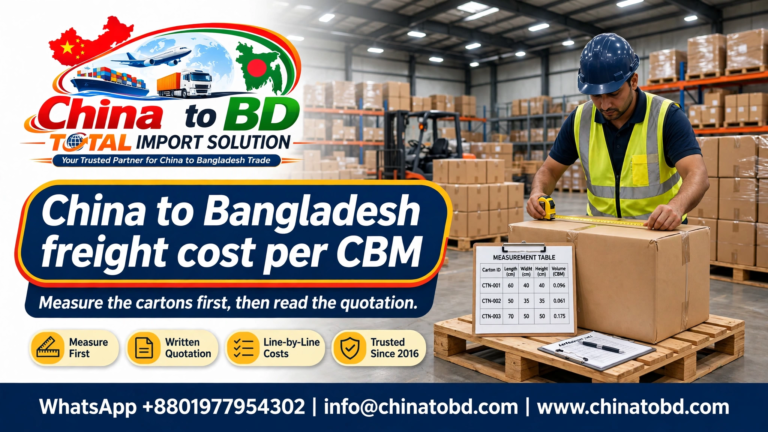
CBM is calculated from the measurements of the packages. Measure the length, the width, and the height of each package in metres, multiply the three numbers together, and the result is the volume of that package in cubic metres. Add the volume of every package in the shipment, and the total is the CBM of the shipment. The measurement should be taken on the packed carton, not on the goods inside it, because the packed carton is what takes up space in the container.
The measurement must be taken with care, because a small error on one package becomes a large error across a whole shipment. Measure each different carton size separately, count how many cartons there are of each size, and write the measurements down in a table before sharing them. Ask the supplier in China to confirm the measurements in writing, with the carton count, and to confirm that the measurements are for the packed cartons, including any pallet or outer packing. If the goods are packed on pallets, measure the pallet as packed, including its height, because the pallet is part of the space the shipment takes up.
Irregular shapes need extra care. Goods that do not pack into a neat carton, such as long items, round items, or items with parts that stick out, should be measured at their widest and longest points, because the space they need in the container is decided by those points, not by their average size. Ask the supplier how the goods will be packed, and measure the packed form. Keep the measurement table with the packing list, so that the volume, the package count, and the contents all agree with each other.
| Measurement step | What to do | What to record |
|---|---|---|
| Measure each carton size | Length, width, and height in metres, on the packed carton | The three numbers for each carton size |
| Multiply for one carton | Length times width times height | Volume of one carton in cubic metres |
| Count the cartons | How many cartons of each size are in the order | Carton count for each size |
| Add across the shipment | Volume of each size times its count, added together | Total CBM of the shipment |
| Confirm with the supplier | Supplier confirms measurements and carton count in writing | Written confirmation with the packing list |
| Check against the packing list | Volume, package count, and contents agree | One matching set of records |
| Measure pallets as packed | Include the pallet height in the measurement | Packed pallet dimensions |
| Measure irregular goods at the widest points | Longest and widest points of the packed form | Packed dimensions of irregular items |
Cost Factors That Change the Freight Cost per CBM
The freight cost per CBM changes with the cargo, the route, and the services in the quotation. The volume is the starting point, but it is not the only factor, and the importer should ask about each factor below before booking. A quotation that cannot explain which factors it includes is a quotation the importer cannot compare with another one, and the importer should ask for the explanation in writing.
The type of goods matters, because different goods need different handling. Fragile goods need more protection and more careful loading. Heavy goods need stronger packing and more labour at offloading. Goods that need special handling, such as goods that do not fit a standard container, need a different plan and different equipment. The loading point in China and the delivery point in Bangladesh matter, because the route, the port handling, and the transport to the delivery point all form part of the cost. The container size and the shipping method matter, because a full container, a shared container, and special handling are planned and charged in different ways.
The timing of the shipment matters as well, because the sailing plan, the port handling, and the warehouse plan all depend on the dates. A shipment that must arrive by a set date needs a plan that fits that date, and the importer should confirm the dates in writing. The documents matter, because an error in the documents can delay the shipment at the port and add handling and storage to the cost. The delivery plan matters, because the truck, the driver, the route, and the delivery time must all be confirmed, and a delivery point that needs a smaller vehicle or more labour will change the transport part of the quotation.
| Factor | How it affects the cost | What to confirm |
|---|---|---|
| Total CBM | The volume of the shipment is the starting point for the freight charge | Measured CBM, confirmed in writing by the supplier |
| Type of goods | Fragile, heavy, or special goods need different handling | Handling needs for the exact goods |
| Packing | Larger or stronger packing changes the volume and the handling | Packed dimensions and carton count |
| Loading point in China | The route and the port handling depend on where the goods start | Loading point and port in the quotation |
| Delivery point in Bangladesh | Transport, vehicle, and labour depend on the delivery point | Delivery address, gate, and turning space |
| Container size and method | Full container, shared container, and special handling differ | Container size and method in the quotation |
| Sailing and delivery dates | Dates decide the sailing plan and the warehouse plan | Dates confirmed in writing |
| Documents | Errors cause delay, handling, and storage at the port | Document list checked before sailing |
| Delivery plan | Truck, driver, route, and labour form part of the cost | Delivery plan confirmed before booking |
| Changes to the plan | A change in volume, dates, or delivery point changes the cost | How a change is charged, in writing |
When the importer is weighing whether to lease or buy a container for the shipment, the volume and the cost factors above should be part of that decision. The article Cost Breakdown: Leasing vs Buying Shipping Containers in Bangladesh explains how the two options are compared, and its guidance on listing each part of the cost in writing applies to any importer who wants to see how the CBM of a shipment relates to the container choice.
Documents and Details to Share for a Written Quotation
A written quotation can only be as clear as the details it is based on, so the importer should share a full set of details before asking for a figure. The cargo list should name the goods, the quantities, the specification, and the packing. The measurement table should give the packed dimensions of each carton size, the carton count, and the total CBM. The loading point in China and the delivery point in Bangladesh should be given in full, with the contact person at each end. The delivery dates should be given, with the dates the goods are ready in China and the dates they are needed in Bangladesh.
The documents for the shipment should be prepared at the same time. The commercial invoice describes the goods, the quantity, and the value for customs purposes. The packing list describes how the goods are packed, how many packages there are, and what is inside each package. The bill of lading is the transport document issued by the carrier, and it must match the invoice and the packing list. The certificate of origin, where required, states where the goods were made. Other certificates may be required for specific goods, and the importer should confirm the requirement for the exact goods before shipment.
Before the vessel arrives, complete a short document review with the customs broker: confirm that the invoice, the packing list, and the bill of lading agree, that the consignee name is spelled the same way on every document, that the port of discharge is correct, and that the container and seal numbers are recorded. If a document needs a correction, request it from the supplier before the vessel sails, because a correction requested at the port takes longer and may need the supplier, the shipping line, and the broker to act together. Keep the import registration, tax identification, and bank documents ready, and confirm with the broker which papers must be presented in original and which as a copy.
Steps to Get a Clear Freight Quotation per CBM
Follow these steps in order, completing each one before the next is confirmed. A quotation requested in a hurry, with the measurements still unclear or the documents still unchecked, is a quotation that will need to be corrected later, and a correction after booking is harder than a check before booking.
- Write the need in full. List the goods, the quantities, the specification, the packing, the delivery point, and the business need, and share them in writing.
- Measure the cargo. Measure each packed carton size in metres, count the cartons, and work out the total CBM in a written table.
- Confirm the measurements with the supplier. Ask the supplier to confirm the packed dimensions, the carton count, and the total CBM in writing.
- Confirm the supplier and the inspection plan. Ask for the specification confirmation, the inspection report, and the photos from China.
- Agree the packing and loading plan. Confirm the carton type, the labels, the loading order, and the loading photos with the supplier.
- Choose the shipping method and the container size. Match the choice to the cargo list, the CBM, and the delivery point, and check the site access before booking.
- Ask for the quotation in writing. Confirm what is included, what is separate, who is responsible for each stage, and what happens if the plan changes.
- Prepare the documents. Use the checklist in the documents section, keep the originals and the copies in one file, and ask the supplier for a copy of each document before loading.
- Confirm the customs plan. Name the customs broker, confirm the duty handling, and confirm who will attend the port if a physical check is required.
- Confirm the transport and delivery plan, then book. Book the truck, confirm the driver and the route, confirm the warehouse or delivery space, labour, and equipment, and name the person in charge of the receipt.
When the shipment moves by sea and the importer wants to see how sea freight quotations are built, the article China to Bangladesh Sea Freight: Best Deals on Leased Containers explains how sea freight and leased containers are planned, and its guidance on reading the quotation line by line applies to any importer who wants to see which parts of the cost sit in the sea freight and which sit elsewhere.
How to Compare Quotations Line by Line
A quotation should be compared line by line, on the same points, and not by its total alone. Two quotations with the same total can cover different services, and two quotations with different totals can cover the same services with different detail. Ask each party for the same list: ocean freight, port charges, customs duty and tax handling, transport to the delivery point, labour, warehouse use, and the return of the empty container. Then read each line against the cargo list, the CBM table, and the delivery plan, and mark any line that is missing or unclear.
Ask about any line that is unclear before booking, and ask for the answer in writing. Ask which charges are included in the per-CBM figure and which are separate. Ask what happens if the volume changes, if the dates change, or if the delivery point changes, and how a change is charged. Ask about the payment terms, because a delayed payment can delay the release of the container. A quotation that lists every charge is more useful than a quotation that gives one total with no detail, because the detail shows where the cost sits and where a change to the plan would change the cost.
Keep the comparison in writing, with the quotations, the cargo list, the CBM table, and the delivery plan in one file. When the booking is confirmed, keep the chosen quotation with the shipment file, so that the charges can be checked against it on arrival. If a charge appears on arrival that was not in the quotation, the written quotation is the record the importer uses to ask about it. No figure in this article is presented as a price or a rate, because the cost depends on the cargo, the route, the container, and the delivery plan, and only a written quotation for the actual shipment can give a figure for that shipment.
Common Mistakes
- Guessing the CBM instead of measuring the packed cartons. Measure each carton size in metres, count the cartons, and work out the total in a written table.
- Measuring the goods instead of the packed cartons. Measure the packed carton, including any pallet, because that is what takes up space in the container.
- Asking for a quotation without the cargo list, the measurements, and the delivery point. Share the full details before asking for a figure.
- Comparing quotations by the total alone. Compare line by line, on the same points, and ask about any line that is unclear.
- Leaving the documents until after the vessel sails, so an error is only found at the port. Ask the supplier for a copy of each document before loading.
- Choosing a container size that does not fit the CBM or the delivery point. Check the cargo list, the volume, the gate, the road, and the turning space before choosing.
- Not recording the seal number at loading. Record the seal number, write it on the documents, and check it again on arrival.
- Relying on verbal agreements. Keep every agreement in writing, in one shipment file, and share the same written plan with every party.
- Signing a clean receipt for damaged or short goods. Note the damage or shortage on the receipt, take a photo, and keep a copy.
Pre-Booking and Delivery Checklist
Copy this table into the shipment file and mark each item as it is completed. Complete the pre-booking items before the booking is confirmed, and the delivery items before the container arrives.
| Check | When | Done |
|---|---|---|
| Need and specification written in full | Before booking | |
| Packed cartons measured in metres, CBM table completed | Before booking | |
| Measurements and carton count confirmed by the supplier in writing | Before booking | |
| Supplier and inspection plan confirmed | Before booking | |
| Packing and loading plan agreed, photos requested | Before booking | |
| Shipping method and container size chosen, site access checked | Before booking | |
| Quotation received in writing, with each charge listed | Before booking | |
| Quotations compared line by line, unclear lines asked about | Before booking | |
| Transport booked, with driver, route, date, and time | Before sailing | |
| Customs broker named, with full document set shared | Before sailing | |
| Invoice, packing list, and bill of lading checked against each other | Before sailing | |
| Loading order agreed with the supplier, with photos requested | Before loading | |
| Container and seal numbers recorded at loading | At loading | |
| Duty and payment arrangements confirmed | Before arrival | |
| Labour and equipment booked for offloading and counting | Before arrival | |
| Delivery space, sorting space, and covered area confirmed | Before arrival | |
| Full plan shared in writing with every party | Before arrival | |
| Seal number checked on arrival, before opening | At arrival | |
| Goods counted and checked against the packing list | At delivery | |
| Damage or shortage noted at once, with photo and written note | At delivery | |
| Delivery receipt signed and recorded | After delivery |
Frequently Asked Questions
Q1: What does freight cost per CBM mean?
Freight cost per CBM is the freight charge looked at in relation to one cubic metre of cargo volume. CBM stands for cubic metre, and it is the unit used to measure how much space a shipment takes up from China to Bangladesh.
Q2: How is CBM calculated?
Measure the length, the width, and the height of each packed carton in metres, multiply the three numbers together for the volume of one carton, and add the volume of every carton in the shipment. The total is the CBM of the shipment.
Q3: Should I measure the goods or the packed cartons?
Measure the packed cartons, not the goods inside them, because the packed carton is what takes up space in the container. If the goods are packed on pallets, measure the pallet as packed, including its height.
Q4: Which factors change the freight cost per CBM?
The volume, the type of goods, the packing, the loading point in China, the delivery point in Bangladesh, the container size and shipping method, the sailing and delivery dates, the documents, and the delivery plan all affect the cost. Ask about each factor before booking.
Q5: Why is the per-CBM figure not the full cost of the shipment?
Because the total cost also includes port charges, customs duty and tax, transport to the delivery point, labour, warehouse use, and the return of the empty container. A quotation that gives only a per-CBM figure, with no list of these parts, does not tell the importer the full cost.
Q6: What details should I share to get a written quotation?
Share the cargo list, the measurement table with the packed dimensions and the total CBM, the loading point in China, the delivery point in Bangladesh, the contact person at each end, and the delivery dates.
Q7: How should I compare two quotations for the same shipment?
Compare them line by line, on the same points: ocean freight, port charges, customs duty and tax handling, transport, labour, warehouse use, and the return of the empty container. Ask about any line that is unclear, and ask for the answer in writing.
Q8: What happens to the cost if the volume changes after booking?
Ask before booking how a change is charged. A change in volume, dates, or delivery point can change the cost, so the quotation should state in writing what happens if the plan changes.
Q9: Which documents do I need for a shipment from China to Bangladesh?
The main documents are the commercial invoice, the packing list, the bill of lading, and the certificate of origin where required. Other certificates may be required for specific goods, so confirm the requirement before shipment.
Q10: How can I avoid a document error that causes a delay at the port?
Ask the supplier in China to send a copy of each document before the goods are loaded, and check the copy against the cargo list. Confirm that the descriptions, package count, consignee name, and port of discharge are all correct, and review the set with the customs broker before the vessel arrives.
Q11: How should goods be packed when the CBM matters?
Use export cartons suited to the goods, with internal protection for fragile items, and label each carton with the item name and quantity. Agree the loading order so that goods needed first come out first, and measure the packed cartons for the CBM table.
Q12: What should I check at the delivery point before the container arrives?
Check the gate width, access road, turning space, ground surface, floor space, sorting space, and working hours. Confirm that labour and equipment are booked and a covered area is available for sorting and checking.
Q13: Why is the seal number important?
The seal number links the container to the documents. Record it at loading in China, write it on the documents, and check it again on arrival in Bangladesh. If it does not match, stop and record the difference with a photo before opening the container.
Q14: What should I do if goods are damaged or short on arrival?
Note the damage or shortage on the receipt, take a photo, and keep a copy. Do not sign a clean receipt for damaged or short goods. Share the note with the supplier and the shipping line on the same day.
Q15: What are the most common mistakes when working with freight cost per CBM?
The most common mistakes are guessing the CBM instead of measuring, measuring the goods instead of the packed cartons, asking for a quotation without the full details, comparing quotations by the total alone, and leaving documents until after sailing.
Q16: How can China to BD | Total Import Solution help with China to Bangladesh freight cost per CBM?
China to BD | Total Import Solution has supported importers from China to Bangladesh since 2016, with sourcing, shipping, customs handling, warehousing, and delivery. The team can help measure the CBM, check the cost factors, and prepare a written quotation for the actual shipment, with one plan, one contact person, and one shipment file.
Contact China to BD | Total Import Solution
For a written plan and quotation for a shipment from China to Bangladesh, contact China to BD | Total Import Solution. Share the cargo list, the measurement table, the loading point in China, the delivery point in Bangladesh, and the delivery dates, so the plan can be based on the actual shipment.
- Brand: China to BD | Total Import Solution
- Company: Total Import Solution, since 2016
- Helpline: +8801977954302
- Email: info@chinatobd.com
- Website: www.chinatobd.com
- Warehouse & Office: House 38A, Mendi Dental College Road, Road 11, Dhanmondi Riverview Model Town, Dhaka 1209
Call the helpline at +8801977954302 or email info@chinatobd.com to discuss a shipment from China to Bangladesh, to check a CBM measurement table, or to ask for a written quotation for the actual shipment.
About the Author