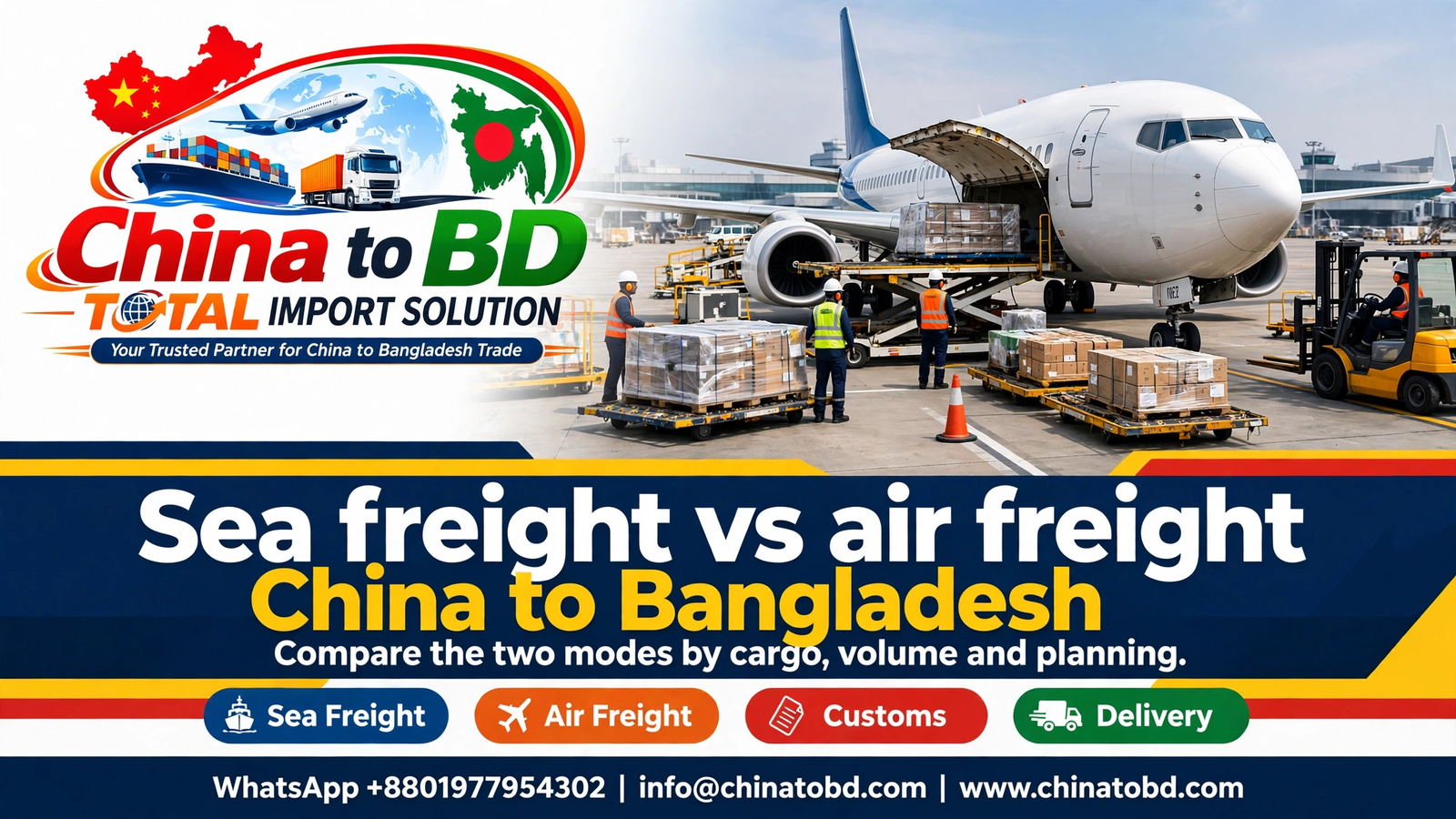
Sea freight vs air freight China to Bangladesh
Sea freight vs air freight China to Bangladesh
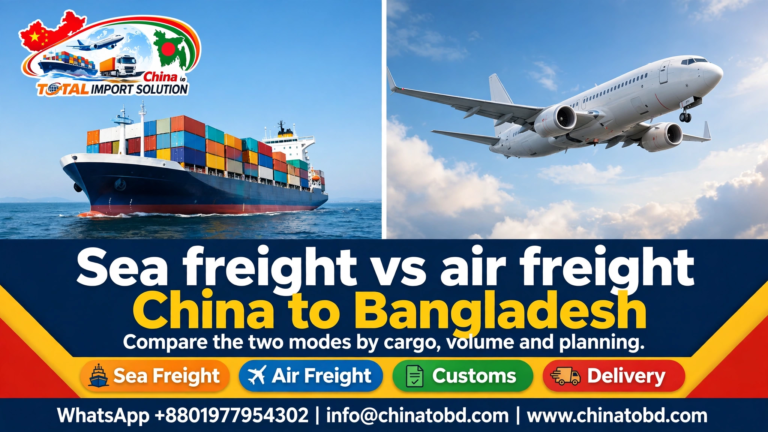
Every importer from China to Bangladesh faces the same first choice: should the goods travel by sea or by air? The two modes work in different ways, suit different kinds of cargo, and need different kinds of planning. Sea freight moves goods in containers on a vessel from a port in China to a port in Bangladesh. Air freight moves goods on an aircraft from an airport in China to an airport in Bangladesh. Both modes end with the same steps in Bangladesh: customs clearance, transport, warehouse receipt, and delivery. The choice between them is not about which mode is better in general. It is about which mode fits the cargo, the volume, the packing, the documents, and the delivery plan of one particular shipment.
Many importers choose by habit. A business that has always used sea freight keeps using sea freight, even when a small order would suit air freight. A business that has used air freight once keeps using it, even when a large regular order would suit a container by sea. Habit is a poor guide, because the cargo changes from order to order. A shipment of garments in cartons is not the same job as a shipment of machine parts, and a shipment of samples is not the same job as a shipment of a full container. Each order should be judged on its own facts, with the same short list of factors checked every time.
This article compares sea freight and air freight from China to Bangladesh on factors only: the kind of cargo, the volume, the packing, the loading, the documents, the customs steps, the planning, and the cost factors to confirm at booking. It gives no figures for transit or freight charges, because those figures depend on the cargo, the route, the container or aircraft space, and the delivery plan, and any figure printed here would be out of date before the shipment is booked. For a figure for a specific shipment, share the cargo list, the loading point, and the delivery point with China to BD | Total Import Solution and ask for a written quotation.
China to BD | Total Import Solution has supported importers from China to Bangladesh since 2016, with sea freight, air freight, customs handling, warehousing, and delivery. The comparison here follows the order used in a real booking: describe the cargo, check the volume, check the packing, check the documents, and only then choose the mode. For help, call +8801977954302, email info@chinatobd.com, or visit www.chinatobd.com. The warehouse and office are at House 38A, Mendi Dental College Road, Road 11, Dhanmondi Riverview Model Town, Dhaka 1209.
Sea Freight from China to Bangladesh: How It Works
Sea freight is the movement of goods in containers on a vessel. The goods are packed in China, loaded into a container, sealed, and carried to a port in China. The container is loaded onto a vessel, which sails to a port in Bangladesh, usually Chittagong. At the port in Bangladesh, the container is offloaded, cleared through customs, and moved by truck to a warehouse, where the goods are counted, checked, and delivered to the shop, the factory, or the buyer.
A full container load suits a larger order, where the importer fills a whole container with one shipment. A shared container load suits a smaller order, where the goods of several importers travel in one container and each importer pays for the space used. A 20-foot container suits a smaller load or a delivery point with limited space. A 40-foot container suits a larger load, but it needs more space for the truck, for turning, and for offloading. Special handling is needed for goods that do not fit a standard container, such as long, wide, or heavy items, and those goods need a separate plan for loading, lashing, and offloading.
Sea freight suits cargo that can be planned well in advance, because the vessel, the container, and the warehouse all need to be booked and prepared before the goods leave China. The importer should confirm the cargo list, the packing, the container size, and the delivery point before booking, and should ask for the terms in writing, including what is included, what is separate, and what happens if the plan changes. The seal number should be recorded at loading in China, written on the documents, and checked again on arrival in Bangladesh.
For importers who want to understand how sea freight bookings are planned in detail, the article China to Bangladesh Sea Freight: Best Deals on Leased Containers explains how leased containers are used for sea shipments, including the checks on the container, the loading, and the offloading plan that protect a load on the journey from China to Bangladesh.
| Sea freight point | What it means for the importer |
|---|---|
| Full container load | One importer fills a whole container with one shipment |
| Shared container load | Goods of several importers travel in one container |
| 20-foot container | Suits a smaller load or a site with limited space |
| 40-foot container | Suits a larger load, needs more space for truck and offloading |
| Oversized cargo | Needs a separate plan for loading, lashing, and offloading |
| Seal number | Recorded at loading, written on the documents, checked on arrival |
| Port of discharge | Usually Chittagong, confirmed on the booking and the documents |
Air Freight from China to Bangladesh: How It Works
Air freight is the movement of goods on an aircraft. The goods are packed in China, taken to an airport, checked, and loaded onto an aircraft that flies to an airport in Bangladesh, usually Dhaka. At the airport in Bangladesh, the goods are offloaded, cleared through customs, and moved to a warehouse or directly to the buyer. Air freight is used for cargo that is small in volume, high in value, fragile, or needed for a production line, a shop, or a customer order that cannot wait for a vessel.
The packing for air freight must be light, strong, and compact, because the space on an aircraft is limited and the goods are handled several times between the supplier and the airport. Each package should be marked with the item name, the quantity inside, and any handling note, such as fragile, this side up, or keep dry. Every package should carry a label that identifies it as part of the shipment, with the consignee name and a package number that matches the packing list. The airline and the handling agent will check the weight, the size, and the documents before the goods are accepted, and goods that do not match the booking may be refused or held back.
Air freight also needs the documents to be ready before the goods reach the airport. The air waybill is the transport document for air freight, and it must match the commercial invoice and the packing list. The importer should keep the import registration, tax identification, and bank documents ready, and confirm with the customs broker which papers must be presented in original and which as a copy. A document error found at the airport is harder to fix than one found at the desk, because the goods are already packed and the supplier is far away.
Sea Freight vs Air Freight: A Factor-by-Factor Comparison
The table below compares the two modes on the factors that matter in a real booking. Read it with the cargo list in hand, and mark which side fits the shipment. A shipment that fits sea freight on most factors should travel by sea. A shipment that fits air freight on most factors should travel by air. A shipment that is split between the two, with some cartons suited to sea and some suited to air, can be sent as two shipments, with each part planned on its own.
| Factor | Sea freight | Air freight |
|---|---|---|
| Cargo volume | Suits larger volumes and full containers | Suits smaller volumes and compact packages |
| Cargo weight | Suits heavy goods and large orders | Limited by aircraft space and handling |
| Cargo type | Suits garments, machinery, furniture, bulk goods | Suits samples, electronics, spares, urgent orders |
| Packing | Export cartons, pallets, crates for a sea journey | Light, strong, compact packing for handling |
| Loading | Container loaded and sealed in China | Packages checked and loaded at the airport |
| Planning | Booked and prepared well in advance | Booked with the documents ready before the airport |
| Documents | Bill of lading, invoice, packing list, certificate of origin | Air waybill, invoice, packing list, certificate of origin |
| Customs | Cleared at the sea port in Bangladesh | Cleared at the airport in Bangladesh |
| Delivery point | Truck from the port to the warehouse | Truck from the airport to the warehouse or buyer |
| Handling | Crane, truck, and warehouse labour for containers | Handling agents and warehouse labour for packages |
Choosing by Cargo Type
The kind of cargo is the first factor to check, because it decides the packing, the handling, and the documents. Garments in cartons, packed in a standard way and ordered in a regular pattern, suit sea freight in most cases, because the volume is large and the goods can be planned in advance. Machinery and machine parts suit sea freight when they are large and heavy, and air freight when they are small, high in value, or needed to keep a production line running. Furniture suits sea freight, because the volume is large and the goods are bulky. Electronics suit air freight when they are small and high in value, and sea freight when they are ordered in a large volume with proper packing and protection.
Samples are a clear case for air freight. A sample is small, light, and needed so that the importer can check the quality before placing a large order. Spare parts are another clear case: a part that a machine needs, a shop needs, or a customer is waiting for should travel by air. Goods with a short shelf life, and goods for a dated event or a dated order, should also be checked against the mode that fits the delivery date in the plan.
Some goods need special handling in either mode. Fragile goods need internal protection, strong cartons, and clear handling notes. Goods with batteries, liquids, or chemicals need a check on the rules that apply to them, and the importer should confirm with the carrier and the customs broker before booking. Goods that are long, wide, or heavy need a plan for loading, lashing, and offloading, and the delivery point must be checked for the gate, the road, and the equipment before the mode is chosen.
Steps to Choose Between Sea Freight and Air Freight
Follow these steps in order, completing each one before the next is confirmed. A choice made in a hurry, with the cargo still unclear or the documents still unchecked, is a choice that has to be fixed at the port or at the airport instead of at the desk.
- Write the cargo list in full. List the goods, the quantities, the weight, the size, the packing, and the business need, and share them with the service team in writing.
- Check the volume against the container and aircraft space. Note how many cartons there are, how large they are, and whether the load fills a container or fits as packages.
- Check the cargo type against the table above. Note whether the goods are garments, machinery, furniture, electronics, samples, spares, or goods that need special handling.
- Check the packing. Confirm that the cartons are suited to export, that fragile items have internal protection, and that every package is labelled with the item name, the quantity, and the consignee name.
- Check the delivery point in Bangladesh. Confirm the gate, the road, the turning space, the ground surface, the floor space, and the working hours, and confirm whether the point can receive a container or only packages.
- Check the documents. Confirm the commercial invoice, the packing list, the certificate of origin where required, and the bill of lading for sea freight or the air waybill for air freight.
- Ask for the terms in writing for both modes. Confirm what is included, what is separate, who is responsible for each stage, and what happens if the plan changes.
- Compare the two modes on the same factors. Use the table above, mark which side fits the shipment, and write the reasons down.
- Choose the mode that fits most factors, and confirm the booking, the loading point, the delivery point, and the delivery dates in writing.
- On arrival, follow the plan in order: check the seal number for sea freight or the package count for air freight, receive the goods, count and check them against the packing list, note any damage or shortage at once, and close the shipment file with a delivery receipt.
For a shipment that travels by sea from a port such as Xiamen, the planning steps are the same, but the loading and the port checks need to be agreed in advance. The article Fast Transit Container Solutions from Xiamen to Chittagong describes how container shipments from Xiamen to Chittagong are planned, and its guidance on the container, the loading, and the delivery point applies to any sea freight shipment from China to Bangladesh.
Documents and Customs for Sea and Air Shipments
The documents for sea freight and air freight are alike in most respects, and different in one. Both modes need a commercial invoice, which describes the goods, the quantity, and the value for customs purposes. Both need a packing list, which describes how the goods are packed, how many packages there are, and what is inside each package. Both need a certificate of origin where required, which states where the goods were made. Other certificates may be required for specific goods, and the importer should confirm the requirement for the exact goods before shipment. The difference is the transport document: a bill of lading for sea freight, issued by the carrier, and an air waybill for air freight, issued by the airline.
Before the goods leave China, complete a short document review with the customs broker: confirm that the invoice, the packing list, and the transport document agree, that the consignee name is spelled the same way on every document, that the port or airport of discharge is correct, and that the container and seal numbers for sea freight, or the package count and weights for air freight, are recorded. If a document needs a correction, request it from the supplier before the goods are loaded, because a correction after loading takes longer and may hold the goods at the port or the airport.
Customs clearance in Bangladesh follows the same order in both modes: the documents are checked, the duty and tax position is confirmed with the customs broker, the goods are cleared, and the container or the packages are released for transport. The importer should keep the import registration, tax identification, and bank documents ready, and confirm with the customs broker which papers must be presented in original and which as a copy.
Cost Factors to Confirm at Booking
The cost of a shipment is made up of several parts, and each part should be confirmed at booking, for both modes. Freight is the cost of moving the goods from China to Bangladesh, by vessel or by aircraft. Port or airport charges cover the handling of the container or the packages at each end. Customs duty and tax are set by the customs rules for the exact goods, and the importer should confirm the duty position with the customs broker before booking. Transport covers the movement of the container or the packages from the port or the airport to the warehouse, the delivery to the shop, factory, or buyer, and the return of the empty container for sea freight. Labour covers the offloading, sorting, counting, and checking. Warehouse use covers the space and the time that the goods occupy.
Each part can change if the plan changes, so ask at booking what happens if the plan changes and how a change is charged. Ask which charges are included in the quotation and which are separate, and read the quotation line by line. Confirm payment terms as well, because a delayed payment can delay the release of the container or the packages. No figure in this article is presented as a price, because the cost depends on the cargo, the route, the mode, and the delivery plan. For a figure for a specific shipment, share the cargo list, the loading point, the delivery point, and the delivery dates with China to BD | Total Import Solution and ask for a written quotation. Contact the helpline at +8801977954302 or email info@chinatobd.com.
A written quotation also protects the importer when the two modes are compared. Compare quotations line by line, on the same points, and ask about any line that is unclear. Ask for a quotation for both modes when the cargo could travel either way, so that the choice is made on the full job, not only on the freight.
Common Mistakes
- Choosing the mode by habit, without checking the cargo list, the volume, and the delivery plan for the order in hand. Judge each order on its own facts.
- Booking sea freight for a small urgent order that needs only a few cartons, so a full container booking, a port clearance, and a warehouse receipt are arranged for a single carton.
- Booking air freight for a large regular order that fills a container, so packages are sent one by one instead of as a single planned load.
- Leaving the documents until after the goods are loaded, so an error is only found at the port or the airport. Ask the supplier for a copy of each document before loading, and check it against the cargo list.
- Packing for the wrong mode: heavy export cartons for air freight, or light packing for a sea journey that needs protection against movement, lifting, and stacking.
- Choosing a container size that does not fit the delivery point. Check the gate, the road, the turning space, and the equipment before choosing the container.
- Not recording the seal number at loading for sea freight, or the package count and weights for air freight. Record them, write them on the documents, and check them again on arrival.
- Relying on verbal agreements. Keep every agreement in writing, in one shipment file, and share the same written plan with every party.
- Signing a clean receipt for damaged or short goods. Note the damage or shortage on the receipt, take a photo, and keep a copy.
Decision Checklist
Copy this table into the shipment file and mark each item as it is completed. Complete the pre-booking items before the mode is chosen, and the arrival items before the goods are put away.
| Check | When | Done |
|---|---|---|
| Cargo list written in full, with goods, quantities, weight, and size | Before booking | |
| Volume checked against container space and aircraft space | Before booking | |
| Cargo type checked against the comparison table | Before booking | |
| Packing checked for the chosen mode | Before booking | |
| Delivery point checked for gate, road, turning space, and equipment | Before booking | |
| Documents listed: invoice, packing list, certificate of origin | Before booking | |
| Transport document confirmed: bill of lading or air waybill | Before loading | |
| Terms received in writing for the chosen mode | Before booking | |
| Customs broker named, with full document set shared | Before departure | |
| Container and seal numbers, or package count and weights, recorded | At loading | |
| Duty and payment arrangements confirmed | Before arrival | |
| Labour and equipment booked for offloading and counting | Before arrival | |
| Warehouse space, sorting space, and covered area confirmed | Before arrival | |
| Seal number or package count checked on arrival, before opening | At arrival | |
| Goods counted and checked against the packing list | At delivery | |
| Damage or shortage noted at once, with photo and written note | At delivery | |
| Delivery receipt signed and recorded | After delivery |
Frequently Asked Questions
Q1: What is the difference between sea freight and air freight from China to Bangladesh?
Sea freight moves goods in containers on a vessel from a port in China to a port in Bangladesh. Air freight moves goods on an aircraft from an airport in China to an airport in Bangladesh. Both modes end with customs clearance, transport, warehouse receipt, and delivery in Bangladesh.
Q2: Which mode suits a large order from China to Bangladesh?
A large order that fills a container, with goods that can be planned in advance, usually suits sea freight. Check the volume, the packing, and the delivery point first, and confirm the container size that fits the site in Bangladesh.
Q3: Which mode suits a small order or a sample from China?
A small order, a sample, or a spare part usually suits air freight, because the volume is small and the goods are needed for a check, a production line, or a customer order. Sending a single carton by sea adds a container booking, a port clearance, and a warehouse receipt for one carton.
Q4: How do I choose between sea freight and air freight for my cargo?
Write the cargo list, check the volume, check the cargo type against the comparison table, check the packing, check the delivery point, and check the documents. Choose the mode that fits most factors, and write the reasons down.
Q5: What documents do I need for sea freight from China to Bangladesh?
The main documents are the commercial invoice, the packing list, the bill of lading, and the certificate of origin where required. Other certificates may be required for specific goods, so confirm the requirement before shipment.
Q6: What documents do I need for air freight from China to Bangladesh?
The main documents are the commercial invoice, the packing list, the air waybill, and the certificate of origin where required. Other certificates may be required for specific goods, so confirm the requirement before shipment.
Q7: Can a shipment be split between sea freight and air freight?
Yes. A shipment with some cartons suited to sea and some suited to air can be sent as two shipments, with each part planned on its own. Keep a separate cargo list, packing list, and document set for each part, so that the two parts are not mixed up at the port or the airport.
Q8: How should goods be packed for sea freight?
Use export cartons with internal protection for fragile items, label each carton with the item name and quantity, and label every package with the consignee name and a package number that matches the packing list. Packing must suit movement at sea, lifting by crane, and stacking under other cargo.
Q9: How should goods be packed for air freight?
Use light, strong, compact packing, because the space on an aircraft is limited and the goods are handled several times. Label each package with the item name, the quantity, and any handling note, and check the weight and size against the booking before the goods reach the airport.
Q10: What should I check at the delivery point before choosing a mode?
Check the gate width, access road, turning space, ground surface, floor space, sorting space, and working hours. Confirm whether the point can receive a container by truck, or only packages, and confirm that labour and equipment are booked.
Q11: What is a bill of lading, and what is an air waybill?
A bill of lading is the transport document for sea freight, issued by the carrier, and it must match the invoice and the packing list. An air waybill is the transport document for air freight, issued by the airline, and it must also match the invoice and the packing list.
Q12: Why is the seal number important in sea freight?
The seal number links the container to the documents. Record it at loading in China, write it on the documents, and check it again on arrival in Bangladesh. If it does not match, stop and record the difference with a photo before opening the container.
Q13: What are the most common mistakes when choosing between sea and air freight?
The most common mistakes are choosing by habit, booking sea freight for a small urgent order, booking air freight for a large regular order, leaving documents until after loading, packing for the wrong mode, and signing a clean receipt for damaged goods.
Q14: Which cost factors should I confirm before booking sea or air freight?
Confirm the freight, the port or airport charges, the customs duty and tax, the transport, the labour, and the warehouse use. Ask which charges are included in the quotation, which are separate, and what happens if the plan changes.
Q15: Can oversized cargo travel by sea or by air from China to Bangladesh?
Oversized cargo usually travels by sea, with a separate plan for loading, lashing, and offloading. Check the route, the equipment, the lifting plan, and the handling team in advance, and confirm the delivery point can receive the goods before booking.
Q16: How can China to BD | Total Import Solution help with sea freight vs air freight China to Bangladesh?
China to BD | Total Import Solution has supported importers from China to Bangladesh since 2016, with sea freight, air freight, customs handling, warehousing, and delivery. The team can help compare the two modes for a specific cargo list, plan the chosen mode, and look after the shipment from loading in China to delivery in Bangladesh.
Contact China to BD | Total Import Solution
For a written plan and quotation for sea freight or air freight from China to Bangladesh, contact China to BD | Total Import Solution. Share the cargo list, the loading point in China, the delivery point in Bangladesh, and the delivery dates, so the plan and the mode can be based on the actual shipment.
- Brand: China to BD | Total Import Solution
- Company: Total Import Solution, since 2016
- Helpline: +8801977954302
- Email: info@chinatobd.com
- Website: www.chinatobd.com
- Warehouse & Office: House 38A, Mendi Dental College Road, Road 11, Dhanmondi Riverview Model Town, Dhaka 1209
Call the helpline at +8801977954302 or email info@chinatobd.com to discuss sea freight vs air freight from China to Bangladesh, to compare the two modes for a specific cargo list, or to check a document list before the goods leave China.
About the Author