Heavy Duty Intermodal Container Rental for Inland Transport
Heavy Duty Intermodal Container Rental for Inland Transport
Heavy goods do not move the way light cartons move. A machine, a set of steel parts, or a load of crated factory equipment needs a container that is checked before loading, a route that is planned before the truck leaves, and a transfer point where the container can change from one mode of transport to another without the goods being handled more than necessary. That is what intermodal inland transport is about: the same container travels by road, by rail, and through the port, and the goods inside stay packed from the loading point to the warehouse in Bangladesh.
China to BD | Total Import Solution works with importers who bring heavy goods from China to Bangladesh and need the inland leg handled with the same care as the sea leg. The company, Total Import Solution, has been serving importers since 2016, and its team plans container rental, loading, transfer, and delivery as one connected job rather than a set of separate bookings. This article explains how heavy duty intermodal container rental works for inland transport, which goods suit it, how to check a route, what documents to prepare, and how loading should be planned.
The Warehouse & Office of China to BD | Total Import Solution is at House 38A, Mendi Dental College Road, Road 11, Dhanmondi Riverview Model Town, Dhaka 1209. Importers can reach the team on Helpline +8801977954302 or by email at info@chinatobd.com, and the website is www.chinatobd.com. Before you rent a container for a heavy inland move, read the sections below and use the checklist near the end of this article to prepare your goods list, your loading point, and your warehouse details.
What Intermodal Inland Transport Means
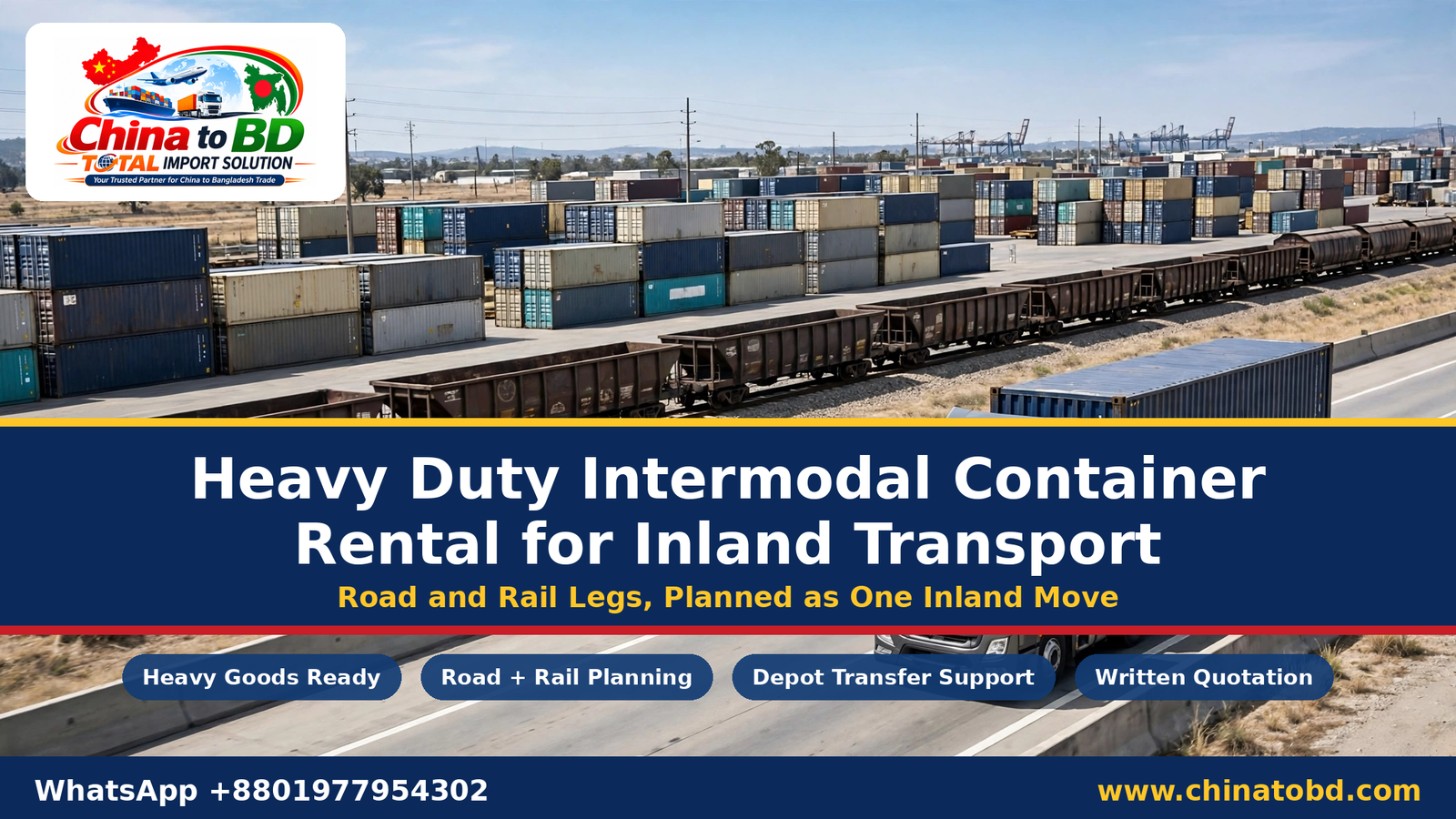
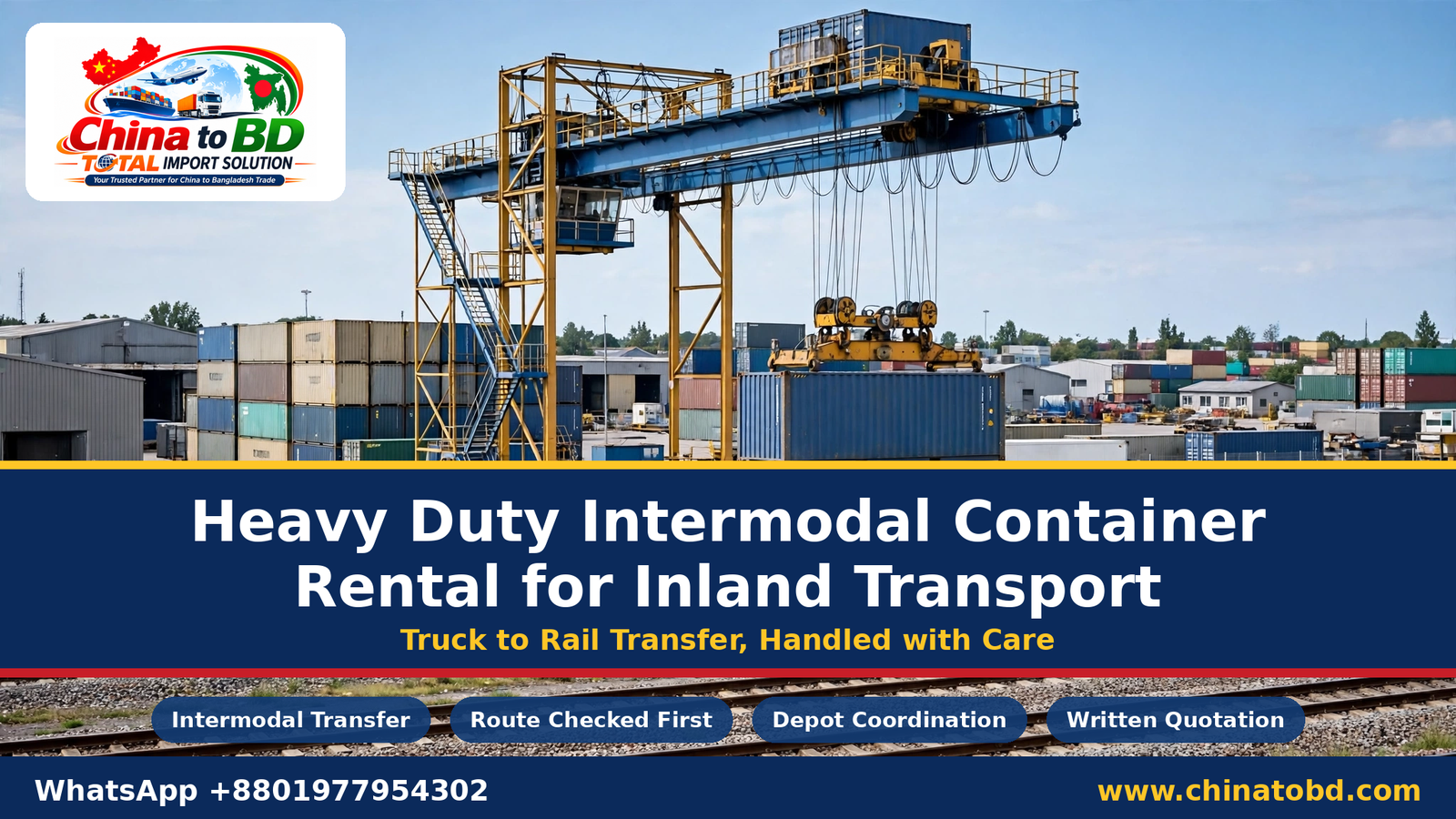
Intermodal transport means a container moves on more than one mode of transport during a single journey while the goods stay inside the same container. For an inland move in Bangladesh, the legs are usually road, rail, and the port. The container is loaded once, sealed, and then carried by truck, transferred to a rail wagon where rail is part of the plan, and delivered by road to the warehouse. Each transfer is a planned handover, not a repacking job.
The port leg is where the container arrives and is cleared for the inland journey. This is the point where the container condition, the seal, and the papers are checked before the inland move begins. A container that leaves the port area with a problem that was not noticed at the port can cause delay further along the route, so the check at this stage matters.
The rail leg suits a container that needs to travel a longer inland distance on a fixed corridor. Rail wagons carry the container between transfer points, and a truck handles the first and last stretches of road where rail does not reach. The road leg gives the flexibility that rail cannot: it reaches the loading point, the depot, and the warehouse gate. When the three legs are planned together, the container spends less time waiting between modes and the goods are handled fewer times.
Which Heavy Goods Suit Intermodal Container Rental
Heavy goods that are packed in crates, cases, or pallets and loaded as one planned unit suit intermodal container rental well. Machinery, factory equipment, steel and structural material, building stone, and heavy palletised cartons are common examples. The key point is not only the weight of the goods but how the weight is spread across the container floor, how the goods are braced, and whether the loading order allows the container to be unloaded safely at the warehouse.
| Goods type | Why it suits intermodal rental | What to check before loading |
|---|---|---|
| Machinery and factory equipment | Packed as a single unit that stays sealed across road and rail legs | Packing strength, lifting points, and loading order |
| Steel and structural material | Long and dense items travel well when braced and spread across the floor | Floor condition, bracing material, and weight spread |
| Building stone and heavy slabs | Crates protect the goods while the container moves between modes | Crate condition, packing, and securing inside the container |
| Heavy palletised cartons | Pallets allow orderly loading and unloading at each end | Pallet condition, stacking order, and carton labelling |
| Crated goods of mixed sizes | Crates of different sizes can be arranged to fill the container evenly | Loading plan, gap filling, and door-side access |
If your goods are loose, unpacked, or packed in a way that shifts during a transfer, talk through the packing with the team before you book. A container that is loaded with care at the start is easier to transfer, easier to unload, and less likely to need extra handling at the depot or the warehouse.
Why Plan the Inland Leg Before You Book
Many inland problems start with a booking that was made before the route was checked. The container may be ready, but the road to the warehouse may not suit a heavy load, the depot may need advance notice, or the warehouse may not have the equipment to unload on the planned day. Planning the inland leg first means these points are confirmed while there is still time to adjust the plan.
A planned inland leg also helps you prepare the goods list properly. When you know the loading point, the transfer point, and the warehouse, you can list the product names, the packing type, the carton or crate count, and the loading dates in one place. That list is what the team uses to prepare a written quotation, and it is also what the loading team uses on the day.
Planning ahead also protects the container itself. A heavy container that waits at a transfer point because the next leg was not arranged can add days to a move and add work for everyone involved. When the road leg, the rail leg, and the depot handover are arranged in order, the container keeps moving and the warehouse can prepare for its arrival.
Checking the Route Before the Container Moves
Route checking is a simple habit: confirm each part of the journey before the container starts moving. Start with the loading point and the road that leads away from it, then the transfer point where the container changes mode, then the depot where it may wait, and finally the road to the warehouse and the warehouse gate itself. If any part of that chain is unclear, ask before the booking is confirmed.
Depot availability is part of the route check. Confirm availability at Chittagong off-dock ICDs and Dhaka inland depots in general terms before you plan a transfer through them, and ask what notice a depot needs for a heavy container. Depot space and handling slots change with the season and with the flow of containers, so a confirmation made close to the loading date is more useful than an assumption made weeks earlier.
| Route check | What to confirm | Why it matters |
|---|---|---|
| Loading point access | Road access for a heavy truck and space to load | A truck that cannot reach the loading point delays the whole move |
| Transfer point | Where the container changes between road and rail | Each transfer needs equipment, space, and a planned time |
| Depot availability | Space and handling at Chittagong off-dock ICDs and Dhaka inland depots | A depot that is full cannot receive a container on short notice |
| Warehouse gate and yard | Entry for a heavy truck and room to unload | The final leg fails if the warehouse cannot receive the container |
| Loading equipment | Crane or forklift availability at loading and unloading points | Heavy goods need the right equipment at both ends |
Readers who want to understand how container timing and waiting time are managed may find Zero Demurrage Shipping: Rent Containers for Extended Offloading useful. It explains how extended offloading is planned so that a container is not rushed at the warehouse.
Container Options for Heavy Goods
Not every container suits every heavy load. A standard dry container suits boxed and palletised goods that load through the doors. An open-top container suits goods that are lowered in from above with a crane, such as tall machinery or long items that do not fit through the doors easily. A flat-rack container suits goods that need an open side or an open top for loading and that are secured to the rack itself. The choice depends on the shape of your goods, the packing, and the equipment at the loading point.
Before you choose, check the container itself. The floor should be sound and dry, the doors should close and seal properly, the walls and roof should be free of damage that could let in water, and the container should be clean inside. A container that fails any of these checks should not be loaded with heavy goods, because a floor weakness or a door that does not seal will only become harder to deal with once the container is on the road or on a rail wagon.
| Container type | Best suited for | Loading note |
|---|---|---|
| Standard dry container | Boxed, crated, and palletised heavy goods | Load through the doors in a planned order |
| Open-top container | Tall machinery and goods loaded from above | Needs a crane at the loading point and a sound cover |
| Flat-rack container | Oversized or awkwardly shaped heavy items | Goods are secured to the rack and checked before the move |
| Ventilated container | Goods that need airflow during the inland move | Check vents are clear and the goods are packed to allow air to move |
Ask the team which container type fits your goods list before you confirm a booking. A short conversation about the product names, the packing type, and the loading point is often enough to point to the right option, and it avoids the cost and delay of changing a container after loading has started.
How to Book a Heavy Duty Intermodal Container Rental
Booking follows a clear order. Each step gives the next step the information it needs, so it is worth completing them in sequence rather than skipping ahead.
- Prepare your goods list with product names, packing type, and the count of cartons or crates.
- Share your loading point, your warehouse in Bangladesh, and your loading dates.
- Ask the team which container type suits your goods and your loading equipment.
- Confirm the route, including the road legs, the rail leg where it applies, and the transfer point.
- Confirm availability at Chittagong off-dock ICDs and Dhaka inland depots where a transfer or a wait is planned.
- Check the container condition, floor, doors, and seal before loading begins.
- Agree the loading plan, the loading order, and the bracing material with the loading team.
- Confirm the unloading plan at the warehouse, including equipment and a contact person on the day.
Keep a written record of each confirmation. A written note of the container type, the route, the depot, and the loading date helps everyone involved — the loading team, the depot, the driver, and the warehouse — work from the same plan on the day of the move.
Documents and Checks to Prepare
Paperwork for an inland intermodal move is straightforward, but it should be ready before the container moves. The goods list, the packing list, and the commercial papers that cover the goods should match each other, and the contact details for the loading point and the warehouse should be written down and shared with the team. When papers and goods match, checks at the port and at the depot go more smoothly.
Checks on the container itself are just as important as the papers. Walk around the container, look at the floor, open and close the doors, check the seal, and note anything that needs attention before loading. Photographs of the container condition before loading are a useful record for both the importer and the team.
| Document or check | What it covers | When to prepare it |
|---|---|---|
| Goods list | Product names, packing type, carton or crate count | Before you ask for a quotation |
| Packing list | How each item is packed and marked | Before loading day |
| Commercial papers | The papers that cover the goods for the journey | Before the container leaves the loading point |
| Container inspection note | Floor, doors, walls, roof, and seal condition | At the container, before loading |
| Route and depot confirmation | Road legs, rail leg, transfer point, and depot | Before the booking is confirmed |
| Warehouse contact sheet | Warehouse address, contact person, and unloading equipment | Before the container is dispatched |
If any paper is missing or any check is unclear, raise it before the container is loaded. A question asked early is a small delay; a problem found after the container is sealed and on the road is a much larger one.
Loading and Handling Planning for Heavy Goods
Loading is where an inland move is won or lost. Heavy goods need a loading order that puts the heaviest items where the floor can carry them and keeps the load balanced from side to side. The loading team should know the weight spread of the goods, the order in which crates will come off at the warehouse, and which items need to stay near the doors for early unloading.
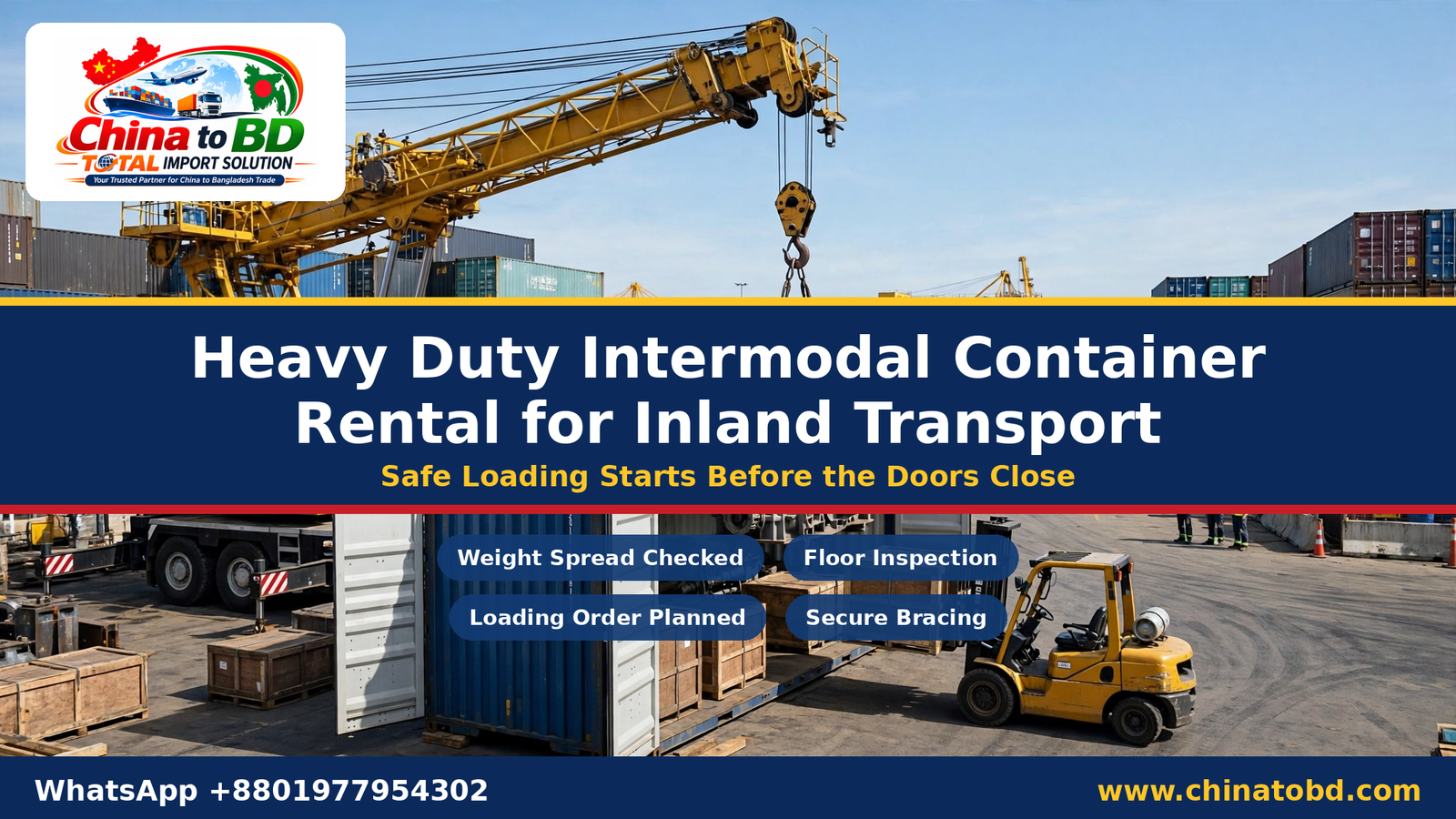
Weight spread matters because a container floor carries a load best when the weight is shared across its length. A single heavy crate placed in one spot puts more strain on that part of the floor than the same weight spread across several crates. Ask the loading team how they plan to spread the load, and check that the plan matches the goods list you shared.
Floor condition should be checked before the first crate goes in. The floor should be dry, free of soft spots, and clear of debris. A floor that is wet or damaged can shift under a heavy load, and a crate that sits on a wet patch can be damaged before the container even leaves the loading point. If the floor is not sound, the container should be changed before loading starts.
Bracing holds the load still while the container changes mode. When a container moves from a truck to a rail wagon and back to a truck, the load feels the change at each transfer. Timber bracing, blocking, and strapping keep crates from moving, and gaps between crates should be filled so that nothing can slide. The bracing plan should be agreed before loading, not improvised while the doors are open.
Inspection does not stop once loading starts. Check the load as it goes in, check the bracing before the doors close, and check the seal once the doors are shut. A short inspection at each stage is far easier than opening a sealed container later to fix a load that has shifted.
For importers who are moving a full load from China, Full Container Load FCL Service from China to BD explains how a full container is planned from the loading point in China to the warehouse in Bangladesh, and it pairs well with the inland planning in this article.
What Shapes the Cost of an Inland Container Move
The cost of an inland container move is shaped by several factors, and no single factor decides it on its own. The distance of the road legs, the length of the rail leg where one is used, and the number of transfers all play a part. A move with one transfer costs less in handling than a move with two, and a direct road leg is planned differently from a road and rail combination.
The type of container also shapes the cost. A standard dry container, an open-top container, and a flat-rack container each need different handling and different equipment, and the choice should follow the goods rather than the price alone. Loading equipment is another factor: a loading point with a crane already in place needs less arrangement than a point where equipment must be brought in.
Depot handling is a further factor. Where a container waits at a depot or changes mode there, the depot handling and the time the container spends there form part of the plan. Confirming availability at Chittagong off-dock ICDs and Dhaka inland depots in advance helps the team plan the handling and the timing together.
Warehouse readiness shapes the cost as well. A warehouse that is ready with equipment, space, and staff on the arrival day unloads the container in one visit. A warehouse that is not ready can need a second visit or a longer wait, and both add work. Sharing the warehouse details and the unloading plan early keeps this part of the move simple.
The goods themselves are the final factor. Heavy, dense, or awkwardly shaped goods need more planning, more bracing material, and more care at each transfer than light, regular cartons. A clear goods list lets the team plan the loading, the bracing, and the equipment properly and prepare a written quotation that reflects the real work involved.
Coordinating the People in the Move
An intermodal move involves several people: the loading team at the loading point, the driver on the road legs, the staff at the transfer point and the depot, and the warehouse team at the end. Each of them needs the same basic information — what is in the container, when it is coming, and what equipment is needed. When that information is shared in writing, each handover is smoother and fewer questions arise on the day.
Choose one contact person for the move and share their name and number with everyone involved. If a loading time shifts or a depot asks for a detail, the contact person can answer once instead of the same question travelling through several people. A single point of contact also helps when the plan changes, because the change is passed on from one person to the whole chain rather than piece by piece.
After the move, keep the notes from the booking, the inspection, and the delivery together. They form a record of what worked well and what to adjust next time, and they make the next booking faster because the goods list, the route, and the warehouse details are already on file.
Common Mistakes to Avoid
- Booking the container before the route and the depot have been confirmed.
- Loading heavy goods without a written loading order.
- Placing the heaviest crates in one spot instead of spreading the weight.
- Skipping the floor and door check before loading begins.
- Leaving gaps between crates with no bracing or blocking.
- Sharing an incomplete goods list and adding items on loading day.
- Forgetting to confirm the unloading equipment at the warehouse.
- Sealing the container before the bracing and the load have been inspected.
Pre-Shipment and Loading Checklist
Use this checklist before the container is loaded. Tick each item off with the team, and keep the completed list with your booking record.
| Check | Done? | Notes |
|---|---|---|
| Goods list complete with product names, packing type, and count | Yes / No | Share the list before asking for a quotation |
| Loading point, warehouse, and loading dates confirmed | Yes / No | Include a contact person at each end |
| Container type agreed for the goods | Yes / No | Standard, open-top, flat-rack, or ventilated |
| Route checked: road legs, rail leg, and transfer point | Yes / No | Confirm each leg before the booking |
| Depot availability confirmed at Chittagong off-dock ICDs and Dhaka inland depots | Yes / No | Ask what notice the depot needs |
| Container floor, doors, walls, roof, and seal inspected | Yes / No | Change the container if any check fails |
| Loading order and weight spread agreed with the loading team | Yes / No | Heaviest items placed to spread the load |
| Bracing material and gap filling ready | Yes / No | Timber, blocking, and strapping as planned |
| Load inspected and bracing checked before the doors close | Yes / No | Check again before the seal goes on |
| Unloading plan and equipment confirmed at the warehouse | Yes / No | Confirm the arrival day with the warehouse |
Frequently Asked Questions
Q1: What is heavy duty intermodal container rental for inland transport?
It is the rental of a container for a heavy inland move in which the same container travels by road, by rail, and through the port without the goods being unpacked. The goods are loaded once, the container is sealed, and it changes mode at planned transfer points until it reaches the warehouse.
Q2: Which goods are heavy enough to need this kind of rental?
Machinery, factory equipment, steel and structural material, building stone, and heavy palletised cartons are common examples. The deciding factors are the weight of the goods, how the weight is spread, the packing, and the loading order, rather than any single item on its own.
Q3: How is an intermodal move different from a road-only move?
A road-only move uses trucks for the whole inland journey. An intermodal move combines road with rail where rail is part of the plan, and the container changes mode at a transfer point. The goods stay in the same container in both cases, but the intermodal plan needs the transfer point and the depot to be arranged in advance.
Q4: Do I need to unload my goods when the container changes from truck to rail?
No. In an intermodal move the container itself is transferred between the truck and the rail wagon, and the goods stay packed inside. That is the main point of the system: fewer handlings of the goods and fewer chances for damage during the move.
Q5: How do I choose between a standard container, an open-top container, and a flat-rack container?
The choice follows the shape of your goods and the equipment at your loading point. A standard container suits boxed and palletised goods loaded through the doors. An open-top container suits tall goods loaded from above with a crane. A flat-rack suits oversized or awkwardly shaped items secured to the rack. Share your goods list with the team and ask which type fits.
Q6: What should I check on a container before loading heavy goods?
Check the floor for soft spots and wet patches, open and close the doors, check the seal, and look at the walls and roof for damage. The container should be clean and dry inside. If any check fails, ask for a different container before loading starts.
Q7: How should heavy goods be loaded inside a container?
Load in a planned order, spread the weight across the floor, keep the load balanced from side to side, and brace the crates so they cannot move. Fill gaps between crates, check the bracing before the doors close, and keep the items that need to come off first near the doors.
Q8: Can a container wait at a depot during an inland move?
Yes, a container can wait at a depot where a transfer or a handover is planned. Confirm availability at Chittagong off-dock ICDs and Dhaka inland depots before you plan a wait there, and ask what notice the depot needs for a heavy container.
Q9: What is a Chittagong off-dock ICD, and why does it matter for my move?
An off-dock inland container depot near Chittagong is a place where containers are received, stored, and handed over away from the port terminals. It matters because a transfer or a wait planned through such a depot needs space and handling to be confirmed in advance, in general terms, before the container is dispatched.
Q10: What are Dhaka inland depots used for?
Dhaka inland depots receive containers that have travelled inland and hold them for handover to the warehouse or for the next leg of the journey. If your plan includes a Dhaka inland depot, confirm availability with the team beforehand and share your warehouse details so the final road leg can be arranged.
Q11: What documents do I need for an inland intermodal move?
Prepare a goods list with product names, packing type, and carton or crate count, a packing list, and the commercial papers that cover the goods. Add a container inspection note and a written confirmation of the route and the depot. Keep the warehouse contact details with the same set of papers.
Q12: How far in advance should I book?
Book as early as you can once your goods list and loading dates are known. Early booking gives time to check the route, confirm the depot, choose the right container type, and arrange loading equipment. A booking made at the last minute leaves less room to adjust the plan if a check fails.
Q13: What information do I need to share for a written quotation?
Share your goods list with product names, packing type, and carton or crate count, your loading point, your warehouse in Bangladesh, and your loading dates. With those details the team can plan the container type, the route, the transfers, and the loading, and prepare a written quotation for your shipment.
Q14: What happens if the warehouse is not ready when the container arrives?
Talk to the warehouse before the container is dispatched and agree the arrival day, the unloading equipment, and a contact person. A warehouse that is ready unloads the container in one visit. If readiness is in doubt, raise it early so the plan can be adjusted before the container leaves.
Q15: Who do I contact if my loading date changes?
Contact the team as soon as the date changes, on Helpline +8801977954302 or by email at info@chinatobd.com. A change in the loading date can affect the container booking, the route, and the depot, so the sooner the team knows, the sooner the plan can be updated.
Q16: Can China to BD | Total Import Solution plan the whole inland move for me?
Yes. The team plans the container rental, the route, the transfers, and the loading together, from the loading point to the warehouse in Bangladesh. Share your goods list, loading point, warehouse details, and loading dates, and the team will prepare a written quotation and a plan for your shipment.
Contact China to BD | Total Import Solution
- Brand: China to BD | Total Import Solution
- Company: Total Import Solution, since 2016
- Helpline: +8801977954302
- Email: info@chinatobd.com
- Warehouse & Office: House 38A, Mendi Dental College Road, Road 11, Dhanmondi Riverview Model Town, Dhaka 1209
- Website: www.chinatobd.com
Get a Written Quotation for Your Shipment
Share your goods list with the team and ask for a written quotation for your shipment. Send the product names, the packing type, the carton or crate count, your loading point, your warehouse in Bangladesh, and your loading dates, and the team will plan the container, the route, and the loading for your inland move.
Chat on WhatsApp | Call +8801977954302 | Email: info@chinatobd.com
Heavy goods deserve a plan that is written down before the container moves. With the route checked, the depot confirmed, the loading order agreed, and the warehouse ready, your inland move has a clear path from the loading point to the warehouse door. Contact China to BD | Total Import Solution today and start your shipment with a written quotation.
About the Author