Import payment methods from China: LC, TT and DDP compared
Import payment methods from China: LC, TT and DDP compared
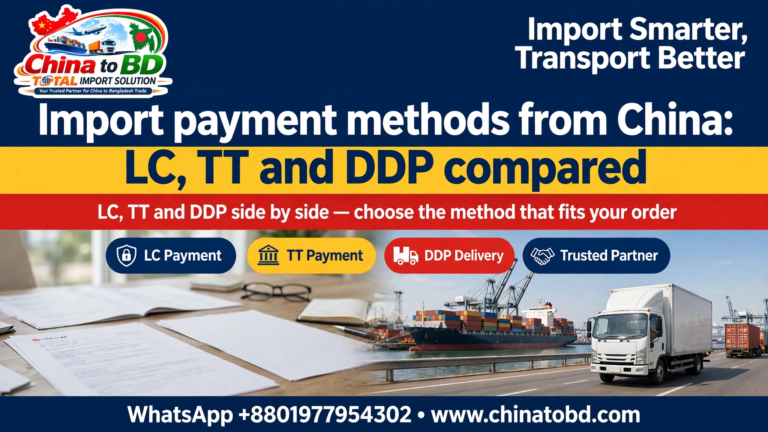
Import payment methods from China are the ways a Bangladesh importer pays a supplier in China, and the three methods in this article — letter of credit (LC), telegraphic transfer (TT), and delivered duty paid (DDP) — work in very different ways. An LC is a bank undertaking to pay against the documents named in the LC. A TT is a direct bank transfer to the supplier’s account, made when the importer instructs the bank. DDP is a delivery term under which the supplier arranges the transport and the duty handling to the agreed delivery point, and the payment terms are agreed separately with the supplier.
The choice between these methods is not a matter of which one is best in general, but of which one fits the order, the supplier, and the risk. A first order with a new supplier, a large order, and an order where the importer wants the bank to check the documents all point toward an LC. A repeat order with a verified supplier, where the importer can check the goods before the final payment, often suits a TT payment in stages. A DDP arrangement suits an importer who wants the supplier to handle the transport and the duty to the delivery point, with the payment stages agreed in writing alongside it.
This article compares LC, TT, and DDP in practical terms for Bangladesh importers: how each method works, who checks what, when the money moves, which documents each method needs, which risks each method carries, how to choose between them, and how to keep a payment file whatever the method. The guidance is general process guidance only; the exact requirements, forms, and conditions are set by the importer’s bank and the regulations in force at the time, and the importer should confirm them with the bank before choosing a method.
China to BD | Total Import Solution has supported importers from China to Bangladesh since 2016, with sourcing, shipping, customs handling, warehousing, and delivery. For help choosing a payment method, call +8801977954302, email info@chinatobd.com, or visit www.chinatobd.com. The warehouse and office are at House 38A, Mendi Dental College Road, Road 11, Dhanmondi Riverview Model Town, Dhaka 1209.
The Three Methods at a Glance
A letter of credit is opened by the importer’s bank at the importer’s request. The bank undertakes to pay the supplier when the supplier presents the documents named in the LC, in the form the LC requires and within its validity period. The bank checks the documents against the LC before payment, but it does not check the goods themselves. The LC gives the supplier confidence of payment and gives the importer confidence that payment follows the documents agreed in advance.
A telegraphic transfer is a direct payment from the importer’s bank to the supplier’s bank account. The importer instructs the bank to send the money, and the bank sends it against the bank details given. The bank does not check the shipping documents or the goods, so the importer’s own checks — supplier verification, sample approval, inspection, and document check — carry the whole weight of the payment. A TT payment is usually split into stages tied to those checks.
DDP, delivered duty paid, is a delivery term rather than a payment method on its own. Under DDP, the supplier arranges the transport and handles the duty to the agreed delivery point, and the importer pays the supplier under the payment terms agreed for the order — which may themselves be by TT or by another method the bank can arrange. The importer should therefore agree two things in writing for a DDP order: the delivery term, and the payment method and stages that go with it. Confusing the two is a common mistake.
| Method | How the money moves | Who checks the documents | Who arranges transport and duty |
|---|---|---|---|
| Letter of credit (LC) | Bank pays when the named documents are presented | The bank checks them against the LC | The importer or the supplier, as the delivery terms state |
| Telegraphic transfer (TT) | Importer instructs the bank to send the money | The importer checks them | The importer or the supplier, as the delivery terms state |
| Delivered duty paid (DDP) | Payment terms agreed separately, often by TT | The importer checks them | The supplier arranges transport and duty to the delivery point |
How a Letter of Credit Works
An LC starts with the importer and the supplier agreeing the order and the LC terms in writing: the goods, the quantity, the value, the ports, the latest shipment date, the validity period, and the documents the supplier must present. The importer then applies to the bank in Bangladesh with the import documents and the supplier’s proforma invoice. The bank issues the LC and sends it to the supplier’s bank, which advises the supplier. The supplier checks the LC against the agreed terms, produces the goods, loads them, and presents the documents. The bank checks the documents against the LC, and payment is released as the LC provides when the documents match.
The strength of an LC is the bank’s document check. The bank reads the commercial invoice, the packing list, the bill of lading, and the certificate of origin where named, and compares each one with the LC. A document that does not match the LC is found by the bank before payment, which gives the importer a check that a direct payment does not. The weakness of an LC is that the bank checks documents, not goods: the quality, the packing, and the quantity inside the cartons still need an inspection in China before loading.
An LC also needs time and preparation. The application, the draft check, the issue, and the advice to the supplier all take time, and an amendment — a change to the shipment date, the validity period, or a document term — must be agreed by the supplier and sent through the banks. An importer who applies before the terms are agreed with the supplier will usually need an amendment, so the terms should be settled in writing first.
- Bank undertakes to pay when the named documents are presented in the required form.
- Bank checks the documents against the LC before payment is released.
- Bank does not check the goods; an inspection in China is still needed.
- Terms must be agreed with the supplier before the importer applies to the bank.
- Amendments need the supplier’s agreement and take time through the banks.
How a TT Payment Works
A TT payment starts with the same checks as an LC order — supplier verification, specification, and sample approval — but the money moves differently. The importer agrees the payment stages with the supplier in writing, confirms the supplier’s bank details against the business licence, and instructs the bank to send each stage when its condition is met. The first stage follows the sample approval, a later stage follows the inspection report, and the final stage follows the shipping documents, checked from copies before the payment is sent.
The strength of a TT payment is its simplicity: there is no LC application, no draft to check, and no bank document check to wait for. The payment can be arranged quickly once the checks are done, and the stages can be matched to the checks the importer can make. The weakness is that the bank does not check the documents or the goods, so the importer’s own checks carry everything. A TT payment sent in full before any check, or sent to unconfirmed bank details, is a payment made on trust alone.
A TT payment suits a supplier who has been verified and used before, an order where the sample has been approved, and an importer who can arrange an inspection in China before the final payment. It suits a first order only when the supplier has been verified in full and the payment is split into stages tied to checks. The importer should confirm with the bank which documents are needed for each TT payment, and prepare them before the payment is due.
How DDP Works for China Imports
Under DDP, delivered duty paid, the supplier takes responsibility for the transport and the duty handling to the delivery point named in the agreement. The supplier arranges the shipping, the customs handling at the destination, and the delivery to the importer’s warehouse, factory, or shop, as the agreement states. The importer pays the supplier under the payment terms agreed for the order, which are separate from the delivery term and must be agreed in writing alongside it.
The strength of a DDP arrangement is that the importer has one party responsible for the movement and the duty handling to the delivery point, instead of separate parties for the shipping, the customs clearance, and the transport. The importer should still ask, in writing, which stages the supplier handles, which documents the supplier will provide, and who the named contact is for each stage. The importer should also confirm which documents will be given for the goods — the commercial invoice, the packing list, and the transport document — and check them against the order on arrival.
The importer should be careful about the delivery point and the documents. The agreement should name the delivery point exactly, state what happens if the delivery is delayed, and state which documents the supplier will hand over with the goods. The payment stages should follow the same rule as any other method: a stage after the sample is approved, a stage after inspection, and a final stage after the goods and the documents have been received and checked. A DDP agreement that asks for the full payment before shipment gives the importer no leverage if the goods are wrong.
| DDP point to confirm | What to ask the supplier | Why it matters |
|---|---|---|
| Delivery point | Exact address and who receives the goods | The supplier’s responsibility ends at the named point |
| Documents with the goods | Invoice, packing list, and transport document | The importer checks the goods against the documents |
| Duty handling | Who handles the duty and how it is confirmed | The duty position must be clear before delivery |
| Delay | What happens if the delivery is delayed | A delay without a written plan causes a dispute |
| Payment stages | Method and stages agreed in writing | Payment follows checks, not dates alone |
Comparing Risk: Who Carries What
Under an LC, the bank carries the document check, and the supplier carries the risk that the documents will not match the LC. The importer carries the risk that the goods themselves are wrong, because the bank does not inspect them. Under a TT payment, the importer carries the document check and the goods check, and the supplier carries no payment risk once the money has been sent. Under DDP, the supplier carries the transport and the duty handling to the delivery point, and the importer carries the risk that the goods or the documents are wrong on arrival.
No method removes the need for the importer’s own checks. The supplier verification, the sample approval, and the inspection in China are needed under all three methods, because no payment method inspects the goods. The difference between the methods is who checks the documents and who arranges the transport and the duty, not whether the goods need checking. An importer who understands that point will not choose a method in the hope that it will check the goods for them.
The risk also changes with the order. A first order with a new supplier carries more risk than a repeat order with a supplier whose record is known, whatever the method. A large order carries more risk than a small one, because more money is at stake. The importer should match the method to the risk of the order: more bank involvement where the risk is higher, and simpler terms where the supplier’s record and the checks justify them.
| Risk | LC | TT | DDP |
|---|---|---|---|
| Documents checked by | The bank, against the LC | The importer | The importer |
| Goods checked by | Inspection arranged by the importer | Inspection arranged by the importer | Inspection arranged by the importer |
| Transport and duty arranged by | As the delivery terms state | As the delivery terms state | The supplier, to the delivery point |
| Payment released when | Named documents are presented | Importer instructs the bank | As the agreed payment stages state |
| Best for | First orders, bank-backed payment | Verified suppliers, repeat orders | One party handling delivery to the point |
Choosing Between LC, TT, and DDP
The choice should start with three questions: how well is the supplier known, how large is the order, and what does the importer want the bank or the supplier to handle. A supplier who is new to the importer, an order of a size that matters to the business, and a wish for the bank to check the documents all point toward an LC. A supplier who has been verified and used before, an order where the importer can inspect the goods before the final payment, and a wish for a simple payment in stages all point toward a TT payment. A wish for the supplier to handle the transport and the duty to the delivery point points toward a DDP arrangement, with the payment stages agreed alongside it.
The importer should discuss the choice with the supplier and with the bank before the order is confirmed. The supplier must accept the method and the stages, and the supplier’s bank must be able to receive the payment in the form agreed. The importer’s bank should be asked which methods it can arrange, which documents each needs, and which charges apply, so that the choice is made with the bank’s advice, not without it. The article End-to-end import service from China to Bangladesh describes how a full import is planned from sourcing to delivery, and its guidance on agreeing the terms before the order applies to any payment method.
The choice should be written into the order confirmation with the supplier, naming the method, the stages, the conditions, and the delivery term. A choice agreed only in chat messages is difficult to prove later. The order confirmation is the document both sides will refer to, and it should be filed with the payment file for the order.
- How well is the supplier known — new supplier, or verified and used before?
- How large is the order, and how much money is at stake?
- Does the importer want the bank to check the documents before payment?
- Does the importer want the supplier to handle transport and duty to the delivery point?
- Can the supplier accept the method and the stages, and can the bank arrange it?
- Is the choice written into the order confirmation with the stages and conditions?
Documents Needed Under Each Method
Under an LC, the documents are named in the LC itself: the commercial invoice, the packing list, the bill of lading, and the certificate of origin where required, each in the form and the number of copies the LC states. The supplier presents them to its bank, and the importer’s bank checks them against the LC. The importer should ask the supplier for a copy of each document before loading, and check the copy against the LC, so that an error is found while it can still be corrected.
Under a TT payment, the documents are checked by the importer, not by the bank. The importer should ask the supplier for the same set — invoice, packing list, bill of lading, and certificate of origin where required — and check them against the order before the final payment stage is sent. The bank will ask for the import documents and the supplier’s invoice to send the payment, and the importer should confirm the bank’s list in writing before the first payment is due.
Under DDP, the supplier should provide the commercial invoice, the packing list, and the transport document with the goods, and the importer should check them against the order on arrival, counting the goods against the packing list. The importer should also ask the supplier, in writing, which documents will be provided and in what form, because the document list under DDP is agreed between the parties rather than set by a bank. The article Import from China to Bangladesh gives general guidance on importing from China to Bangladesh, and its advice on preparing the documents before shipment applies under any method.
| Document | LC | TT | DDP |
|---|---|---|---|
| Commercial invoice | Named in the LC, checked by the bank | Checked by the importer before final payment | Provided with the goods, checked on arrival |
| Packing list | Named in the LC, checked by the bank | Checked by the importer before final payment | Provided with the goods, checked on arrival |
| Bill of lading | Named in the LC, checked by the bank | Checked by the importer before final payment | Transport document provided with the goods |
| Certificate of origin | Where the LC names it | Where required, checked by the importer | Where required, provided with the goods |
| Inspection report | Where the LC names it | Checked by the importer before final payment | Checked by the importer before final payment |
Common Mistakes When Choosing a Payment Method
The most common mistake is choosing the method from habit instead of from the order. An importer who always pays by TT may pay a new supplier in full before any check, and an importer who always uses an LC may pay bank charges and wait for a document check on a repeat order where a TT payment in stages would have been enough. The method should be chosen from the supplier, the size of the order, and the checks that can be made, and the choice should be reviewed for each order.
The second common mistake is treating DDP as a payment method on its own. DDP is a delivery term: it states who arranges the transport and the duty to the delivery point. The payment method and stages must still be agreed separately, and a DDP agreement that asks for the full payment before shipment gives the importer no leverage if the goods are wrong. The third common mistake is agreeing the method verbally and not writing it into the order confirmation, so that the stages, the conditions, and the delivery term cannot be proved later.
The fourth common mistake is skipping the inspection under the belief that the payment method checks the goods. No payment method inspects the goods: the bank under an LC checks documents, and the supplier under DDP arranges the transport. The inspection in China, arranged before loading, is the check that protects the quality of the goods under every method, and it should be booked before the payment terms are finalised.
- Choosing the method from habit instead of from the supplier, the order size, and the checks.
- Treating DDP as a payment method, with no payment stages agreed alongside it.
- Agreeing the method verbally instead of writing it into the order confirmation.
- Skipping the inspection because the payment method is thought to check the goods.
- Paying the full amount before the sample is approved or the supplier is verified.
- Paying to bank details that have not been confirmed against the business licence.
- Keeping no payment file, so no stage or term can be proved later.
Checklist
| Check | When | Done |
|---|---|---|
| Supplier verified: licence, factory, and bank account name checked | Before payment | |
| Specification agreed in writing; sample received and approved | Before payment | |
| Payment method chosen from the supplier, the order size, and the checks | Before payment | |
| Method, stages, conditions, and delivery term written into the order confirmation | Before payment | |
| Bank asked which methods it can arrange and which documents each needs | Before payment | |
| Bank details confirmed in writing against the business licence | Before payment | |
| For LC: draft checked against the order before issue | Before issue | |
| For TT: stages tied to sample, inspection, and documents | Before payment | |
| For DDP: delivery point, duty handling, and documents agreed in writing | Before payment | |
| Inspection in China arranged before loading | Before shipment | |
| Inspection report read before the next payment stage | Before shipment | |
| Shipping document copies checked against the order | Before final payment | |
| Final payment sent only after inspection and document checks | At final payment | |
| Bank instructions, receipts, and supplier receipts filed | At payment | |
| Goods counted against the packing list on arrival in Dhaka | At delivery | |
| Payment file closed with the full record of method, stages, and receipts | After delivery |
Frequently Asked Questions
Q1: What is the difference between LC, TT, and DDP?
An LC is a bank undertaking to pay when the documents named in the LC are presented in the required form. A TT is a direct bank transfer to the supplier’s account, sent when the importer instructs the bank. DDP is a delivery term under which the supplier arranges transport and duty handling to the agreed delivery point, with the payment terms agreed separately.
Q2: Which payment method is best for a first order from China?
A first order with a new supplier usually suits an LC, because the bank checks the documents before payment is released, and the importer has not yet built a record with the supplier. The supplier should still be verified, the sample approved, and the goods inspected, because the bank checks documents, not goods.
Q3: When does a TT payment suit an import from China?
A TT payment suits a supplier who has been verified and used before, an order where the sample has been approved, and an importer who can arrange an inspection in China before the final payment. The payment should be split into stages tied to checks, not sent in full at the start.
Q4: Is DDP a payment method?
No. DDP, delivered duty paid, is a delivery term: it states that the supplier arranges the transport and the duty handling to the delivery point named in the agreement. The payment method and stages must still be agreed separately in writing, and are often settled by TT or another method the bank can arrange.
Q5: Who checks the documents under an LC?
The bank checks the documents named in the LC — usually the commercial invoice, the packing list, the bill of lading, and the certificate of origin where required — against the LC before payment is released. The importer should still check copies from the supplier before loading.
Q6: Who checks the documents under a TT payment?
The importer checks them. The bank sends the money against the bank details given and does not check the shipping documents or the goods, so the importer should check the invoice, the packing list, and the bill of lading against the order before the final payment stage is sent.
Q7: Who arranges transport and duty under DDP?
Under DDP the supplier arranges the transport and handles the duty to the delivery point named in the agreement. The importer should confirm the delivery point, the documents to be provided, and what happens if delivery is delayed, all in writing before the order is confirmed.
Q8: Does any payment method check the quality of the goods?
No. No payment method inspects the goods. The bank under an LC checks documents, and the supplier under DDP arranges transport. The quality, packing, and quantity must be checked by an inspection in China before loading, arranged separately under every method.
Q9: How should I choose between LC, TT, and DDP?
Ask how well the supplier is known, how large the order is, whether the importer wants the bank to check the documents, and whether the importer wants the supplier to handle transport and duty to the delivery point. Discuss the choice with the supplier and the bank, and write the method, the stages, and the delivery term into the order confirmation.
Q10: What documents are needed under each method?
Under an LC the documents are named in the LC and checked by the bank. Under a TT payment the importer checks the invoice, packing list, and bill of lading before the final stage. Under DDP the supplier provides the invoice, packing list, and transport document with the goods, and the importer checks them on arrival.
Q11: What are the common mistakes when choosing a payment method?
Choosing from habit instead of from the order, treating DDP as a payment method with no payment stages agreed, agreeing the method verbally instead of in the order confirmation, and skipping the inspection because the method is thought to check the goods are the most common mistakes.
Q12: How should payment stages work under TT or DDP?
Agree the stages in writing before the order is confirmed, with each stage tied to a check: a stage after sample approval, a stage after production and inspection, and a final stage after the goods and the shipping documents have been received and checked. Never agree a stage that is due on a date with no condition attached.
Q13: What costs should I confirm before choosing a payment method?
Confirm the bank’s charges for the method in writing, the transfer charges and who bears each one, the cost of the inspection, and, for DDP, which costs the supplier’s quotation includes and which are separate. No figure is given here, because the charges depend on the bank, the account, and the order.
Q14: Can I change the payment method after the order is confirmed?
A change of payment method after the order is confirmed needs the supplier’s agreement in writing, and, for an LC, an amendment through the banks. Agree the method before the order is confirmed, so a change is not needed after production or shipment has started.
Q15: How do I keep a payment file for an import?
Keep one file per order holding the supplier verification, the specification, the sample approval, the order confirmation with the method and stages, the bank details, the LC or payment receipts, the inspection report, the shipping documents, and the delivery receipt, each with a date.
Q16: How can China to BD | Total Import Solution help choose a payment method?
China to BD | Total Import Solution has supported importers from China to Bangladesh since 2016, with sourcing, shipping, customs handling, warehousing, and delivery. The team can help plan an import, agree the payment stages with the supplier, and follow the shipment from loading to delivery in Dhaka.
Contact China to BD | Total Import Solution
For a written plan and quotation for import payment methods from china: lc, tt and ddp compared, contact China to BD | Total Import Solution. Share the details of your order, your supplier, and your delivery point in Bangladesh, so the plan can be based on the actual shipment.
- Brand: China to BD | Total Import Solution
- Company: Total Import Solution, since 2016
- Helpline: +8801977954302
- Email: info@chinatobd.com
- Website: www.chinatobd.com
- Warehouse & Office: House 38A, Mendi Dental College Road, Road 11, Dhanmondi Riverview Model Town, Dhaka 1209
Call the helpline at +8801977954302 or email info@chinatobd.com to discuss your import, to confirm a plan from sourcing to delivery, or to check a document list before the goods leave China.
About the Author