Import documentation checklist for first-time importers
Import documentation checklist for first-time importers
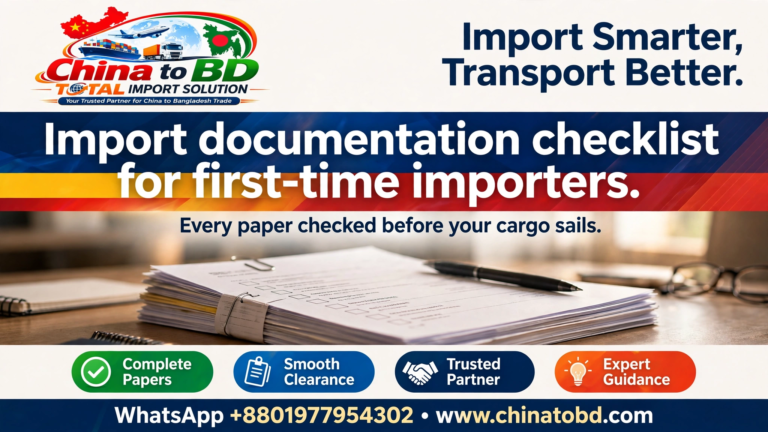
For a first-time importer, the documents are the shipment. The goods may be packed, the container may be booked, and the vessel may be ready to sail, but if the papers do not agree with each other, the container will wait at Chittagong port while the papers are corrected. A checklist, used before the goods leave China, is the tool that prevents that delay. An import documentation checklist is a written list of every paper a shipment needs, with the name of the paper, the office or party that issues it, the date it must be ready, and a check that it agrees with the other papers. For a first-time importer, the list covers the registration papers of the business, the commercial papers of the order, the transport papers of the shipment, and the certificates for the goods. Each paper must show the same consignee name, the same goods description, and the same quantities, because the customs office reads the papers as one file, not as separate papers. China to BD | Total Import Solution has supported importers from China to Bangladesh since 2016, with sourcing, shipping, customs handling, warehousing, and delivery. This article gives a first-time importer a complete documentation checklist: the core documents, the commercial and transport papers, the certificates and the bank papers, the checks to make before the goods leave China, what to do when a paper is wrong, and how to keep a shipment file. For help, call +8801977954302, email info@chinatobd.com, or visit www.chinatobd.com. The warehouse and office are at House 38A, Mendi Dental College Road, Road 11, Dhanmondi Riverview Model Town, Dhaka 1209.
Why a Document Checklist Matters for a First Import
A first-time importer faces two kinds of risk that an experienced importer has already learned to manage. The first is a missing paper: a certificate that was never requested, a bank paper that was never signed, a registration that was never completed. The second is a paper that exists but does not agree with the others: a consignee name spelled one way on the invoice and another way on the bill of lading, a quantity written one way on the packing list and another way on the invoice, a port of discharge written for the wrong port. Either kind of error is found at the port, and either kind holds up the clearance.
A checklist works because it turns the papers into a sequence. Instead of gathering papers when they are asked for, the importer gathers them in the order the shipment needs them: the registration papers first, the order papers second, the transport papers third, and the certificates alongside the order. Each paper is checked against the papers already gathered, so a spelling difference is found at the desk, where it can be corrected with a message to the supplier, rather than at the port, where it needs a formal correction.
The checklist should be kept in the shipment file, with a column for the date each paper was received and a column for the person who checked it. A first-time importer who keeps the checklist with the file can show the bank, the customs broker, and the shipping agent exactly which papers are ready and which are still waiting. That record is also the basis for the second shipment, because the same list, with the corrections noted, becomes the importer's own standard list for every later order.
The Core Documents for Every Shipment
Every commercial shipment from China to Bangladesh needs the same core set of documents. The commercial invoice describes the goods, the quantities, and the value for customs purposes. The packing list describes how the goods are packed, how many packages there are, and what is inside each package. The bill of lading is the transport document issued by the carrier, and it is the paper that proves the goods were loaded and that states the consignee, the port of loading, and the port of discharge. The certificate of origin, where required, states where the goods were made.
Behind those shipment papers sit the papers of the business itself. The trade license shows that the business may trade, the BIN shows that the business is registered for value added tax, the e-TIN certificate shows the tax identification number, and the import registration certificate shows that the business may import. The bank holds the papers for the payment: the letter of credit or the payment instruction, and the bank's own forms. The customs broker works from the whole set, and the broker cannot prepare the customs file until the set is complete.
A first-time importer should ask the customs broker for the broker's own list of required papers before the order is placed, and should compare it with the checklist in this article. If the broker asks for a paper that is not on the list, add it to the list with a note of who asked for it and why.
| Document | Issued by | Purpose | Checked against |
|---|---|---|---|
| Commercial invoice | Supplier | Goods, quantity, value | Packing list, bill of lading |
| Packing list | Supplier | Packages and contents | Invoice, actual load |
| Bill of lading | Carrier | Transport, consignee, ports | Invoice, packing list |
| Certificate of origin | Issuing authority | Where goods were made | Invoice description |
| Trade license | Local government body | Business may trade | BIN, import registration |
| BIN certificate | Tax authority | Registered for value added tax | Trade license, registration |
| Import registration certificate | Chief Controller of Imports and Exports | Business may import | Trade license, BIN |
| Bank payment papers | Bank | Payment to the supplier | Invoice, letter of credit terms |
The Commercial Invoice, Packing List, and Bill of Lading
The commercial invoice is the paper the customs office reads first. It should show the name and address of the supplier, the name and address of the importer as consignee, a description of each item of goods, the quantity of each item, the unit value and the total value, and the terms of the sale. The description of the goods on the invoice is the description the customs office will use, so it should be written in full, in plain words, and it should be the same description that appears on the packing list and the bill of lading. A short or vague description is a common cause of questions at the port.
The packing list is the paper that proves what is inside the shipment. It should show the number of packages, the type of package, the contents of each package, the weight of each package, and the total weight and the total number of packages. The count on the packing list must match the count that is actually loaded, because the warehouse in Dhaka will count the packages against the list on arrival. If the list says one count and the container holds another, the difference must be explained before the goods can be released.
The bill of lading is issued by the carrier after the goods are loaded. It shows the shipper, the consignee, the notify party, the port of loading, the port of discharge, the container number and the seal number, and the number of packages. The importer should check the bill of lading against the invoice and the packing list as soon as it is received, and should ask the supplier or the carrier for a correction at once if the consignee name, the port, or the package count is wrong. A correction made before the vessel arrives is a message; a correction made after arrival is a formal process.
| Paper | Must show | Most common error | When to check |
|---|---|---|---|
| Commercial invoice | Supplier, consignee, goods, quantity, value | Description that does not match the goods | Before payment |
| Packing list | Package count, contents, weights | Count that does not match the load | Before loading |
| Bill of lading | Consignee, ports, container and seal | Consignee name or port that is wrong | On receipt |
| Certificate of origin | Country of origin | Missing for goods that require it | Before sailing |
Certificates and Product Papers
Some goods need a certificate in addition to the core papers. A certificate of origin states where the goods were made, and it is required for goods whose origin the customs office must confirm. A product certificate, such as a test report or a conformity certificate, confirms that the goods meet a stated standard, and it is required for goods where the standard is part of the import condition. A health or safety certificate may be required for goods that come into contact with food or with people. The importer should confirm the certificate requirement for the exact goods before ordering, because a certificate that is requested after the goods have sailed may not be obtainable in time.
The certificate must cover the exact goods in the shipment, not a similar product from the same supplier. A test report for one model does not cover another model, and a certificate that names a different item is of no use at the port. The importer should check the name of the goods, the model or the specification, and the quantity on the certificate against the invoice, and should ask the supplier for a corrected certificate if anything differs. The certificate should also be in the form the customs office accepts, with the issuing authority, the date, and the signature or the seal that the office requires.
Product papers also include the papers that describe the goods for the warehouse and the buyer: the specification sheet, the user manual where one is supplied, and the labels on the cartons. The labels on the cartons should match the packing list, with the item name, the quantity in the carton, and the marks the supplier and the importer agreed. A carton that is labelled one way and listed another way will be opened and counted at the warehouse, and the count will be recorded against the packing list.
Bank, Registration, and Payment Papers
The bank papers are the papers that allow the money to move, and they must be ready before the payment is made. For a letter of credit, the bank needs the import registration certificate, the trade license, the BIN certificate, and the supplier's invoice, and it will issue the letter of credit with the terms the importer and the supplier agreed. For a telegraphic transfer, the bank needs the invoice and the registration papers, and it will record the payment against the import file. In either case, the name of the importer on the bank papers must match the name on the trade license and the import registration.
The registration papers should be checked as a set before the first payment. The trade license should be current and renewed. The BIN certificate should show the same name and address as the trade license. The import registration certificate should show the same name and address as both. The e-TIN certificate should show the same name. If any paper shows a different spelling or address, the bank may ask for a correction before it processes the payment.
The importer should keep a copy of every bank paper with the shipment file: the letter of credit or the payment instruction, the bank's receipt, and the exchange papers. These papers are the record of what was paid, when it was paid, and under which terms. If a question arises later about the payment, the file is the answer. The article Import from China to Bangladesh describes the import route from China to Bangladesh, and its guidance on preparing the business papers before ordering applies to the bank papers as much as to the customs papers.
| Paper | Needed for | Check before use |
|---|---|---|
| Trade license | Bank account, letter of credit | Current, renewed, name and address correct |
| BIN certificate | Import registration, customs file | Number, name, address match the license |
| Import registration certificate | Letter of credit, customs clearance | Name and address match the license and BIN |
| Letter of credit or payment instruction | Payment to the supplier | Terms match the invoice and the agreement |
| Bank receipt | Record of payment | Amount, date, and reference recorded |
Checking Documents Before the Goods Leave China
The check before the goods leave China is the most valuable check in the whole import, because it is the last point at which a correction is simple. The importer should ask the supplier for a copy of every document before the goods are loaded: the invoice, the packing list, the certificate of origin, and any product certificate. The copies should be checked against the order, line by line, and against each other. The consignee name should be the same on every paper. The description of the goods should be the same on every paper. The quantities should be the same on every paper.
The loading should also be checked before the vessel sails. The supplier should send photographs of the loaded container, showing the goods inside, the packing, and the seal on the door, with the container number and the seal number visible. The importer should compare the seal number in the photographs with the seal number on the bill of lading, and should record both numbers in the shipment file. A seal number that is recorded at loading and checked on arrival is the link between the container and the documents, and it is the first thing the warehouse should check when the container arrives in Dhaka.
If a paper is wrong, the importer should ask for a corrected copy before the vessel sails, and should not allow the goods to be loaded under a wrong paper. A supplier who is asked for a correction before loading can issue a new invoice or a new packing list in the same working day. A supplier who is asked after the vessel has sailed must issue a correction through the carrier or the bank, and the correction may take far longer. The discipline is simple: no paper is accepted unchecked, and no unchecked paper is allowed to sail.
- Ask the supplier for a copy of the invoice, the packing list, and every certificate before loading.
- Check the consignee name on every paper against the trade license and the import registration.
- Check the description of the goods on every paper against the order, word for word.
- Check the quantities and the package count on the invoice against the packing list.
- Check the port of loading and the port of discharge on the transport papers.
- Ask for loading photographs showing the goods, the packing, and the seal, with the container and seal numbers visible.
- Compare the seal number in the photographs with the seal number on the bill of lading.
- Record every checked paper in the shipment file, with the date it was checked and the name of the person who checked it.
What Happens When a Document Is Wrong
When a document is wrong, the first step is to find out which paper is wrong and which paper is right. The invoice, the packing list, and the bill of lading are compared with each other and with the order, and the paper that differs from the others is the paper that needs correction. The importer should write to the supplier or the carrier, describe the error in plain words, and ask for a corrected paper, with the correct spelling, quantity, or port. The request should be in writing, so that there is a record of when it was made and what was asked for.
If the error is found before the vessel sails, the correction is usually a new paper issued by the supplier or the carrier. If the error is found after the vessel has sailed, the correction may need the carrier to issue an amended bill of lading, or the bank to amend the letter of credit, and either step takes more time. If the error is found at the port in Bangladesh, the customs office may hold the container while the correction is made, and the importer should work through the customs broker, who knows which correction the office will accept and in which form.
A wrong document should never be answered by altering the paper by hand. A hand alteration, without the signature and the seal of the issuing party, is not a correction, and it can create a worse problem than the original error. The correct course is always to ask the issuing party for a new paper. The article End-to-end import service from China to Bangladesh describes how a full-chain service is planned from sourcing to delivery, and its guidance on one plan, one contact, and one shipment file applies when a document must be corrected, because the correction must reach every party that holds the old paper.
Keeping a Shipment File
A shipment file is a single folder, paper or digital, that holds every paper for one shipment, in the order the shipment needs them. The file should hold the registration copies, the order and the supplier's confirmation, the invoice, the packing list, the bill of lading, the certificates, the bank papers, the loading photographs, the tracking record, the customs papers, the warehouse receipt, and the delivery receipt. Each paper should be filed as soon as it is received, with the date written on it, so that the file is complete at every stage and nothing has to be searched for when an office asks for it.
The file should also hold a copy of the checklist itself, with each item marked as it is completed. When the shipment is delivered, the file should be closed with the delivery receipt, and kept for later reference. The next shipment then starts from a complete file, not from a search through old messages.
For a first-time importer, the shipment file is also a learning record. The notes on the checklist, the corrections that were needed, and the papers that were asked for late are the lessons that make the second shipment simpler. A first shipment that is filed well is the foundation of every shipment that follows, because the importer can see, in one place, what was needed, what was checked, and what should be done differently next time.
- One file per shipment, with every paper filed as soon as it is received.
- A copy of the checklist in the file, marked as each item is completed.
- Old copies kept with a note when a paper is corrected and replaced.
- Dates written on every paper, with the name of the person who checked it.
- The file closed with the delivery receipt, and kept for later reference.
- The lessons from the first shipment noted on the checklist for the next order.
Checklist for First-Time Importers
Copy this table into the shipment file and mark each item as it is completed. Complete the registration items before ordering, the order items before payment, and the transport items before the vessel sails.
| Check | When | Done |
|---|---|---|
| Trade license current and renewed, name and address checked | Before ordering | |
| BIN certificate checked, name and address matching the license | Before ordering | |
| Import registration certificate in hand and checked | Before ordering | |
| Customs broker named, broker's own paper list received | Before ordering | |
| Order confirmed in writing: goods, quantities, specification | Before payment | |
| Commercial invoice received, description and value checked | Before payment | |
| Packing list received, package count and contents checked | Before loading | |
| Certificate of origin requested, where required | Before loading | |
| Product certificates requested for the exact goods | Before loading | |
| Bank papers ready: letter of credit or payment instruction | Before payment | |
| Bill of lading received, consignee, ports, and seal checked | On receipt | |
| Loading photographs received, seal number recorded | At loading | |
| All papers checked against each other, corrections made | Before sailing | |
| Copies of all papers shared with the customs broker | Before arrival | |
| Shipment file complete, checklist marked, delivery plan ready | Before arrival | |
| Warehouse receipt and delivery receipt filed on delivery | After delivery |
Frequently Asked Questions
Q1: What documents does a first-time importer need for a shipment from China?
A first-time importer needs the business papers, the trade license, BIN certificate, e-TIN certificate, and import registration certificate, and the shipment papers, the commercial invoice, packing list, bill of lading, and certificate of origin where required, plus the bank papers for the payment and any product certificate the exact goods require.
Q2: What is a commercial invoice and what should it show?
A commercial invoice is the supplier's paper describing the goods, the quantities, and the value for customs purposes. It should show the supplier and the importer, a full description of each item, the quantity of each item, the unit value and the total value, and the terms of the sale, with the same description used on the packing list and the bill of lading.
Q3: What is a packing list and why does it matter?
A packing list describes how the goods are packed: the number of packages, the type of package, the contents of each package, and the weight of each package. It matters because the warehouse counts the packages against the list on arrival, so a list that does not match the actual load will hold up the receipt of the goods.
Q4: What is a bill of lading?
A bill of lading is the transport document issued by the carrier after the goods are loaded. It shows the shipper, the consignee, the notify party, the port of loading, the port of discharge, and the container and seal numbers, and it is the paper that proves the goods were loaded for the stated voyage.
Q5: What is a certificate of origin?
A certificate of origin is a paper stating where the goods were made, issued by the authority the customs office accepts. It is required for goods whose origin the customs office must confirm, and the importer should confirm whether the exact goods require one before ordering, because a certificate requested after sailing may not be obtainable in time.
Q6: Which papers should I check before the goods leave China?
Before the goods leave China, check the invoice, the packing list, and every certificate against the order and against each other, and check the bill of lading when it is received. Confirm that the consignee name, the goods description, the quantities, and the ports are the same on every paper, and ask for loading photographs showing the seal.
Q7: What should I do if a document is wrong?
Find which paper differs from the others, write to the supplier or the carrier describing the error in plain words, and ask for a corrected paper. Never alter a paper by hand. A correction made before the vessel sails is a new paper; a correction made after arrival may need the carrier or the bank to amend the paper, which takes more time.
Q8: Do I need an import registration certificate for my first shipment?
Yes, a first-time importer needs an import registration certificate, because it is the paper that allows the business to import in its own name. It is applied for after the trade license and the BIN are in hand, and the bank and the customs broker will ask for it before they handle the payment and the customs file.
Q9: What is the difference between the invoice and the packing list?
The invoice describes the goods, the quantities, and the value for customs purposes, while the packing list describes how the goods are packed and what is inside each package. The two papers must agree on the goods and the quantities, and both must agree with the bill of lading on the consignee and the number of packages.
Q10: Why must the consignee name be the same on every document?
The consignee name must be the same on every document because the bank, the carrier, and the customs office each compare the papers, and a name spelled one way on the invoice and another way on the bill of lading looks like two different importers. The name should match the registered business name on the trade license and the import registration exactly.
Q11: What product certificates might my goods need?
Product certificates depend on the exact goods. Some goods need a test report or a conformity certificate confirming a stated standard, and some need a health or safety certificate. The importer should confirm the requirement for the exact goods with the customs broker before ordering, and should check that the certificate names the exact model and specification in the shipment.
Q12: How do I keep a shipment file?
Keep one folder per shipment holding the registration copies, the order, the invoice, the packing list, the bill of lading, the certificates, the bank papers, the loading photographs, the tracking record, the customs papers, the warehouse receipt, and the delivery receipt, each filed as soon as it is received, with the date written on it.
Q13: When should I share documents with my customs broker?
Share the full set of documents with the customs broker before the vessel arrives, so that the broker can prepare the customs file and confirm the duty handling in advance. Sharing the papers late leaves the broker no time to check them, and an error found at the port will hold up the clearance while it is corrected.
Q14: What is the seal number and why should I record it?
The seal number is the number of the seal fixed on the container door at loading. It links the container to the documents, so the importer should record it from the loading photographs and the bill of lading, and the warehouse should check it on arrival before opening the container. If it does not match, the difference should be recorded with a photograph before opening.
Q15: Can I use the same checklist for my second shipment?
Yes, the same checklist should be used for every shipment, with the notes and corrections from the first shipment added to it. The first shipment's file shows which papers were needed and which needed correction.
Q16: How can China to BD | Total Import Solution help a first-time importer with documents?
China to BD | Total Import Solution has supported importers from China to Bangladesh since 2016, with sourcing, shipping, customs handling, warehousing, and delivery. The team can check the document list for a first shipment, confirm the papers with the supplier before loading, and plan the shipment from China to delivery in Bangladesh with one shipment file.
Contact China to BD | Total Import Solution
For a written plan and quotation for Import documentation checklist for first-time importers, contact China to BD | Total Import Solution. Share the cargo list, the loading point in China, the delivery point in Bangladesh, and the delivery dates, so the plan can be based on the actual shipment.
- Brand: China to BD | Total Import Solution
- Company: Total Import Solution, since 2016
- Helpline: +8801977954302
- Email: info@chinatobd.com
- Website: www.chinatobd.com
- Warehouse & Office: House 38A, Mendi Dental College Road, Road 11, Dhanmondi Riverview Model Town, Dhaka 1209
Call the helpline at +8801977954302 or email info@chinatobd.com to discuss Import documentation checklist for first-time importers, to confirm a plan from sourcing to delivery, or to check a document list before the vessel sails.
About the Author