

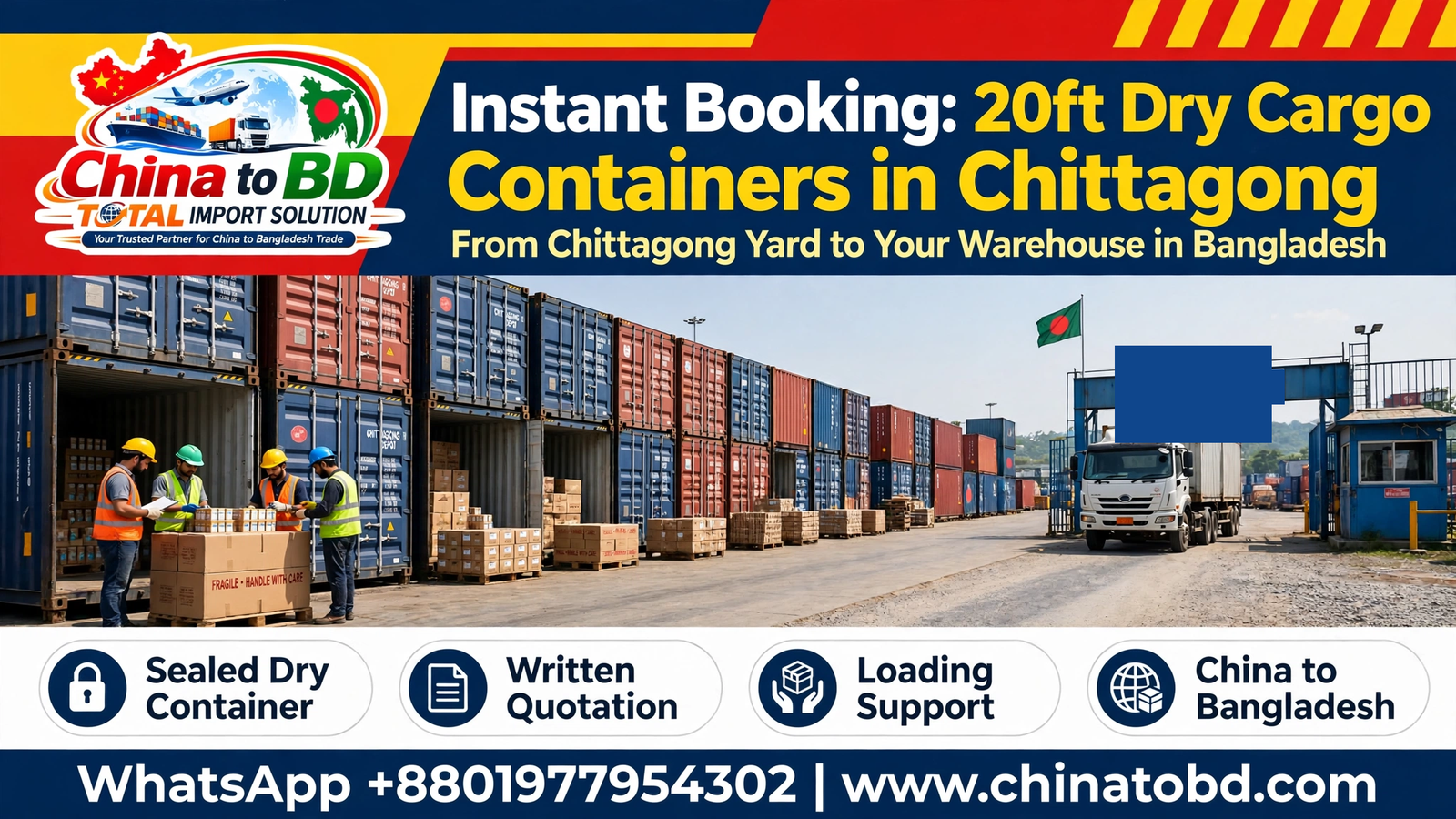
Instant Booking: 20ft Dry Cargo Containers in Chittagong
Instant Booking: 20ft Dry Cargo Containers in Chittagong
Booking a 20ft dry cargo container in Chittagong is a practical step for importers who move general cargo from China to Bangladesh and need a sealed, weather-protected unit for the journey. A dry container suits boxed goods, bagged goods, palletised cargo and many kinds of factory output, and it gives you a single enclosed space that can be loaded at one point, sealed, and moved onward without repeated handling of loose cartons. For a business that imports on a regular cycle, a planned container booking is often simpler to manage than arranging space carton by carton, because the whole shipment travels as one unit with one set of papers.
China to BD | Total Import Solution has supported importers moving goods between China and Bangladesh since 2016, and a 20ft dry container booking in Chittagong is one of the most common requests from businesses that import machinery parts, garments accessories, household goods, electronics accessories, raw materials and many other dry cargoes. This article explains what a 20ft dry cargo container booking involves, which goods suit this container type, what to measure and prepare before you book, which documents to keep ready, how loading and handling are planned, and which cost factors to review before you confirm.
If you need help with a booking, you can visit the Warehouse & Office at House 38A, Mendi Dental College Road, Road 11, Dhanmondi Riverview Model Town, Dhaka 1209, or contact the team by phone, WhatsApp or email. The contact details at the end of this article list every channel. Early booking helps, because it gives the team time to check container availability, confirm the loading point, review your documents and arrange the handling plan with you, instead of rushing each step close to the loading date.
What This Booking Means for Your Shipment
A 20ft dry cargo container booking means you reserve a standard enclosed steel container for your goods, and the container is placed at an agreed loading point so your cargo can be loaded, checked and sealed. The container protects the goods from rain, dust and handling damage during the road move and the sea leg of the journey, and the seal number recorded at loading gives you a clear record of the unit that left the loading point. For the importer, the value of this arrangement is control: you know which goods went into which container, you have a loading record, and the container moves as one sealed unit until it reaches the delivery point.
Booking is a process with steps, not a single action. You share your goods list, the team checks the container size and condition, the loading point and the loading date are agreed, the documents are reviewed, and you receive a written confirmation before loading begins. A written confirmation matters because it records what was agreed — the container type, the loading point, the loading date and the scope of the service — so both sides work from the same record.
Chittagong is the main sea gateway for Bangladesh, and many importers plan their container bookings around the port city because the container yards, off-dock ICDs and handling facilities are located there. A booking in Chittagong usually means the container is arranged through the port area network, loaded at an agreed point, and then moved onward under the shipping plan for that consignment. Availability at Chittagong off-dock ICDs and Dhaka inland depots should be confirmed for your loading date and your goods type, because yard space, handling slots and depot capacity vary with the season and with the volume of cargo moving through the port. Ask the team to confirm availability in writing when you book, and keep that confirmation with your shipping papers.
A 20ft dry container suits general dry cargo that can be packed in cartons, bags, crates or pallets and loaded through the container doors. It is a common choice for a single importer whose goods fill a useful share of the container but do not need a larger unit, and for businesses that want their goods kept together in one sealed unit rather than mixed with other cargo. The table below lists common goods types and the planning note for each, so you can judge whether this container type fits your shipment.
| Goods type | Why a 20ft dry container fits | Planning note |
|---|---|---|
| Cartoned consumer goods | Cartons stack in order and the doors close on a tidy load | Record the carton count and the stacking limit for each carton type |
| Garments and textile accessories | Packed bales and cartons stay dry and together in one unit | Keep the packing list by style or item so unloading is simple |
| Machinery parts and hardware | Crates and heavy cartons can be braced and secured inside | Note the heavy items first so they are loaded at the floor level |
| Household goods and plastic items | Light, bulky cartons fill the space without loose handling | Check the carton strength so lower layers are not crushed |
| Electronics accessories | Sealed cartons are protected from rain and dust | Mark fragile cartons clearly and agree the loading order |
| Bagged raw materials | Bags stack evenly and the container keeps them dry | Confirm the bag type and whether pallets are used |
| Mixed general cargo for one buyer | One buyer, one container, one set of loading papers | List every product name so nothing is missed at loading |
A 20ft dry container is not the right choice for every shipment. Goods that need temperature control, goods that are liquid in bulk, and cargo that cannot be loaded through standard container doors need a different container type or a different mode of transport. If you are unsure whether your goods suit a dry container, describe them to the team — product name, packing type, size of the largest piece and any handling need — and ask for advice before you book.
The size of your shipment also matters. If your goods fill only a small share of a container, ask the team whether a shared load or a different arrangement would suit you better. If your goods fill more than one container, plan the loading order across the containers and keep a separate loading list for each unit.
Why Book a 20ft Dry Container in Chittagong
Chittagong is where most sea cargo enters Bangladesh, so booking a container there puts your shipment close to the port network, the container yards and the handling teams that move cargo every day. When the container is booked through the Chittagong network, the loading point, the yard and the onward movement are planned together, which reduces the number of separate arrangements you need to manage. For importers based in Dhaka, Chattogram or an export processing zone, this also keeps the road leg of the journey short and the handling chain simple.
Another reason to book in Chittagong is access to off-dock ICDs. An off-dock ICD is a yard outside the main port where containers are stored, loaded and handled, and it can ease pressure on the port itself. Confirming availability at Chittagong off-dock ICDs for your loading date is part of the booking process, and the same applies to Dhaka inland depots when the goods need to move inland after arrival.
Measure and Plan Before You Book
Good loading starts with good measurement. Before you ask for a quotation, measure your goods and write the numbers down. You do not need to guess the container size yourself — the team will confirm the container size and condition — but you do need to know what you are loading. Count the cartons, note the packing type, and measure the largest pieces so the loading team knows what will come through the doors. A goods list with real numbers is the difference between a loading plan that works and a loading day full of changes.
| Item to measure | How to record it | Why it matters |
|---|---|---|
| Carton count | Count by product name and carton size | The loading team plans the stacking order from the count |
| Packing type | Carton, bag, crate, pallet or loose piece | Each packing type loads and braces differently |
| Largest piece | Note the longest side and the shape | Confirms the piece can pass through the container doors |
| Stacking limit | Ask the supplier how high cartons can stack | Prevents crushing of lower layers during the journey |
| Weight distribution | Mark the heavy cartons and crates on the list | Heavy items load first at floor level for a stable load |
| Loading point | Full address and contact person at the loading site | The container and the handling team go to the right place |
| Delivery warehouse | Full address in Bangladesh and the receiving contact | The onward move is planned from the correct destination |
Keep one master goods list and share the same list with everyone involved — the booking team, the supplier in China and the warehouse in Bangladesh. If the list changes, send the updated list to all three so nobody works from an old version.
Container Options for a 20ft Dry Booking
When you book a 20ft dry container, the team confirms the container size and condition before the unit is placed for loading. Condition matters as much as size: the doors should close and seal cleanly, the floor should be sound, and the inside should be dry and free of odour or damage that could affect your goods. Ask the team how the container condition is checked and what happens if the unit placed for loading does not meet the standard you agreed. A clear answer before loading protects you from a dispute on the loading day.
There are a few choices to settle at the booking stage. The first is the loading point — a supplier warehouse, a yard or an off-dock ICD — and the second is the loading date and time window. The third is whether the goods need pallets, bracing material or dunnage, and who supplies it. The fourth is the sealing arrangement: who seals the container, who records the seal number, and who receives a copy of the loading record.
| Booking choice | What to agree | Why it matters |
|---|---|---|
| Container condition | Clean, dry, sound floor and working doors | Protects the goods and avoids loading delays |
| Loading point | Full address and the contact person on site | The container arrives at the right place at the right time |
| Loading date and time | Date and time window agreed in writing | The handling team and the goods are ready together |
| Pallets and bracing | Who supplies pallets, straps and bracing material | The load stays stable during the road and sea journey |
| Sealing and records | Who seals the container and records the seal number | Creates a clear record of the sealed unit |
| Onward movement | Next step after loading, agreed before the day | Avoids the loaded container waiting without a plan |
If your shipment needs the container to stay loaded for a longer period before onward movement, discuss that at the booking stage. Extended holding can create extra charges and yard pressure, and it should be planned rather than discovered after loading. For guidance on planning a longer hold, read Zero Demurrage Shipping: Rent Containers for Extended Offloading, which explains how extended offloading is arranged and what to check before you agree to it.
Booking Steps: From Enquiry to Written Confirmation
A container booking follows a clear order of steps. Follow them in sequence, and do not skip the written confirmation step — it is the record that protects both sides if a detail changes later. Booking needs steps, written confirmation and early booking helps, so start the process as soon as your goods list is ready rather than waiting until the loading date is close.
- Share your goods list. Send the product names, packing type, carton count, loading point, warehouse in Bangladesh and preferred loading dates. A complete list gives you an accurate quotation and a realistic loading plan.
- Ask for a written quotation. Request the quotation in writing so the scope of the service, the container type and the loading arrangement are recorded. Check the quotation line by line and ask about anything unclear before you accept it.
- Confirm the container and the loading point. Agree the container size and condition, the loading point address and the contact person on site. Confirm availability at the loading point and at any Chittagong off-dock ICD or Dhaka inland depot involved in the plan.
- Prepare the documents. Gather the papers listed in the next section and check that the names, counts and addresses match your goods list. Send copies to the booking team before the loading day so errors can be fixed in time.
- Agree the loading date and time window. Fix the date and the time window in writing, and confirm that the handling team, the goods and the container will all be ready in that window.
- Confirm the handling plan. Agree who supplies labour, handling equipment, pallets and bracing material, and agree the loading order — heavy items first, fragile cartons marked and placed where they are protected.
- Load, check and seal. Load in the agreed order, count the cartons as they go in, check the load before the doors close, and record the seal number with the loading record and photos if available.
- Keep the records. File the written confirmation, the quotation, the loading list, the seal record and the documents together, and share copies with the warehouse that will receive the goods.
Each step depends on the one before it. A goods list that arrives late delays the quotation, a quotation that is never confirmed in writing leaves the loading plan open to change, and a loading date fixed before the documents are ready risks a delay at the loading point. Work through the steps in order and keep every agreement in writing.
Documents and Checks Before Loading
Documents are the part of a container booking that importers most often leave until the last moment, and they are also the most common cause of loading delays. Prepare them early, check them against your goods list, and send copies to the booking team before the loading day. If a document is missing or a name does not match, it is far easier to fix before the container is placed than after the goods are loaded.
| Document or check | What to verify | When to prepare it |
|---|---|---|
| Goods list and packing list | Product names, carton count and packing type match the goods | Before asking for a quotation |
| Supplier invoice | Buyer and seller names, goods description and values as agreed | Before the loading day |
| Booking confirmation | Container type, loading point, date and scope in writing | At the time of booking |
| Loading point details | Full address, contact person and access notes | Before the container is placed |
| Warehouse receiving details | Full address in Bangladesh and the receiving contact | Before the loading day |
| Seal record | Seal number recorded with the loading list | At loading, before the container moves |
| Photos of the load | Loaded container, bracing and the sealed doors | At loading, shared with the warehouse |
Check the spelling of names and addresses on every document. A small difference between the name on the invoice and the name on the booking confirmation can cause questions later, and it is simple to fix before loading.
Keep a single file for the shipment — paper or digital — with the quotation, the booking confirmation, the packing list, the invoice, the loading list and the seal record together. Share the file with the warehouse team that will receive the container so they know what is coming and how many cartons to expect.
Loading and Handling Planning in Chittagong

Loading is where the booking plan meets the real goods, and a good loading plan saves time, protects the cargo and avoids rework. Plan the loading order before the container arrives: heavy crates and heavy cartons at floor level, lighter cartons above them, fragile cartons marked and placed where they will not be crushed, and the goods that must come out first loaded last. Walk through the order with the loading team before the first carton moves, and keep the packing list in hand so every carton is counted as it goes in.
Handling equipment and labour should be agreed before the loading day, not arranged on the morning of loading. Confirm who supplies the labour, whether a forklift or other handling equipment is needed, and whether the loading point has a level surface where the container can be placed safely. If the loading point is a Chittagong off-dock ICD, confirm the yard slot, the handling arrangement and the gate procedure in advance, and confirm availability for your loading date in writing.
Bracing and securing deserve attention. A load that shifts during the road move can damage cartons and crush lower layers, so agree the bracing material — straps, dunnage or blocking — and who supplies it. Load the container evenly, fill gaps so cartons cannot slide, and check the load before the doors close. Take photos of the loaded container, the bracing and the sealed doors, and share them with the warehouse that will receive the goods so the receiving team knows what to expect.
Weather is a practical factor at a Chittagong loading point. Rain can wet cartons waiting outside the container, so plan cover for goods staged outdoors and agree with the loading team what happens if heavy rain interrupts loading. Keep the loading record updated if the plan changes, and tell the booking team about any change to the loading date or the carton count as soon as you know.
For importers who regularly move a full container of goods from one supplier, the full container load model is worth understanding alongside a single 20ft booking. Read Full Container Load FCL Service from China to BD to see how a full container load is arranged from China to Bangladesh and how it compares with booking a single container for one consignment.
Cost Factors to Review Before You Confirm
The cost of a 20ft dry container booking is shaped by several factors, and it is worth reviewing each of them in the written quotation before you confirm. This section lists the factors only — no figures are given here, because the amount depends on your goods, your loading point, your dates and the scope of the service, and any figure quoted without those details would be misleading. Ask for the quotation in writing, check each factor in it, and ask the team to explain any line you do not understand.
- Container arrangement: the container type, the condition check and the placement of the unit at the loading point.
- Loading point and distance: where the container is placed, and the distance and route involved in moving it.
- Handling and labour: the labour and handling equipment used at loading, and who supplies them.
- Loading time: the length of the loading window and whether the load needs more than one session.
- Yard and depot use: any use of a Chittagong off-dock ICD or a Dhaka inland depot, subject to confirmed availability.
- Extended holding: whether the loaded container needs to wait before onward movement, and how that waiting period is arranged.
- Bracing and packing material: pallets, straps, dunnage and other material used to secure the load.
- Documentation and records: the preparation, checking and filing of the booking, loading and seal records.
- Changes after booking: what happens if the loading date, the carton count or the loading point changes after confirmation.
Review the quotation as a whole, not line by line in isolation. A quotation that looks simple may leave out handling or yard use that you later need, while a detailed quotation shows you exactly what is included and what is not. Ask for any missing item to be added in writing before you confirm.
Common Mistakes to Avoid
Most container booking problems come from a small set of avoidable mistakes. The list below covers the ones the booking team sees most often.
- Sharing an incomplete goods list: missing product names or carton counts lead to a quotation and a loading plan that do not match the real goods.
- Leaving documents until the loading day: a missing paper or a mismatched name is hard to fix once the container is placed and the team is waiting.
- Fixing the loading date before the goods are ready: goods that are not packed when the container arrives waste the loading window.
- Not confirming the loading point in writing: a vague address or no contact person on site can send the container to the wrong place.
- Skipping the container condition check: a unit with damaged doors or a wet floor should be reported before loading, not after.
- Loading without an agreed order: cartons loaded in no order are hard to count, hard to brace and hard to unload.
- Forgetting the seal record: a seal number that is never recorded leaves no clear record of the sealed unit.
- Not telling the warehouse what is coming: the receiving team needs the carton count, the loading list and the seal number before arrival.
- Assuming depot availability: availability at Chittagong off-dock ICDs and Dhaka inland depots should be confirmed for your date, not assumed.
- Changing the plan without telling the team: a new carton count or a new loading date must reach the booking team in writing, early.
Pre-Shipment and Loading Checklist
Use this checklist before every 20ft dry container booking. Tick each item off only when it is done, and keep the completed checklist with the shipment file.
| Check | Done? | Note |
|---|---|---|
| Goods list complete with product names and carton count | Yes / No | Share the same list with the supplier and the warehouse |
| Written quotation received and checked | Yes / No | Ask about any line that is unclear before confirming |
| Booking confirmation in writing | Yes / No | Container type, loading point, date and scope recorded |
| Container size and condition confirmed | Yes / No | Doors, floor and dryness checked before loading |
| Loading point address and contact confirmed | Yes / No | Full address and the person on site |
| Availability at ICD or depot confirmed | Yes / No | Chittagong off-dock ICDs and Dhaka inland depots, in writing |
| Documents prepared and names checked | Yes / No | Packing list, invoice and booking papers match |
| Labour and handling equipment agreed | Yes / No | Who supplies labour, forklift and bracing material |
| Loading order agreed with the team | Yes / No | Heavy first, fragile marked and protected |
| Seal number recorded and shared | Yes / No | Record with the loading list and photos |
| Warehouse told what is coming | Yes / No | Carton count, loading list and seal number shared |
Frequently Asked Questions
Q1: What is a 20ft dry cargo container used for?
A 20ft dry cargo container is an enclosed steel unit used to move general dry cargo — cartoned goods, bagged goods, crated items and palletised loads — in one sealed space. It protects the goods from rain, dust and handling damage during the road and sea journey, and it suits shipments where one importer wants the goods kept together under a single loading record.
Q2: Who should book a 20ft dry container in Chittagong?
Any importer whose dry goods fill a useful share of a container and who wants the shipment loaded, sealed and moved as one unit should consider this booking. It suits factory output, trading goods, garments accessories, machinery parts and household items, and it works well for businesses that import on a regular cycle from China to Bangladesh.
Q3: What details should I share before booking?
Share the product names, the packing type, the carton count, the loading point, the warehouse in Bangladesh where the goods will go, and your preferred loading dates. These details shape the quotation and the loading plan, so share the complete list.
Q4: How do I know if my goods fit in a 20ft dry container?
Count your cartons, note the packing type and measure the largest pieces, then share the list with the booking team. The team will confirm the container size and condition for your goods. If a piece cannot pass through the container doors, the team will tell you before you book.
Q5: What documents are needed before loading?
Prepare the goods list and packing list, the supplier invoice, the written booking confirmation, the loading point details and the warehouse receiving details. Check that names, counts and addresses match, and send copies to the booking team before the loading day.
Q6: Can I load cartons and pallets together?
Cartons and pallets can be loaded together when the loading order is planned in advance. Heavy pallets usually load first at floor level, cartons stack above them, and the load is braced so nothing shifts.
Q7: What should I check about the container before loading?
Check that the doors close and seal cleanly, the floor is sound, and the inside is dry and free of odour or damage. If the unit placed for loading does not meet the agreed standard, report it before loading begins.
Q8: How does loading work at a Chittagong off-dock ICD?
An off-dock ICD is a yard outside the main port where containers are stored, loaded and handled. Loading there follows the yard slot and gate procedure agreed in advance. Confirm availability at Chittagong off-dock ICDs for your loading date in writing when you book.
Q9: Can the container be moved to a Dhaka inland depot?
A container can be planned onward to a Dhaka inland depot when that step is agreed as part of the booking. Confirm availability at Dhaka inland depots for your date in writing, and share the depot address and receiving contact with the booking team.
Q10: What happens if my loading date changes?
Tell the booking team as soon as you know the date has changed, and ask for the updated loading date to be confirmed in writing. A change can affect the container placement, the handling team and the yard slot, so early notice gives everyone time to adjust the plan.
Q11: How do I plan for loading labour and handling equipment?
Agree before the loading day who supplies the labour, whether handling equipment is needed, and whether the loading point has a level surface for the container. Confirm the contact person at the loading site, and make sure the goods are packed and ready when the team arrives.
Q12: What affects the cost of a 20ft dry container booking?
The container arrangement, the loading point and distance, the handling and labour, the loading time, any yard or depot use, extended holding, bracing and packing material, documentation, and changes after booking all shape the cost. Ask for a written quotation that shows each factor, and ask the team to explain any line you do not understand.
Q13: How can I avoid delays at the loading point?
Share a complete goods list, prepare the documents early, confirm the loading point address and contact in writing, and make sure the goods are packed before the container arrives. Early booking helps, because it leaves time to check availability, fix document errors and confirm the handling plan before the loading day.
Q14: Do I need to be present during loading?
Being present helps, because you can check the carton count, the loading order and the bracing as the work proceeds. If you cannot attend, send a trusted person with the packing list, and ask for photos of the loaded container and the sealed doors.
Q15: How do I get a written quotation?
Share your goods list — product names, packing type, carton count, loading point, warehouse in Bangladesh and loading dates — with the booking team by WhatsApp, phone or email, and ask for the quotation in writing. Check the quotation line by line, ask about anything unclear, and keep the final version with your booking record.
Q16: Who do I contact for help with a booking?
Contact China to BD | Total Import Solution on the helpline, by WhatsApp or by email using the details in the contact section below. The team can check container availability, review your goods list and prepare a written quotation for you.
Contact China to BD | Total Import Solution
- Brand: China to BD | Total Import Solution
- Company: Total Import Solution, since 2016
- Helpline: +8801977954302
- WhatsApp: +8801977954302
- Email: info@chinatobd.com
- Warehouse & Office: House 38A, Mendi Dental College Road, Road 11, Dhanmondi Riverview Model Town, Dhaka 1209
- Website: www.chinatobd.com
Get a Written Quotation for Your Shipment
To get a written quotation for your shipment, share your goods list with the team — product names, packing type, carton count, loading point, warehouse in Bangladesh and loading dates — and the team will prepare a written quotation for your 20ft dry cargo container booking in Chittagong. Reach out on WhatsApp +8801977954302, call +8801977954302, or email info@chinatobd.com. Booking needs steps and written confirmation, and early booking helps the team check availability, review your documents and plan the loading with you.
A planned container booking is the simplest way to move a full load of dry cargo from China to Bangladesh with a clear record at every step. Measure your goods, share a complete list, ask for the quotation in writing, prepare the documents early, confirm the loading point and the handling plan, and keep the seal record with your shipment file.
About the Author