Step-by-Step Guide to Renting SOC Containers from China
Step-by-Step Guide to Renting SOC Containers from China
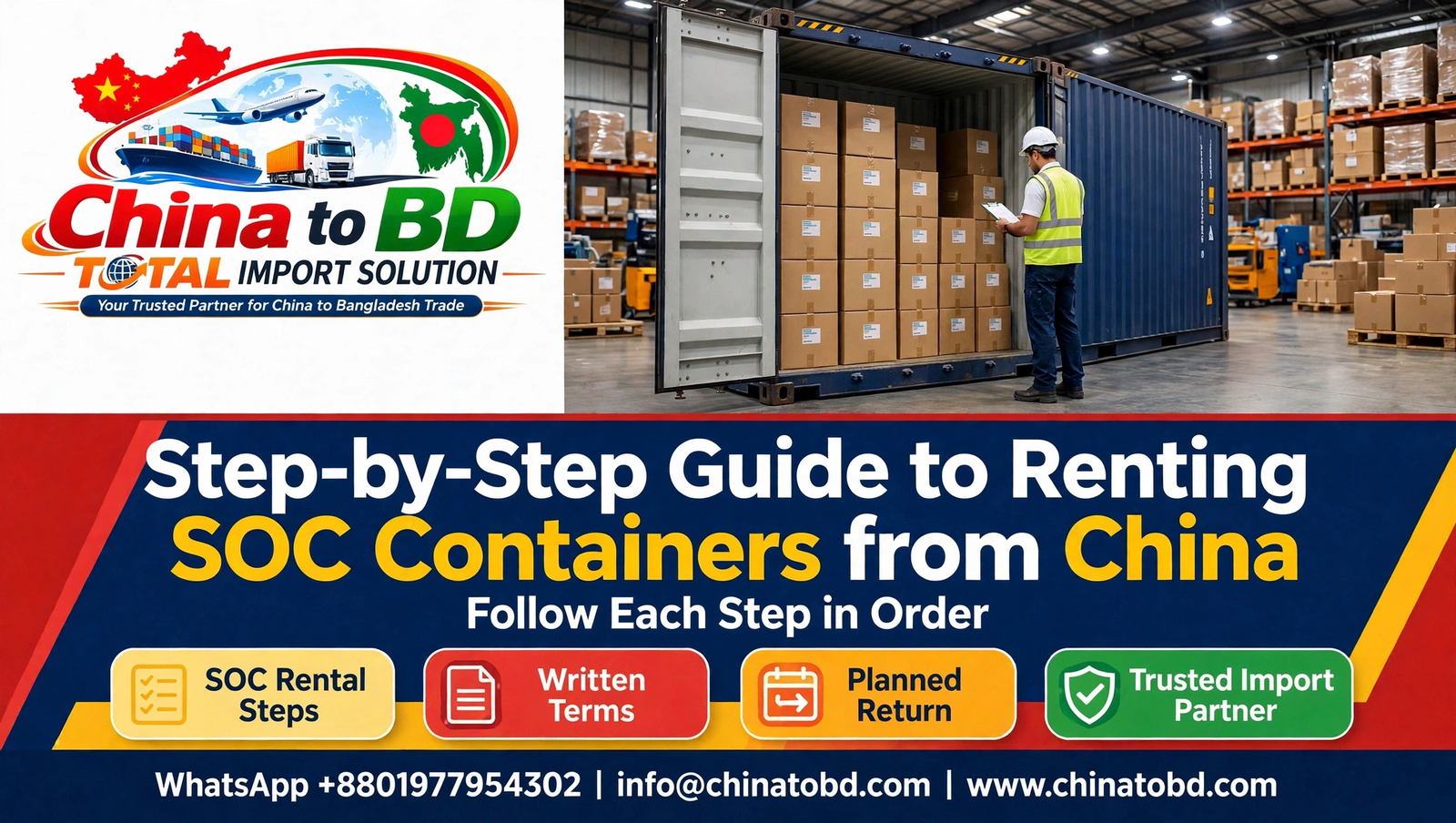
An SOC container is a shipper-owned container: a container owned by the shipper, or rented by the shipper under a separate arrangement, rather than supplied by the carrier for the voyage. For importers in Bangladesh who buy goods from China, renting an SOC container can be a practical choice when the cargo needs more time for unloading, when the container must go to a place the carrier container cannot easily reach, or when the importer wants one container arrangement that covers the whole journey from the supplier to the warehouse.
Renting an SOC container is not complicated, but it must be done in the right order. The cargo list comes first, then the container choice, then the rental terms, then the documents, then the booking. A step missed early in the process often shows up later as a delay at the port, a container that does not fit the site, or a return that was never planned. This guide walks through each step in order, so that the importer can follow it from the first cargo list to the final return of the empty container.
China to BD | Total Import Solution has supported importers from China to Bangladesh since 2016, with sourcing, shipping, customs handling, warehousing, and delivery. The steps here follow the order used in a real shipment: confirm the cargo, choose the container, confirm the terms in writing, prepare the documents, and only then confirm the booking. For help, call +8801977954302, email info@chinatobd.com, or visit www.chinatobd.com. The warehouse and office are at House 38A, Mendi Dental College Road, Road 11, Dhanmondi Riverview Model Town, Dhaka 1209.
What an SOC Container Is
SOC stands for shipper-owned container. In practice, the term covers containers that the shipper owns outright, and containers that the shipper rents from a container leasing company for the shipment. The key point is the same in both cases: the container does not belong to the carrier, and the carrier is not the party that sets the terms for its use. The shipper arranges the container, and the carrier carries it on the vessel under the booking terms.
An SOC container is loaded at the supplier in China, sealed, and delivered to the port of loading. The carrier loads it onto the vessel, carries it to the port of discharge in Bangladesh, and discharges it. The importer then moves the container to the unloading point, unloads the cargo, and returns the empty container under the rental terms agreed at the start. The container is not returned to the carrier; it is returned to the party named in the rental arrangement.
The main difference from a carrier-owned container is control. With a carrier-owned container, the carrier sets the allowed period for its use. With an SOC container, the importer agrees the rental period with the container owner or leasing company, and the period can be matched to the real unloading work.
An SOC container still needs the same shipping documents as any other container shipment. The commercial invoice, the packing list, the bill of lading, and the certificate of origin where required must be prepared, checked, and matched. The carrier still applies its own rules for the vessel, the loading, and the discharge. The importer should confirm with the carrier, before booking, that the carrier accepts SOC containers on the chosen route, and what the carrier requires for the booking.
SOC Containers and Carrier-Owned Containers Compared
The choice between an SOC container and a carrier-owned container depends on the shipment, not on habit. The table below sets out the main differences, so the importer can compare them against the real needs of the cargo and the unloading plan.
| Point | SOC container | Carrier-owned container |
|---|---|---|
| Owner | Shipper, or a leasing company named by the shipper | Carrier |
| Rental period | Agreed with the owner or leasing company | Set by the carrier terms |
| Return point | Named in the rental arrangement | Named by the carrier |
| Flexibility for unloading | Period can match the unloading plan | Fixed period, less room to adjust |
| Responsibility | Shipper arranges the container | Carrier supplies the container |
| Documents | Same shipping documents required | Same shipping documents required |
| Carrier acceptance | Must be confirmed before booking | Usually accepted as standard |
An SOC container often suits an importer who needs the container for longer than a short carrier period, who unloads in several sessions, or whose warehouse is far from the port. A carrier-owned container often suits a simple shipment where the cargo can be unloaded quickly and the container returned without delay. Neither choice is right for every shipment, and the importer should decide from the cargo list and the unloading plan, not from a general preference.
Confirm the condition of the container early. An SOC container should be clean, dry, and in good condition before loading, with doors that close and lock properly. Ask for photos of the container before loading, and for the container number to be recorded and shared.
When Renting an SOC Container Makes Sense
Renting an SOC container makes sense when the unloading work needs more time than a short carrier period allows. A buyer may order a mixed load that must be sorted by item, size, colour, or customer. A warehouse may receive several shipments in the same week, so floor space for one shipment may only become free in stages. A factory may need raw material in batches, and a shop may need goods delivered to more than one branch. In each case, the importer needs time and space, and an SOC container provides a controlled space for that time.
It also makes sense when the unloading point is far from the port, or when the container must be moved more than once before it is empty. A rented container gives the importer a clear arrangement for the whole movement, with the delivery and return points named in writing. The importer can open the container, take out one part, close it again, and continue the next day, without moving the whole load twice. That reduces double handling, damage, and counting errors.
An SOC container can also suit cargo that needs a particular container type, such as a container with wider access, an open top container, or a refrigerated container. The importer should still confirm the choice with the transporter and the warehouse.
Step 1 to Step 5: Cargo, Container, and Terms
The first five steps cover the cargo, the container, and the rental terms. Complete each step before moving to the next, and keep a written record of every decision.
- List the cargo in full. Write the item names, the packing type, the number of packages, and any handling note, such as fragile, heavy, or keep dry. Share this list with the supplier in China and with the warehouse in Bangladesh, so that every party works from the same list.
- Name the loading point and the unloading point. Confirm the supplier address in China and the warehouse address in Bangladesh, with a contact person at each end. Check the gate, the road, and the floor space at the unloading point in person where possible.
- Choose the container type and size. Match the choice to the cargo list and to the space at the unloading point. A standard dry container suits general cargo; a high cube suits light, bulky cargo; a refrigerated container suits cargo that needs temperature control; an open top container suits cargo loaded from above. Confirm the choice with the transporter and the warehouse.
- Ask for the container and check its condition. Ask for photos of the container, confirm that it is clean and dry, and confirm that the doors close and lock. Record the container number and share it with the importer and the customs broker.
- Ask for the rental terms in writing. Confirm the rental period, the delivery point, the return point, the condition required on return, the contact person for any change, and the party responsible for the container, the transport, and the return. Keep a copy with the shipment file.
These five steps are the foundation of the shipment. A cargo list that is incomplete leads to a container that does not fit. A container chosen without checking the site leads to a delay on arrival. Rental terms that are not in writing lead to disagreement about the return.
Step 6 to Step 10: Booking, Documents, and Return
The next five steps cover the booking, the documents, the loading, the unloading, and the return. Each step should be confirmed in writing before the vessel sails, or before the container arrives.
- Confirm the carrier booking. Confirm with the carrier that SOC containers are accepted on the chosen route, and confirm the loading port, the discharge port, the sailing, and the documents the carrier will issue. Share the container number with the carrier and the customs broker.
- Prepare the documents. Use the checklist in the documents section, and keep the originals and the copies in one file. Ask the supplier for a copy of each document before loading, and check it against the cargo list. Do not leave a document to be collected on the day of arrival.
- Agree the loading order with the supplier. Goods that must come out first should be loaded last, near the door. Group mixed cargo by type, buyer, or destination, and ask for loading photos and a loading plan. Record the container and seal numbers at loading and share them at once.
- Plan the unloading in sessions. Write down each session with a date, a start time, a named team, and a named task. Confirm labour, equipment, floor space, and warehouse hours for each session. Count each package as it leaves the container and compare it with the packing list.
- Return the empty container. Book the return transport with the delivery transport, name the return point and date, and keep the return receipt. Check the container condition on return against the agreed terms, and keep a photo of the empty container as a record.
When the cargo is oversized and needs special handling, the planning steps are the same, but the transport and handling checks need more time. The article Breakbulk Shipping from China to Bangladesh explains how oversized cargo is handled, and its guidance on planning the route, the equipment, and the handling in advance applies to SOC shipments as well.
Choosing the Container Type and Size
A standard dry container is the most common choice for general cargo packed in cartons, bags, or crates. It protects the cargo from rain and dust, and it can be locked between unloading sessions. Before booking, confirm that the container is clean, dry, and in good condition, and that the doors close and lock properly.
A high cube container offers more height than a standard container of the same length. It suits light, bulky cargo. Check the height of the cargo and the height of the warehouse door before choosing a high cube.
A refrigerated container suits cargo that must be kept at a set temperature. Confirm the temperature setting, the power supply during transport and at the unloading point, and the monitoring arrangement. A refrigerated container should only be chosen when the cargo truly needs temperature control, because it needs more planning than a dry container.
An open top container suits cargo that must be loaded or unloaded from above, such as tall machinery or long items. Confirm the cover, the lifting equipment, and the weather plan, because the cargo is exposed until the cover is fitted.
The choice between a 20-foot and a 40-foot container depends on the size of the load and the space at the unloading point. A 20-foot container is easier to place on a small site, while a 40-foot container carries a larger load but needs more room for the truck and for turning. Measure the site, not guess it, and confirm the choice with the transporter and the warehouse before booking.
| Container type | Suits | Check before booking |
|---|---|---|
| Standard dry container | General cargo in cartons, bags, or crates | Clean, dry interior, doors close and lock |
| High cube container | Light, bulky cargo that needs height | Cargo height and warehouse door height |
| Refrigerated container | Cargo that needs temperature control | Temperature setting, power supply, monitoring |
| Open top container | Cargo loaded or unloaded from above | Cover, lifting equipment, weather plan |
| Flat rack container | Wide or heavy cargo | Lashing, lifting, and transport plan |
| 20-foot container | Smaller load or limited site space | Gate width, turning space, ground surface |
| 40-foot container | Larger load | Truck access, turning space, unloading area |
Rental Terms to Confirm in Writing
The rental terms are the written agreement for the use of the container, and they should be confirmed before the vessel sails. The terms should name the rental period, with a start date and an end date. The importer should match the rental period to the unloading plan, with the sessions, the labour, and the transport all planned before the vessel sails. If the unloading needs more time than the rental period allows, the importer should ask about an extension before booking, not after arrival.
The terms should also name the delivery point and the return point. The delivery point is where the container is handed over for loading in China, or where it is received in Bangladesh. The return point is where the empty container must go after unloading. Both points should be named with a full address and a contact person. A container returned to the wrong place can still create a charge after unloading.
The condition required on return should also be named. The container should be returned clean, dry, and in the condition agreed at the start, with any damage noted at once, with a photo and a written note. The importer should check the container at unloading and note any damage found, so that damage found at the start is not confused with damage found at the end.
The terms should name the party responsible for the container, the transport, and the return, and a contact person for any change. If the plan changes, share the change at once, in writing, with every party.
Documents and Customs Checks
Documents are the part of the shipment that most often causes a delay at the port. A missing paper, a mismatched description, or a name spelled in two different ways can hold a container while the matter is corrected. The importer should therefore prepare the document set before the vessel sails, and should check each document against the cargo list and the booking.
The commercial invoice describes the goods, the quantity, and the value for customs purposes. The packing list describes how the goods are packed, how many packages there are, and what is inside each package. The bill of lading is the transport document issued by the carrier, and it must match the invoice and the packing list. The certificate of origin, where required, states where the goods were made. Other certificates may be required for specific goods, such as electrical items, food items, or chemicals, and the importer should confirm the requirement for the exact goods before shipment.
The importer should also keep the import registration, tax identification, and bank documents ready, and confirm with the customs broker which papers must be presented in original and which as a copy. Before the vessel arrives, complete a short document review with the customs broker: confirm that the invoice, the packing list, and the bill of lading agree, and that the container and seal numbers are recorded.
| Document or check | Purpose | Common error to avoid |
|---|---|---|
| Commercial invoice | Describes goods, quantity, and value | Value or description that does not match the cargo |
| Packing list | Describes packages and contents | Package count that does not match the actual load |
| Bill of lading | Transport document from the carrier | Consignee name or port that does not match the booking |
| Certificate of origin | States where goods were made | Missing certificate for goods that require one |
| Product certificate | Confirms standard for specific goods | Certificate that does not cover the exact item |
| Import registration and tax papers | Confirms the importer is registered | Expired or incomplete registration |
| Customs duty handling | Payment and clearance for the cargo | Duty payment arranged late, after arrival |
| Container and seal numbers | Links the container to the documents | Seal number not recorded at loading |
Customs checks in Bangladesh follow the documents. An officer may check the papers, ask for a clarification, or ask for a physical check of the cargo. The customs broker should have the full document set and the contact numbers of the importer and the warehouse, and the importer should be ready to answer questions about the goods, the supplier, and their intended use.
Loading and Transport Planning
Loading in China and unloading in Bangladesh are two parts of one plan. A mistake in loading can make unloading slow, and a slow unloading can affect the return of the container. Goods that must come out first should be loaded last, near the door, and goods that must come out last should be loaded first, at the back. Heavy items should be placed where they can be moved safely, fragile items where they will not be crushed, and mixed cargo grouped by type, buyer, or destination.
The supplier should send loading photos and a loading plan showing where each group is placed. Keep these photos with the packing list, so the warehouse team in Bangladesh knows what to expect when the doors are opened, and can prepare the right equipment, labour, and floor space. The container and seal numbers should be recorded at loading and shared with the importer at once.
Transport from the port in Bangladesh to the unloading point should be booked with a named date, a named time, and a named contact person. Confirm the truck, the driver, the route, and the time, and share the truck details with the warehouse. Book the return transport at the same time.
Cost Factors to Confirm at Booking
The cost of an SOC container shipment is made up of several parts, and each part should be confirmed at booking. Ocean freight is the cost of moving the container from the port in China to the port in Bangladesh. Port charges cover the handling of the container at each port. Customs duty and tax are set by the customs rules for the exact goods, and the importer should confirm the duty position with the customs broker before booking. Transport covers the movement of the container from the port to the unloading point and the return of the empty container. Labour covers the unloading, sorting, counting, and checking. Warehouse use covers the space and the time that the cargo occupies. Container rental covers the use of the SOC container for the agreed period.
Each part can change if the plan changes, so ask at booking what happens if the plan changes and how a change is charged. Ask which charges are included in the quotation and which are separate, and read the quotation line by line. No figure in this article is presented as a price, because the cost depends on the cargo, the route, the container, the rental period, and the unloading plan. For a figure for a specific shipment, share the cargo list, the loading point, the unloading point, and the unloading dates with China to BD | Total Import Solution and ask for a written quotation.
Common Mistakes
- Booking the shipment before the cargo list is complete, so the container type and size are chosen by guesswork. Complete the cargo list first, and choose the container from the list.
- Choosing an SOC container without confirming that the carrier accepts SOC containers on the route. Confirm acceptance in writing before booking.
- Agreeing the rental terms verbally, so the rental period and the return point are not clear. Ask for the terms in writing and keep a copy with the shipment file.
- Leaving the documents until after the vessel sails, so an error is only found at the port. Ask the supplier for a copy of each document before loading, and check it against the cargo list.
- Loading the container in the wrong order, so the goods needed first are at the back. Agree the loading order with the supplier, and ask for loading photos.
- Planning one short session for cargo that needs several sessions. Count the cargo, estimate the sorting work, and write down the sessions that are really needed.
- Forgetting the return of the empty container. Book the return transport at the same time as the delivery transport, and name the return point and date.
- Not sharing a change with every party. Share any change at once, in writing, with the supplier, the shipping line, the transporter, the warehouse, and the customs broker.
Pre-Shipment Checklist
Copy this table into the shipment file and mark each item as it is completed. Complete the pre-shipment items before the vessel sails, and the unloading items before the container arrives.
| Check | When | Done |
|---|---|---|
| Cargo list complete, with packing type and handling notes | Before booking | |
| Loading point and unloading point named, with contact persons | Before booking | |
| Container type and size chosen, and site access checked | Before booking | |
| Container condition checked, with photos and number recorded | Before booking | |
| Rental terms received in writing, with period and return point | Before booking | |
| Carrier acceptance of SOC containers confirmed in writing | Before booking | |
| Transport booked, with driver, route, date, and time | Before sailing | |
| Customs broker named, with full document set shared | Before sailing | |
| Invoice, packing list, and bill of lading checked against each other | Before sailing | |
| Loading order agreed with the supplier, with photos requested | Before loading | |
| Container and seal numbers recorded at loading | At loading | |
| Duty and payment arrangements confirmed | Before arrival | |
| Labour and equipment booked for each unloading session | Before arrival | |
| Floor space, sorting space, and covered area confirmed | Before arrival | |
| Full plan shared in writing with every party | Before arrival | |
| Empty container returned to the named point, with receipt | After unloading |
Frequently Asked Questions
Q1: What is an SOC container?
An SOC container is a shipper-owned container: a container owned by the shipper, or rented by the shipper from a container leasing company, rather than supplied by the carrier for the voyage. The shipper arranges the container, and the carrier carries it on the vessel under the booking terms.
Q2: What is the difference between an SOC container and a carrier-owned container?
With a carrier-owned container, the carrier supplies the container and sets the allowed period for its use. With an SOC container, the shipper arranges the container and agrees the rental period with the owner or leasing company, so the period can be matched to the real unloading work.
Q3: When should I rent an SOC container from China?
Renting an SOC container makes sense when the unloading work needs more time than a short carrier period allows, when the cargo must be sorted over several sessions, when the unloading point is far from the port, or when a particular container type is needed.
Q4: How do I rent an SOC container step by step?
List the cargo, name the loading and unloading points, choose the container type and size, check the container condition, ask for the rental terms in writing, confirm the carrier booking, prepare the documents, agree the loading order, plan the unloading in sessions, and return the empty container with a receipt.
Q5: Does the carrier accept SOC containers on the China to Bangladesh route?
The importer should confirm this with the carrier before booking. Ask in writing whether SOC containers are accepted on the chosen route, and what the carrier requires for the booking, including the container number and the documents.
Q6: What should the rental terms include?
The rental terms should name the rental period, the delivery point, the return point, the condition required on return, the contact person for any change, and the party responsible for the container, the transport, and the return. Ask for the terms in writing.
Q7: Which container size should I choose, 20-foot or 40-foot?
The choice depends on the size of the load and the space at the unloading point. A 20-foot container suits a smaller load or a site with limited space, while a 40-foot container suits a larger load but needs more room for the truck and for turning.
Q8: What documents do I need for an SOC container shipment?
The main documents are the commercial invoice, the packing list, the bill of lading, and the certificate of origin where required. Other certificates may be required for specific goods, so confirm the requirement for the exact goods before shipment.
Q9: How can I avoid a document error that causes a delay at the port?
Ask the supplier in China to send a copy of each document before the goods are loaded, and check the copy against the cargo list. Confirm that the descriptions, package count, consignee name, and port of discharge are all correct.
Q10: How should I plan unloading in sessions?
Write down each session with a date, a start time, a named team, and a named task. Confirm labour, equipment, floor space, and warehouse hours for each session, and count each package as it leaves the container against the packing list.
Q11: What happens if the empty container is returned late?
If the empty container is returned late, to the wrong place, or without required cleaning or repair, a charge can still apply after unloading. Book the return transport with the delivery transport and keep the return receipt.
Q12: How should loading in China be planned?
Agree the loading order with the supplier before packing: goods that must come out first should be loaded last, near the door. Group mixed cargo by type, buyer, or destination, and ask for loading photos and a loading plan.
Q13: What are the most common mistakes when renting an SOC container?
The most common mistakes are booking before the cargo list is complete, not confirming carrier acceptance, agreeing the rental terms verbally, leaving documents until after sailing, loading in the wrong order, and forgetting the return of the empty container.
Q14: What cost factors should I confirm before booking?
Confirm the ocean freight, port charges, customs duty and tax, transport, labour, warehouse use, and container rental. Ask which charges are included in the quotation, which are separate, and what happens if the plan changes.
Q15: Can an SOC container help when unloading takes longer than planned?
Yes. When unloading takes longer than a short visit, a rented container gives the importer a planned place and period for unloading in sessions. The article Zero Demurrage Shipping: Rent Containers for Extended Offloading explains how rented containers help with extended offloading, and its guidance on planning the rental period and the return applies to SOC shipments as well.
Q16: How can China to BD | Total Import Solution help with SOC container rental?
China to BD | Total Import Solution has supported importers from China to Bangladesh since 2016, with sourcing, shipping, customs handling, warehousing, and delivery. The team can help choose the container, confirm the rental terms, prepare the document checklist, and plan unloading and return.
Contact China to BD | Total Import Solution
For a written plan and quotation for renting SOC containers from China, contact China to BD | Total Import Solution. Share the cargo list, the loading point in China, the unloading point in Bangladesh, and the unloading dates, so the plan can be based on the actual shipment.
- Brand: China to BD | Total Import Solution
- Company: Total Import Solution, since 2016
- Helpline: +8801977954302
- Email: info@chinatobd.com
- Website: www.chinatobd.com
- Warehouse & Office: House 38A, Mendi Dental College Road, Road 11, Dhanmondi Riverview Model Town, Dhaka 1209
Call the helpline at +8801977954302 or email info@chinatobd.com to discuss a shipment from China to Bangladesh, to rent an SOC container, or to check a document list before the vessel sails.
About the Author